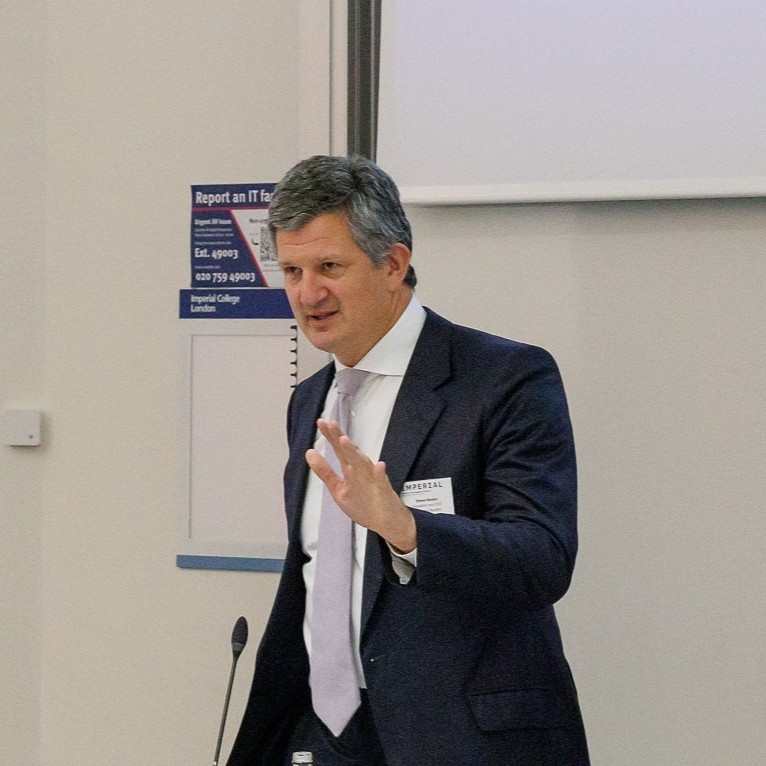
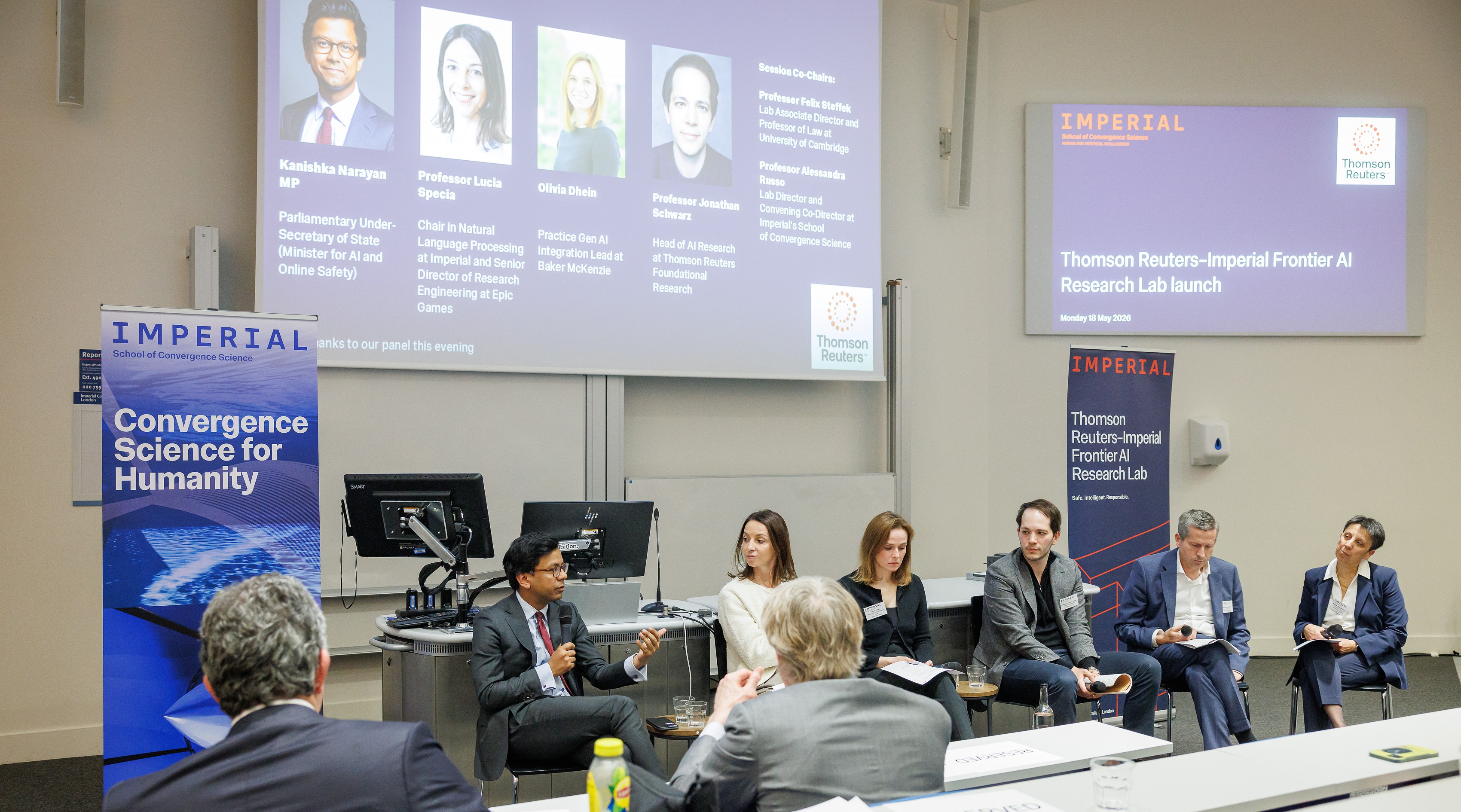
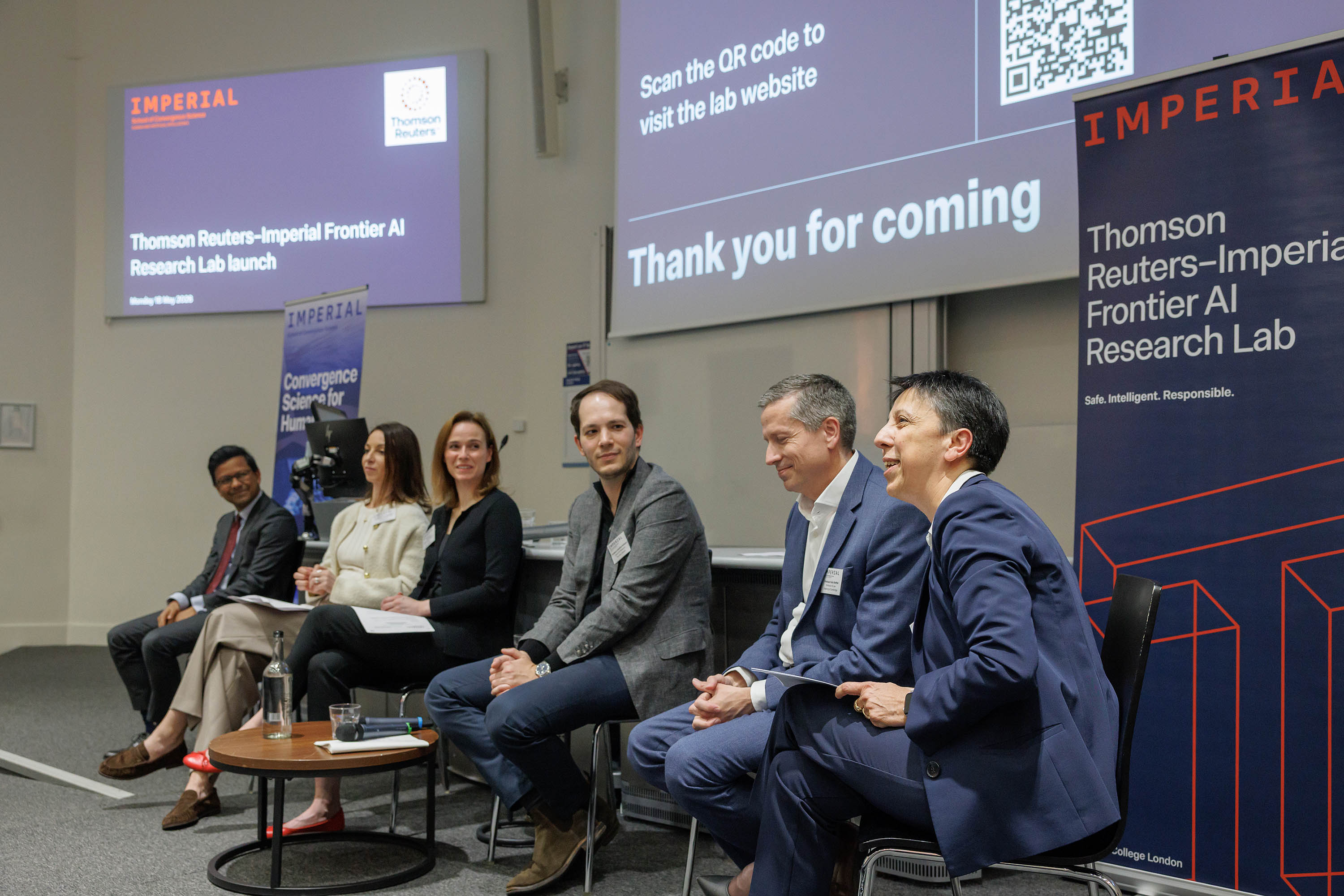
Imperial, Lab and Thomson Reuters leadership are pictured at the launch event in South Kensington. From left to right: Steve Hasker, Professor Alessandra Russo, Lord Thomson, Professor Felix Steffek and Professor Jonathan Schwarz.
Imperial College London and Thomson Reuters have formally launched a new Frontier AI Research Lab, a five-year partnership focused on foundational AI research spanning safety, reliability and societal impact.
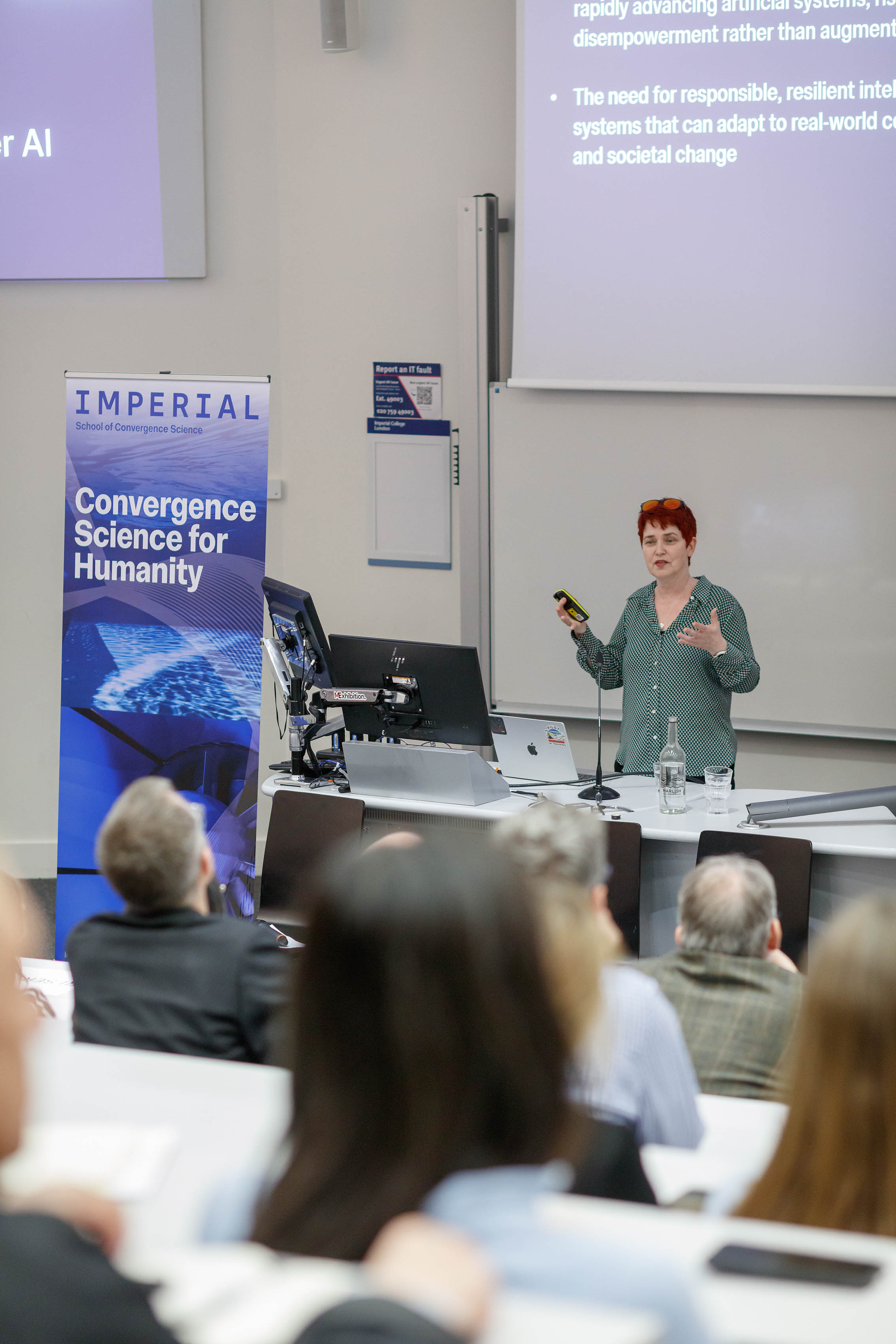
The milestone launch event was held on Monday 18 May 2026 at Imperial’s South Kensington Campus, bringing together leaders from academia, government and industry for a panel and networking session exploring the development of frontier AI, its applications across sectors, and the regulatory and policy questions arising from this rapidly advancing technology.
“The Frontier AI Research Lab marks the first strategic partnership within our School of Convergence Science, and I believe it is a genuinely important one.
"Our lab brings together Imperial’s academic excellence and independence with Thomson Reuters global reach and deep real-world expertise, creating a rare environment where we can tackle some of the most complex questions in AI, particularly in the critical areas of safety and reliability, while ensuring the work remains grounded in practical impact and public value.”
Contributions were also provided by special guests, Steve Hasker, President and CEO of Thomson Reuters and Kanishka Narayan MP, Minister for AI and Online Safety, as part of the panel discussion.
Introduction from Steve Hasker, President and CEO of Thomson Reuters
In his welcome, Steve Hasker reflected on the significance of the UK collaboration and the opportunities it creates for closer academic and industry engagement in frontier AI research:
"Imperial is a world-class academic institution, and what stood out to us was the open mindedness and truly collaborative approach to partnership and research we found there.
"The UK is fast becoming a global centre for AI innovation, and we're proud to be building this work here. We believe it's the start of something really exciting."
Kanishka Narayan MP, Minister for AI and Online Safety
Adding valuable policy perspective, the university was delighted to hear from Kanishka Narayan MP, who attended the panel discussion and remarked on the timeliness of this collaboration:
"AI is critical to the UK's future prosperity and security. To make sure everyone gets a chance to feel the benefits of this technology, the way we build and govern it needs to be informed by the best and latest research.
"The new Imperial and Thomson Reuters Frontier AI Research Lab will be vital to that effort, helping us put AI to work to deliver growth, jobs and opportunity for our communities."
A pivotal moment for frontier AI
The partnership comes at a time of rapid acceleration in frontier AI systems, alongside growing attention on their safety, reliability and real-world impact.
As large-scale foundation models and increasingly autonomous AI systems become more powerful and widely deployed across critical sectors, there is increasing demand for approaches that ensure these systems are trustworthy, explainable and robust.
By combining Imperial’s academic expertise with Thomson Reuters industry knowledge and real-world applications, the partnership brings together research expertise and industry insight at a pivotal moment, enabling research that addresses both emerging technical challenges and the broader societal and regulatory questions raised by advanced AI.
An interdisciplinary research agenda
Professor Alessandra Russo, Director of the Frontier AI Lab and Convening Co-Director of the School of Convergence Science, Human and Artificial Intelligence, posed some of the fundamental questions that the Lab could help answer:
How can we build AI systems that are not just capable, but reliably truthful?
How do we ensure that the productivity gains from AI are shared broadly across regions, professions, and community, rather than captured by just a few, and they reflect the value of our society and democracy?
How do we maintain meaningful human oversight of systems that are increasingly acting autonomously in our society?
These questions cannot be answered by individual institutions. They require serious collaborations and conversations across disciplines and sectors.
“AI reshapes labour markets, transforms information ecosystems, challenges epistemic norms and rearranges distributions of power.” Professor Felix SteffekAssociate Director of the Lab and Professor of Law at the University of Cambridge
“This is exactly what the Frontier AI Lab is aiming to do”, explains Professor Felix Steffek, Associate Director of the Lab and Professor of Law at the University of Cambridge:
“... By drawing on methods from law, computational science, social science, economics, and political science to research these second-order effects with rigour and breadth, we can develop solutions to capture the advantages and minimise the risks”.
The collaboration is already active and delivering tangible benefits, including the development of a frontier large language model competitive with the world’s best models, set to launch this summer. Other current activities include building a cohort of exceptional PhD students.
Based in a dedicated facility within Imperial’s WestTech London ecosystem, the partnership will support this PhD cohort and give researchers access to shared computing infrastructure, interdisciplinary supervision and high-quality real-world data.
Panel discussion: Future of AI and its socio-economic impact
On the panel were “Four experts who, between them, represent the precise breadth that we need to start this serious conversation” – as introduced by Professor Russo:
Kanishka Narayan MP - Minister for AI and Online Safety at the Department for Science, Innovation, and Technology
Professor Lucia Specia - Chair in Natural Language Processing at Imperial College London and Senior Director of Research Engineering at Epic Games
Olivia Dhein - Practice GenAI Integration Lead at Baker McKenzie
Professor Jonathan Schwarz - Associate Director of the Frontier AI Lab and Head of AI Research at Thompson Reuters Foundational Research
The discussion explored what it will truly take - scientifically, economically, legally and politically - to operate at the frontier of AI.
The panellists shared expert insights across three key themes: truthfulness and reliability; distribution, inclusion, and the economics of AI; and autonomy, agency and oversight.
Why do models still fail?
In considering how we build AI systems that are not only capable, but reliably truthful, Professor Specia, explained that models are optimised for likelihood and approval, not for truthfulness.
She noted: “We are training models on human preferences and to generate outputs that people will favour rather than outputs that are truthful... A lot of what they are trained on is text, but that’s not truly grounded in the real world”.
When asked how this can be addressed, Professor Schwarz highlighted the need to focus on the training stage, to re-align the models so they are grounded in evidence-based data:
“Models are strongly urged to be helpful and agreeable to humans and to provide a response, even in cases of incomplete or uncertain information. As a model developer, you have to recognise that sometimes it might be more responsible to not provide a response if the reliability is low and to understand how we motivate the models to do so”.
How is AI impacting the legal profession?
Olivia Dhein mentioned that AI provides a huge opportunity for improved efficiency within the legal profession while maintaining the quality of the outputs and there is a growing trend towards embracing the benefits of this technology. However, there is an ongoing critical global debate arising from the public’s increasing access to legal advice via large language models.
While this has potential for making the legal system more equitable, it also raises questions around reliability of these models and liability concerns if people are ill advised by AI. She noted: “It raises an interesting point on access to justice”.
Will AI replace or augment human labour?
Kanishka Narayan MP reflected that while there are some sectors where there are significant overlaps between AI and human capabilities, there are others in which human capability can be augmented, but not replaced, by AI.
Indeed, in some sectors we are seeing how the use of AI technology alongside humans can lead to an increase in head count and economic growth. Opportunities lie where workflows can be reorganised to replace the things that are least fulfilling and most automatable and to augment those that are specific to human performance.
The UK government is working to understand the effects of AI on different sectors, so we can create resilience in the market for future transformations and ensure the UK capitalises on areas where AI provides opportunities for growth.
What is the government doing?
Critical components of the government’s AI strategy were also discussed. These included building internal capabilities for evaluation in order to understand and address risk in public service deployment, growing the AI Security Institute (AISI), pushing the frontiers of measurement science (such as through the Centre for AI Measurement), and creating the AI Playbook for the UK Government.
It will be vital to further develop the science ecosystem capable of understanding and addressing different types of harms and risks arising from AI and provide the evidence base to ensure sector-specific regulations enable rather than hinder AI innovation.
Closing remarks
In closing the panel session, Professor Russo reflected that the challenges and opportunities highlighted throughout the discussion reinforced the need for the Frontier AI Lab to help produce:
"... Not just capable AI systems, but trustworthy ones. Not just productive AI, but equitable AI. Not just powerful AI, but accountable AI - and not just technically aligned AI, but democratically legitimate AI”.
Frontier AI in society – an example of Science for Humanity in practice
The School of Convergence Science is an initiative of the university’s Science for Humanity strategy designed to bring together interdisciplinary research to address global challenges through a mission-led approach.
It is tackling some of the most urgent challenges in artificial intelligence: ensuring AI systems are grounded in real-world contexts, narrowing the gap between rapidly advancing technologies and human understanding, and developing systems that are safe, resilient, and socially responsible.
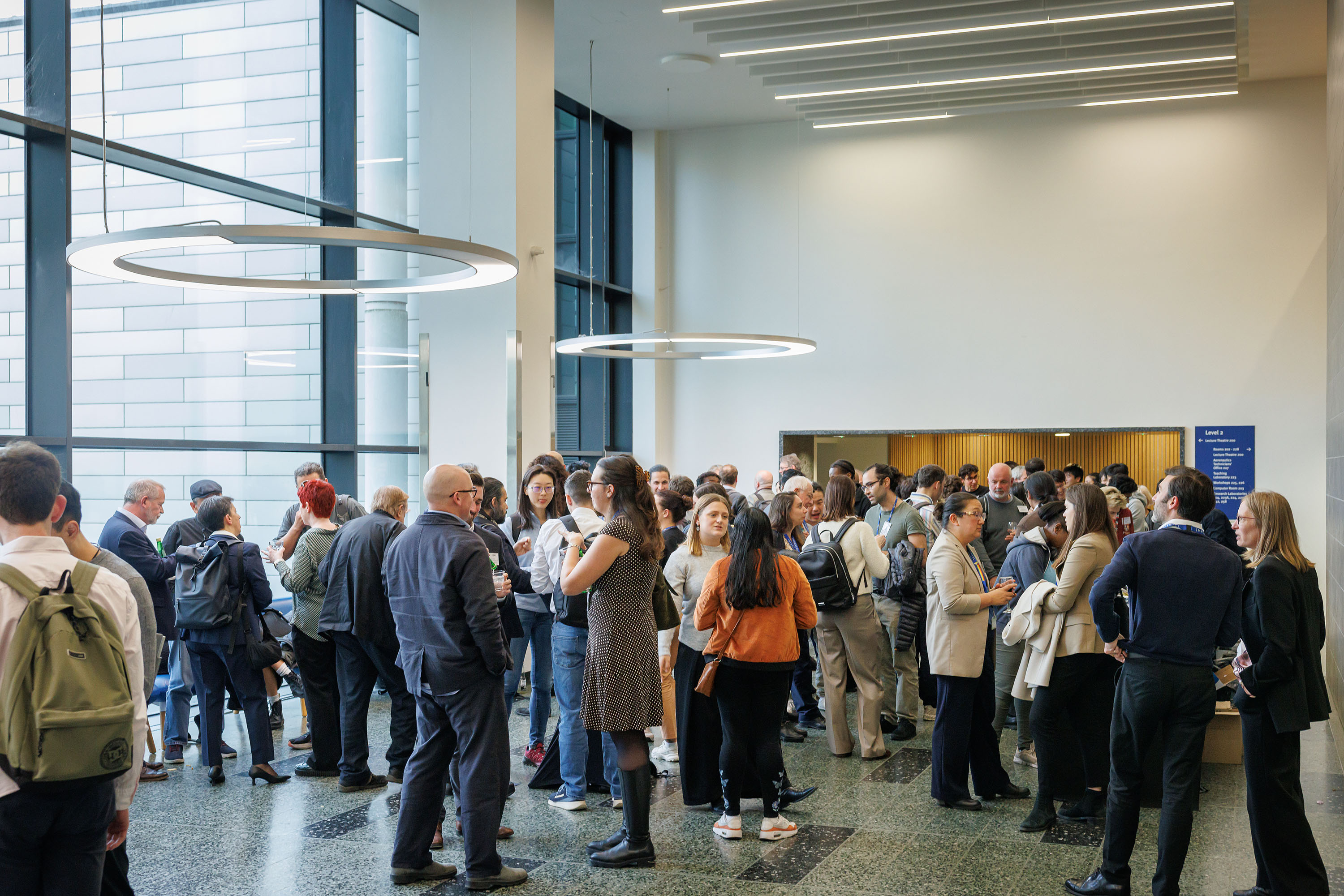
Hosted by Imperial's School of Convergence Science, the launch event took place on Monday 18 May 2026 in City and Guilds Building, South Kensington Campus. The panel session was followed by a networking reception (pictured).
/prod01/channel_4/imperial-news/media/news-images/3000X2000-main-article-images/Lead-photo-3000X2000.jpg)
 I Research Lab marks the first strategic partnership within our School of Convergence Science, and I believe it is a genuinely important one.