Imperial researchers awarded multi-million European grants
/prod01/channel_4/imperial-news/media/news-images/3000X2000-main-article-images/Z_Guo_1.jpg)
Three Imperial academics have been awarded prestigious ERC Consolidator Grants recognising their research in energy materials and storage and pure mathematics.
 Dr Chun Ann Huang, Associate Professor in Energy Storage Materials in the Department of Materials, has won a grant worth approximately €2 million to understand ion transport dynamics in 3D microstructure for batteries. The insights will support the development of safer, higher-performance batteries for future energy storage technologies. Her project, ‘Dynamics in 3D structures of zero-excess devices (3D-ZERO)’, will pioneer operando correlative imaging of X-ray scattering–computed tomography (e.g. XCS-CT) to image chemical heterogeneity in 3D structures, incorporating machine learning in imaging. The project will also develop processing techniques to fabricate novel electrode structures and improve battery energy storage performance.
Dr Huang said: “This ERC Consolidator Grant will provide valuable opportunities to collaborate with groups at Imperial and externally to increase the impact of battery research. I could not have achieved this without my team and the support from my colleagues, department, and faculty.”
She added: “I would also like to thank my collaborators for exchanging knowledge and tackling joint research challenges together. I am proud to contribute to the large community in the advancement of clean energy storage and conversion.”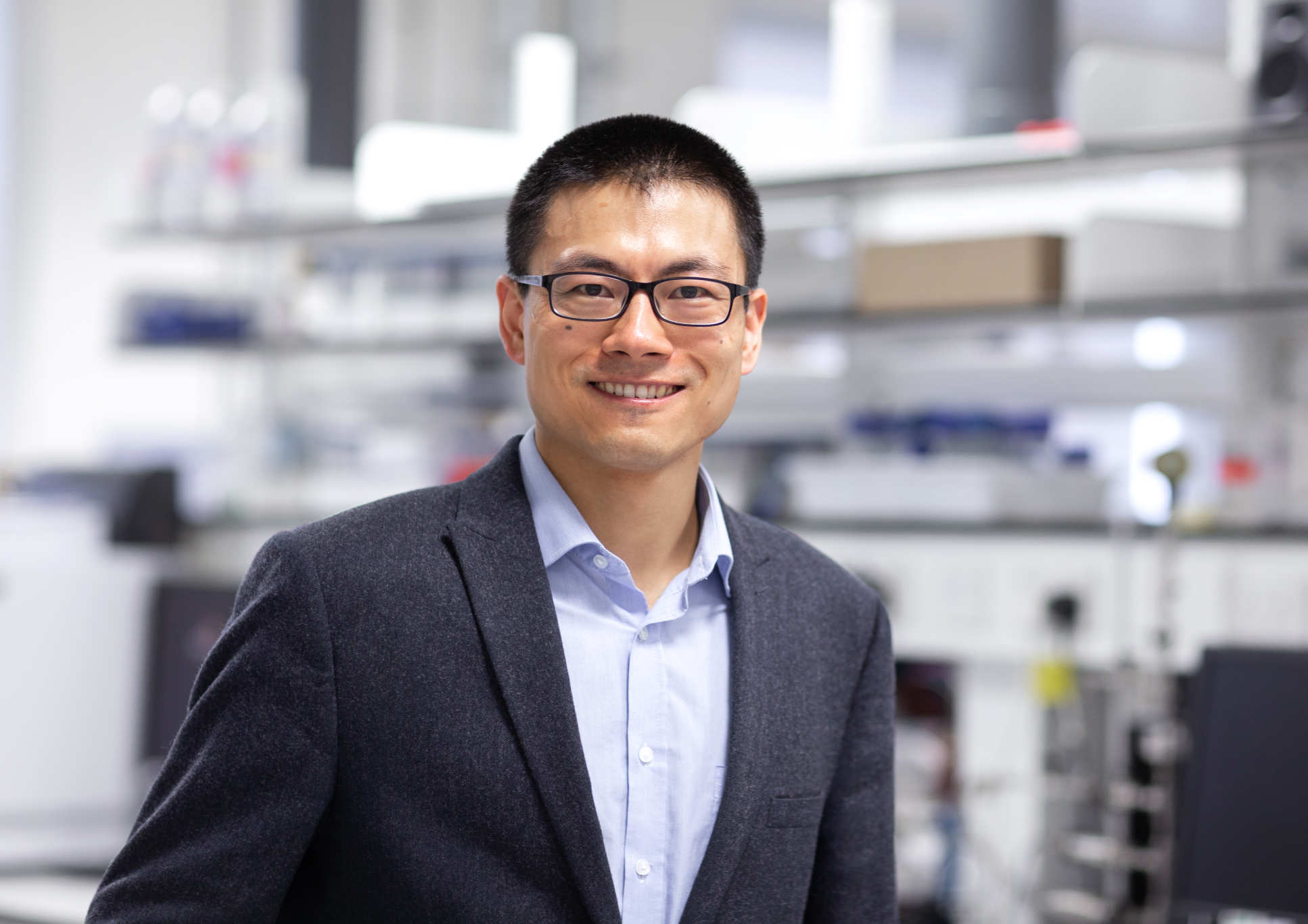 Dr Qilei Song, Reader in Chemical Engineering in the Department of Chemical Engineering, leads the project ‘Molecular engineering of ion-conductive polymers for regulating heterogeneous electrochemical interfaces (IonPATH)’. His grant of €2.7 million will address one of the most critical challenges in the global transition to net-zero emissions: how efficiently energy can be stored, converted and used.
At the heart of many clean energy devices are special materials known as ion-exchange membranes and ionomers. These control how charged ions, gases and water move through a device, directly affecting its efficiency, durability and cost. Dr Song’s team will design entirely new ion-conductive polymers at the molecular scale, creating nano-sized channels that act like “molecular highways” to precisely control mass transport inside working devices.
This curiosity-driven, fundamental research has the potential to unlock a new generation of electrochemical technologies that are significantly more efficient, longer-lasting and more affordable.
The work could lead to major advances across a wide range of applications, from large-scale energy storage using green hydrogen, to fuel cells for heavy transport, new reactors that convert carbon dioxide into valuable chemicals, and advanced electrochemical separation processes for recycling and resource recovery.
“This award marks my fourth ERC grant, building on an ERC Starting Grant and two proof-of-concept grants,” said Dr Song. “It is a tremendous honour and a testament to the hard work of my team and collaborators. This new grant gives us the freedom to take risks, reinvent our approach, and tackle some of the most pressing scientific challenges in clean energy conversion.”
The project will involve collaborations with researchers at the University of Edinburgh, Lund University, University College London and the University of Birmingham, alongside internal collaborations across Imperial in computational chemistry and electrochemical engineering. The research is also expected to lead to future enterprise activity, supporting the development of new membrane materials and electrochemical technologies with commercial potential.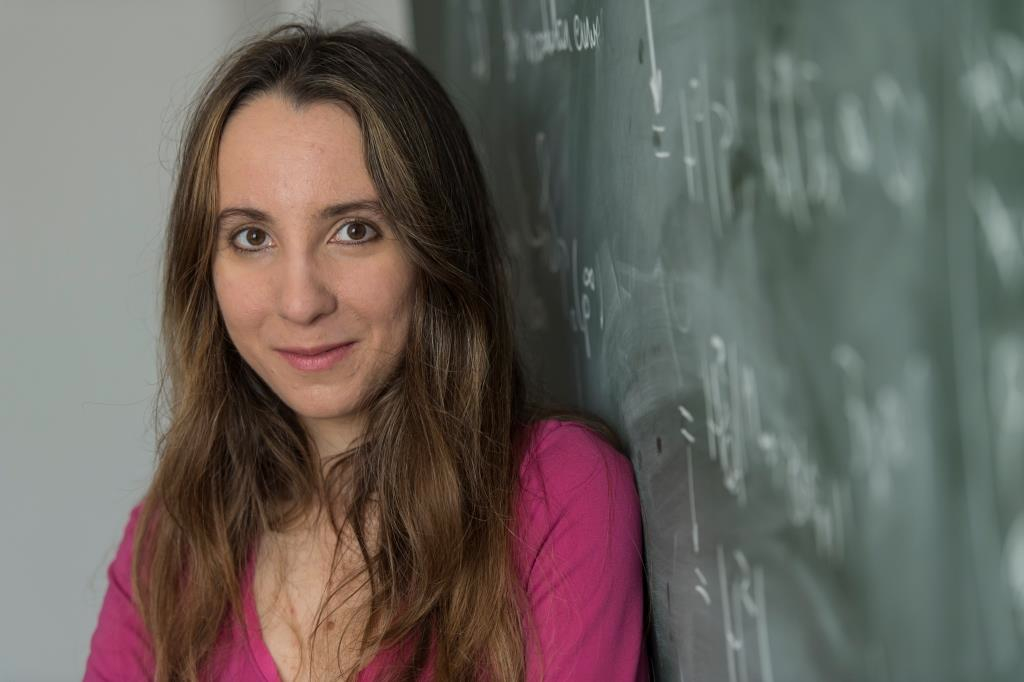 Professor Ana Caraiani, Royal Society University Research Fellow in the Department of Mathematics has received a €2 million grant for her project on Igusa stacks and the Langlands program.
The Langlands program is a ‘grand unified theory of mathematics’, bridging different areas of pure mathematics. Professor Caraiani works on a number-theoretic version of the Langlands program, a strand of research that famously led to the proof of Fermat’s last theorem, which has blossomed in the 30 years since this milestone result. This proposal will use newly discovered objects called Igusa stacks to bring powerful new geometric techniques into this area of research.
Professor Caraiani said: “I’m thrilled to receive this funding, which gives me so much time and freedom to focus on deep questions in pure maths. I wouldn’t have been able to write this proposal without my wonderful collaborators.”
Supporters

Article text (excluding photos or graphics) © Imperial College London.
Photos and graphics subject to third party copyright used with permission or © Imperial College London.
Article people, mentions and related links
Sanjana Kakar
Faculty of Engineering

Navta Hussain
Faculty of Engineering