Campus and community
/prod01/channel_4/imperial-news/media/images/landscape-3000X2000/Umang-lab-award-pic.jpg)
Dr Umang Shah, Head of Undergraduate Teaching Laboratories and Principal Teaching Fellow, has been recognised at Imperial's inaugural Sustainable Lab Awards, celebrating staff who are driving environmental sustainability across the university's research and teaching laboratories.
Dr Shah received the Communication and Engagement Award in recognition of championing sustainable lab practices within Chemical Engineering, from co-designing projects with students to creating resources and activities that embed sustainability into day-to-day teaching and research.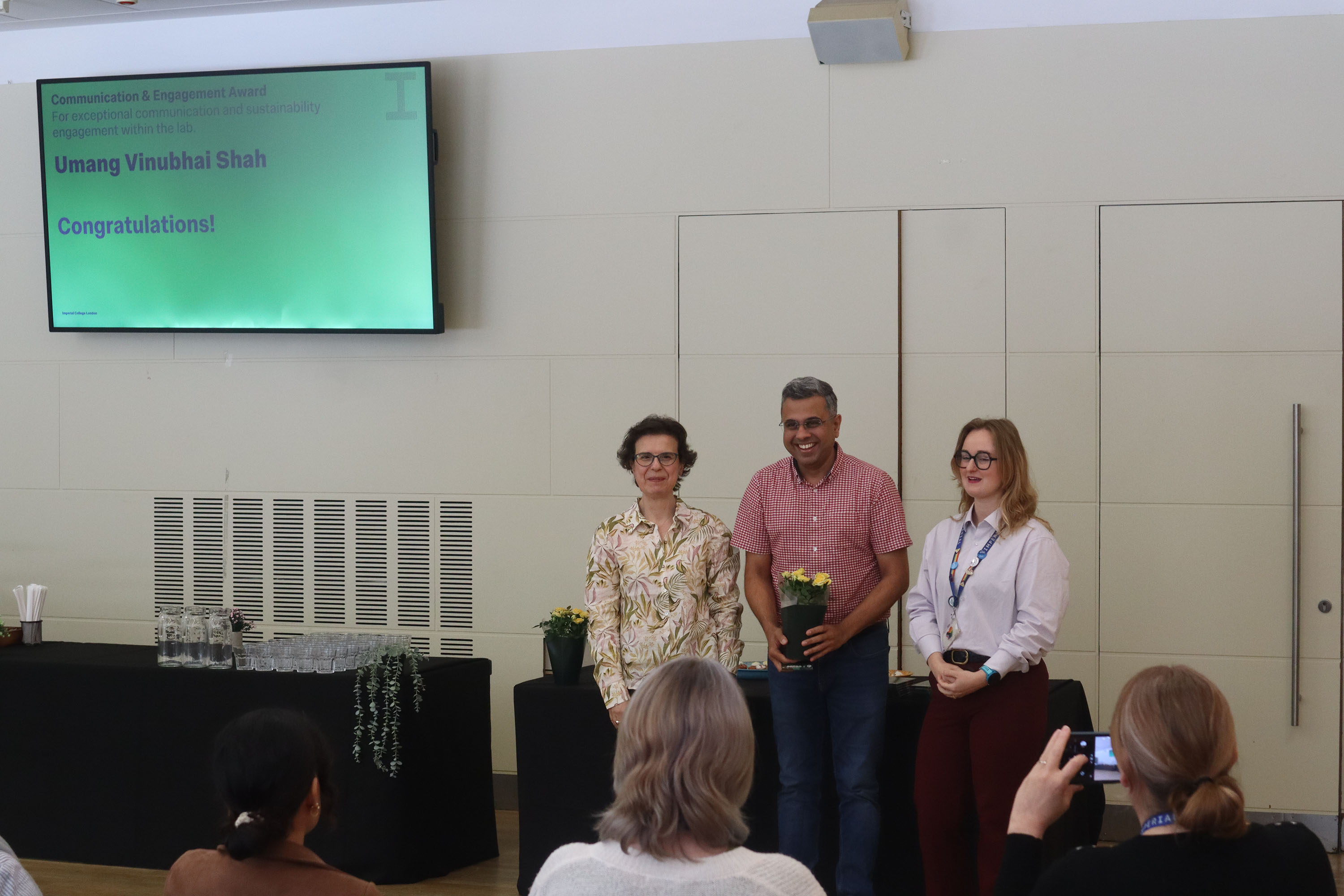 Over the past decade, Dr Shah has led a transformation of the Department's undergraduate teaching laboratories, embedding sustainability into both laboratory operations and the student experience. Working closely with colleagues, he has championed initiatives that have significantly reduced water and energy consumption while ensuring students gain first-hand experience of sustainable laboratory practice.
"In our teaching laboratories, we have tried to show that safe, rigorous and inspiring practical education can also be resource-aware and environmentally responsible. That is the mindset I hope our students carry into their future careers as engineers." Dr Umang Shah Head of Undergraduate Teaching Laboratories and Principal Teaching Fellow
His work has already earned national and institutional recognition. In 2025, the Department's undergraduate laboratories became the first in Imperial's Faculty of Engineering to achieve Green Level certification from My Green Lab, one of the highest recognised accreditations for laboratory sustainability. Under Dr Shah's leadership, the laboratories have reduced freshwater use by more than 85 per cent and energy consumption by around 60 per cent, demonstrating how teaching excellence and environmental responsibility can go hand in hand.
Reflecting on the recognition, Dr Shah said: "Receiving this award is a very meaningful recognition of a collective journey. Sustainable laboratories are not created by one change or one person; they come from hundreds of small, evidence-based decisions made by students, technicians, academics and professional services colleagues. In our teaching laboratories, we have tried to show that safe, rigorous and inspiring practical education can also be resource-aware and environmentally responsible. That is the mindset I hope our students carry into their future careers as engineers."
The Sustainable Lab Awards celebrate the people whose innovation, collaboration and leadership are helping Imperial deliver its sustainability ambitions. Dr Shah's award highlights the impact of sustained commitment to improving laboratory practices while equipping future generations of engineers with the knowledge and skills to build a more sustainable future.
We are delighted to see Umang recognised with this well-deserved award. His passion and leadership have transformed sustainability from an aspiration into everyday practice within our teaching laboratories. Professor Omar Matar and Dr Salvador Acha Co-Chairs of the Department of ChemEng Sustainability Committee
Professor Omar Matar and Dr Salvador Acha, co-Chairs of the Department of Chemical Engineering Sustainability Committee, said: "We are delighted to see Umang recognised with this well-deserved award. His passion and leadership have transformed sustainability from an aspiration into everyday practice within our teaching laboratories. Through his commitment to innovation, collaboration, and student engagement, he has shown that environmental responsibility and excellence in education go hand in hand. This recognition reflects the lasting impact of his work, not only within our department but across the wider Imperial community."
My sustainability journey at Imperial started with very practical observations in the teaching laboratories: water running continuously for cooling, energy-intensive equipment being switched on longer than necessary, and consumables being used in ways where the environmental impact was not always visible. The earliest gains came from measuring what was actually happening, working with technicians and students to test simple improvements, and showing that we could reduce waste without compromising safety, learning outcomes or the quality of experimental data. The biggest challenge was cultural rather than technical: moving sustainability from being seen as an extra task to being understood as part of good laboratory practice. The most rewarding part has been seeing students and colleagues start to ask their own questions and suggest their own improvements.
2. Was there a moment when you realised your sustainability initiatives were making a real difference?
One important moment was when students began questioning resource use for themselves. Rather than simply following an instruction, they started asking why water needed to run continuously, whether equipment could be warmed up for a shorter period, or whether materials could be shared more intelligently. That shift in mindset showed me that sustainability was no longer just a set of operational changes; it was becoming part of how students thought about experimental engineering.
3. What is the one change you are most proud of in our teaching laboratories?
I am most proud that sustainability is now embedded into the undergraduate teaching laboratories as normal practice. The reductions in freshwater use and energy consumption are important, but the deeper change is that students experience sustainability as part of rigorous, safe and high-quality laboratory work. For future engineers, that is a powerful message: technical excellence and environmental responsibility should sit together.
4. If you could encourage every member of the Imperial community to make one change in the lab, what would it be?
Make resource use visible before starting any experiment. Ask whether water, energy, chemicals or consumables can be reduced, reused, shared or monitored more carefully without compromising safety or scientific integrity. Small decisions, repeated consistently across many laboratories, can create a very significant institutional impact.
Article text (excluding photos or graphics) © Imperial College London.
Photos and graphics subject to third party copyright used with permission or © Imperial College London.
Faculty of Engineering

Faculty of Engineering