Cutting solar panel cleaning water use by 90% with ‘liquid droplet mops’
/prod01/channel_4/imperial-news/media/news-images/3000X2000-main-article-images/OA1.jpg)
Imperial researchers, working with colleagues at City University of Hong Kong, have developed a new way to clean solar panels using far less water, by precisely controlling how individual water droplets strike dusty surfaces.
Published in Nature Sustainability, the study shows that effective cleaning does not depend on using more water or higher pressure. Instead, there is a “sweet spot” where droplets hit with just the right amount of energy to remove dirt efficiently. At this optimal point, solar panels can be cleaned using only a fraction of the water required by conventional methods.
Why cleaning solar panels matters
Dust and other particles building up on solar panels can significantly reduce how much electricity they produce. Regular cleaning is therefore essential, particularly for large solar farms. However, most current cleaning techniques rely on continuous water jets, which are water-intensive and often poorly suited to dry or remote regions.
With solar power expanding rapidly around the world, especially in water-scarce areas, reducing the water needed for maintenance is becoming increasingly important.
“Our work shows how a detailed understanding of the physics can lead directly to practical, sustainable solutions. By working across disciplines and institutions, we have been able to rethink a very common process in a completely new way.” Professor Omar Matar Imperial lead author
Rethinking how surfaces are cleaned
The research team, led by Professor Omar Matar, Department of Chemical Engineering, and Professor Steven Wang, Department of Mechanical Engineering, City University of Hong Kong, found that cleaning performance does not steadily improve as droplet energy increases. When droplets strike with too little energy, particles remain stuck to the surface. When the energy is too high, efficiency drops again.
Instead, particle removal peaks at an intermediate energy level. This finding challenges the assumption that stronger or wetter cleaning is always better, and shows that tuning how water is delivered can be far more effective than simply increasing volume or force.
The physics behind efficient cleaning
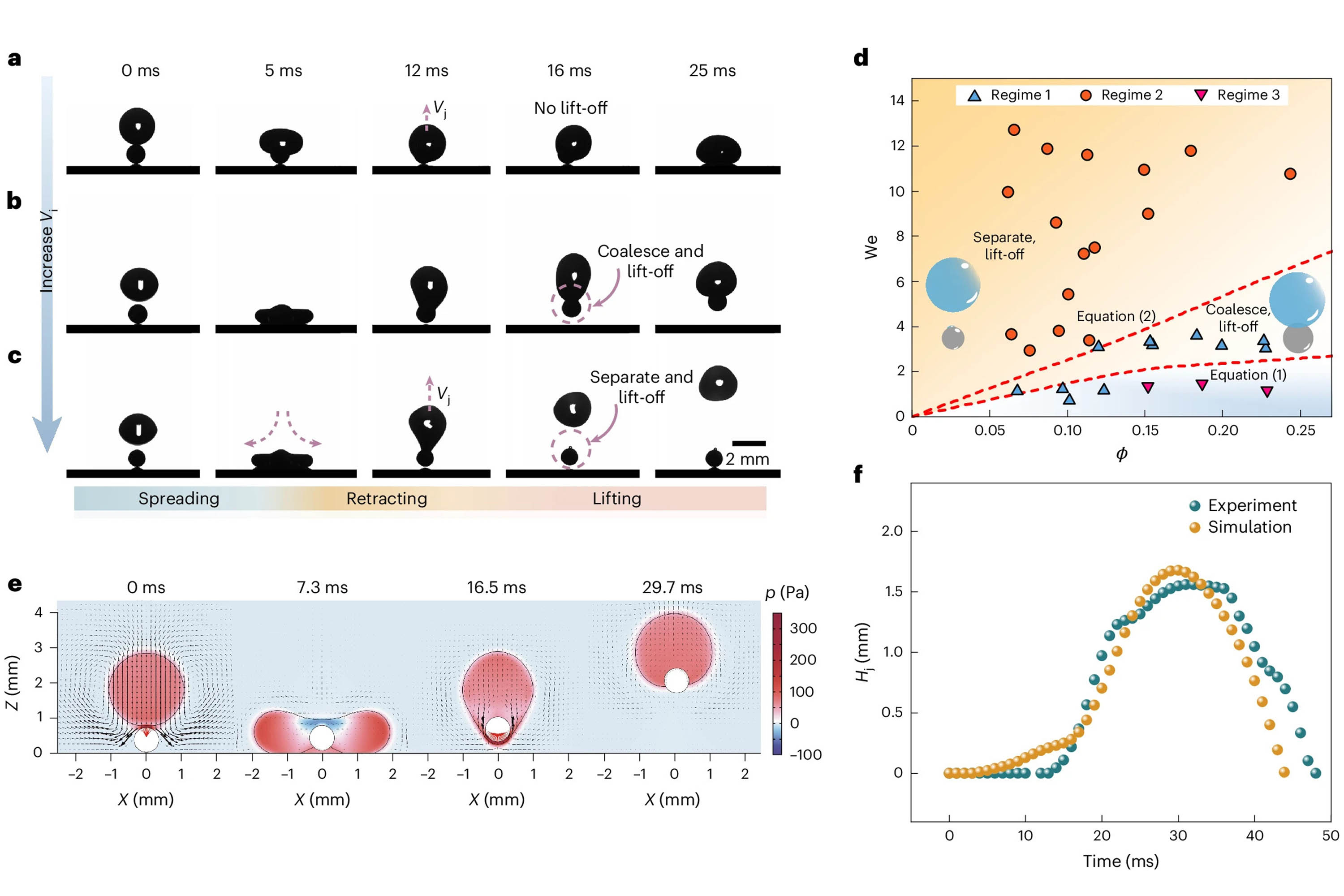
The team showed that particle removal depends on a balance between droplet impact speed and the microscopic interactions between the water, the particles and the surface. Together, these factors determine whether contaminants detach when a droplet hits.
Importantly, the mechanism works for particles with a wide range of densities and on superhydrophobic surfaces, which are increasingly used on solar panels to reduce fouling and improve long-term performance.
 A new approach: ‘liquid droplet mops’
Using these insights, the researchers developed a new cleaning method they call “liquid droplet mops”. Instead of continuous jets, the system delivers carefully controlled droplets tuned to the optimal energy range.
In tests, the approach removed up to 99.9 percent of contaminants while using just 10 percent of the water required by standard cleaning methods. By focusing on precision rather than volume, the technique dramatically improves water efficiency.
Tackling water scarcity
The findings are particularly relevant for solar farms in arid regions, where panels need frequent cleaning but water supplies are limited. More efficient cleaning could cut both environmental impact and operating costs, helping to make solar energy more sustainable and resilient.
The bigger picture
Beyond solar power, the study advances fundamental understanding of how liquids interact with particles during surface cleaning. It shows that relatively small changes to physical parameters, such as droplet energy, can lead to major gains in efficiency.
The researchers say the approach could be adapted for a wide range of industrial cleaning applications, offering a scalable way to reduce water use across many sectors.
Read the full article here
Article text (excluding photos or graphics) © Imperial College London.
Photos and graphics subject to third party copyright used with permission or © Imperial College London.
Article people, mentions and related links
Navta Hussain
Faculty of Engineering

Shafali Jain
Faculty of Engineering