Department of Computing researchers win Best Paper Award at ECCV 2026
by Ruth Ntumba
/prod01/channel_4/imperial-news/media/news-images/3000X2000-main-article-images/heat-kernel-textures-v2.jpg)
Researchers from Imperial's Department of Computing have received the Best Paper Award at the European Conference on Computer Vision (ECCV) 2026, one of the world's leading conferences in computer vision.
Held in Malmö, Sweden, from 8 to 12 September 2026, ECCV is the flagship conference of the European Computer Vision Association and one of the world's leading venues for computer vision research. The biennial conference is widely recognised as an A* conference and brings together researchers from academia and industry to present and discuss the latest advances in the field.
The award was presented for the paper Heat Kernel Textures (HKTex), authored by Dr Simone Foti, Caner Korkmaz, Professor Stefanos Zafeiriou and Dr Tolga Birdal, all from Imperial's Department of Computing.
ECCV's Best Paper Award is the conference's highest distinction. Heat Kernel Textures was selected from a highly competitive field that included more than 10,000 submissions and approximately 3,000 accepted papers. The awards committee praised the work for its "neat and novel contribution to surface texture representation" and highlighted its "elegant solution and its broad potential beyond the paper.”
Reflecting on the award, the team said: "ECCV is one of the leading conferences in computer vision, and receiving the Best Paper Award is a tremendous honour. We are particularly proud that this work was developed entirely within a single academic institution, fully open-sourced and using only a single consumer-grade GPU. At a time when deep neural networks dominate the field, we proposed a novel optimisation-based approach grounded in mathematics. We are especially pleased that the committee recognised both its technical elegance and its potential to influence future research. The CIRCLE Group is a young, dynamic research team at Imperial tackling challenges across 3D vision and the theory of machine learning. This is the group's first award and recognises the world-class excellence it has achieved in a remarkably short time. We hope this recognition inspires young researchers to explore the fundamentals more deeply and build on this work through future research and collaboration."
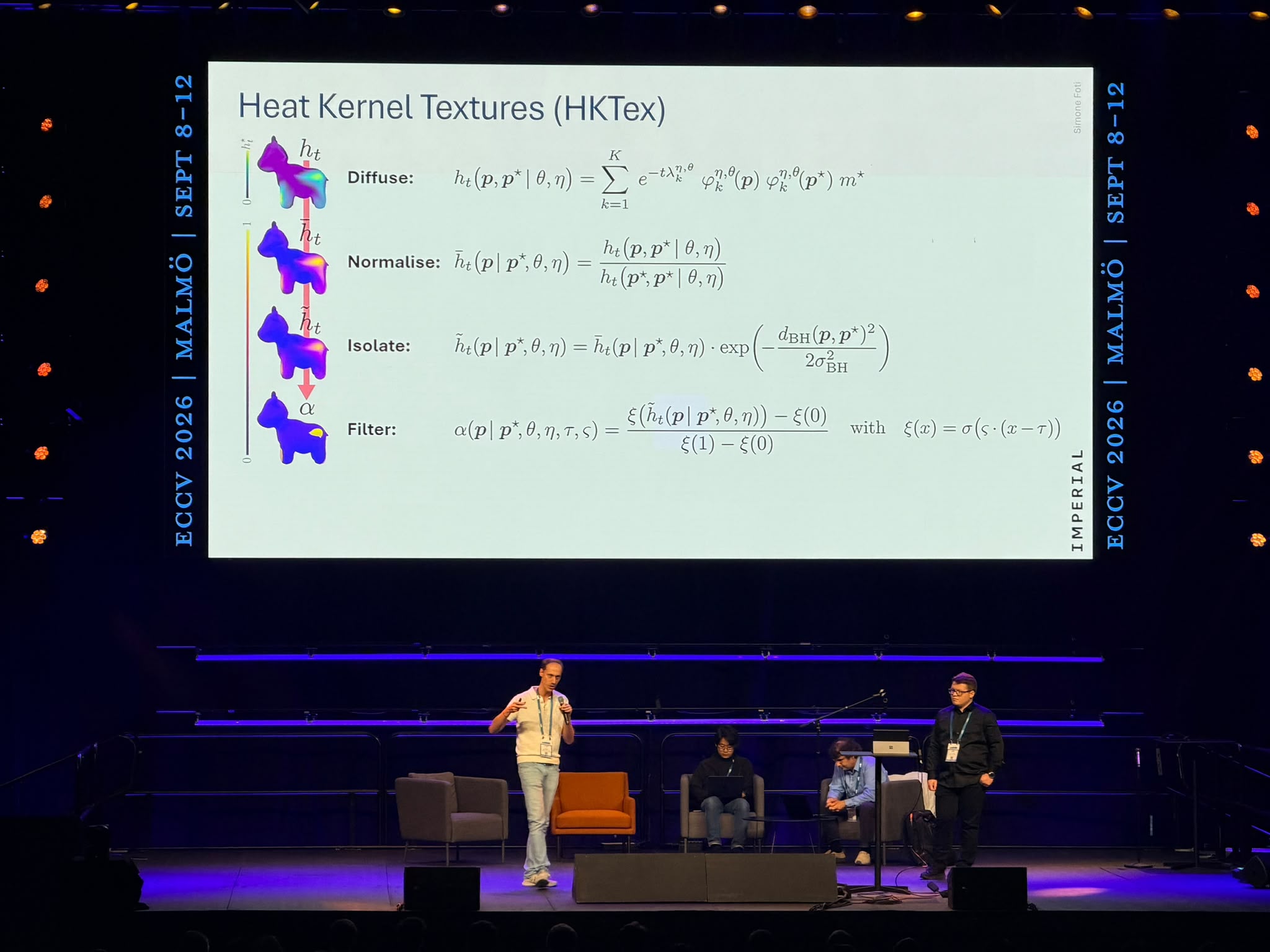
Rethinking how computers represent 3D surfaces
Heat Kernel Textures (HKTex) introduces a new mathematical framework for representing the surface appearance of 3D objects.
For decades, computer graphics and vision applications have relied on a process known as UV mapping, which requires a three-dimensional object to be "unwrapped" into a two-dimensional surface before textures can be applied. While widely used, this approach can create challenges such as visible seams, distortions, duplicated geometry and inefficient use of texture space.
Drawing inspiration from the recent success of 3D Gaussian Splatting, the researchers developed an alternative representation that removes the need for UV mapping altogether. Grounded in discrete Riemannian geometry and defined directly on the surface of a 3D object, HKTex uses anisotropic heat kernels as geodesic equivalents of Gaussians, enabling texture information to be stored and optimised intrinsically on curved surfaces.
The approach addresses longstanding limitations of conventional texturing methods, including wasted UV space, seams, distortions, vertex duplication and varying texture resolution. It also significantly reduces memory requirements while maintaining high-quality visual representations.
Unlike traditional texture representations, HKTex can be optimised directly from existing textures or from photographs captured from multiple viewpoints. The method is fully integrated with physically based rendering systems and opens up new possibilities for applications across computer vision, computer graphics, digital content creation and virtual environments.
A milestone for the Department
The achievement marks an important milestone for both the CIRCLE Group and the Department of Computing.
It is the first Best Paper Award won by a Department of Computing researcher at a leading A* conference in computer vision, graphics or machine learning in a decade. The department's previous success came at ECCV 2016, when research by Hanme Kim, Stefan Leutenegger and Andrew J. Davison received a Best Paper Award for their work on real-time 3D reconstruction and six-degrees-of-freedom tracking with event cameras.
The award highlights Imperial's continuing strength in foundational research at the intersection of mathematics, machine learning and computer vision, and recognises a breakthrough that could influence future methods for representing and rendering 3D worlds.
Article text (excluding photos or graphics) © Imperial College London.
Photos and graphics subject to third party copyright used with permission or © Imperial College London.
Article people, mentions and related links
Ruth Ntumba
Faculty of Engineering