Imperial researchers lead launch of world’s first open-access battery imaging library
/prod01/channel_4/imperial-news/media/images/landscape-3000X2000/Edits-3000X2000---colour-etc.jpg)
The library gives scientists free access to advanced battery imaging data with the aim of accelerating research into next-generation batteries.
A team of Imperial College London researchers has led the development of the world’s first open-access battery imaging library, a resource that will provide the global scientific community with free access to advanced battery imaging data.
The Battery Imaging Library (BIL) brought together over 40 scientists from 18 institutions around the world. The collaboration was led by Dr Antony Vamvakeros, a Royal Society Industry Fellow at the Dyson School of Design Engineering at Imperial College London and R&D Lead Scientist at Finden Ltd., with the Imperial team including colleagues from the Dyson School of Design Engineering, the Department of Materials, and the Department of Earth Science and Engineering.
Supporting the development of AI methods for battery research
Battery advanced imaging data has been historically difficult to acquire: synchrotron experiments, conducted to image the internal structures of batteries, are often expensive, time-consuming and highly competitive to access, with datasets rarely made openly available as a result. To address this issue, the Imperial team created the BIL, making raw data and reconstructed images available to researchers at any institution or career stage.
The library contains over 4.5 terabytes of experimental data acquired at various synchrotrons and national laboratories, covering 13 imaging modalities at different length scales. One of the techniques used was X-ray micro-CT at Diamond Light Source’s I12-JEEP, the UK’s flagship high-energy X-ray imaging and diffraction beamline, which the authors used to perform high-resolution static and dynamic measurements of commercial cylindrical lithium-ion, LiFeS2 and alkaline batteries, revealing how their internal structure changes during electrochemical cycling.
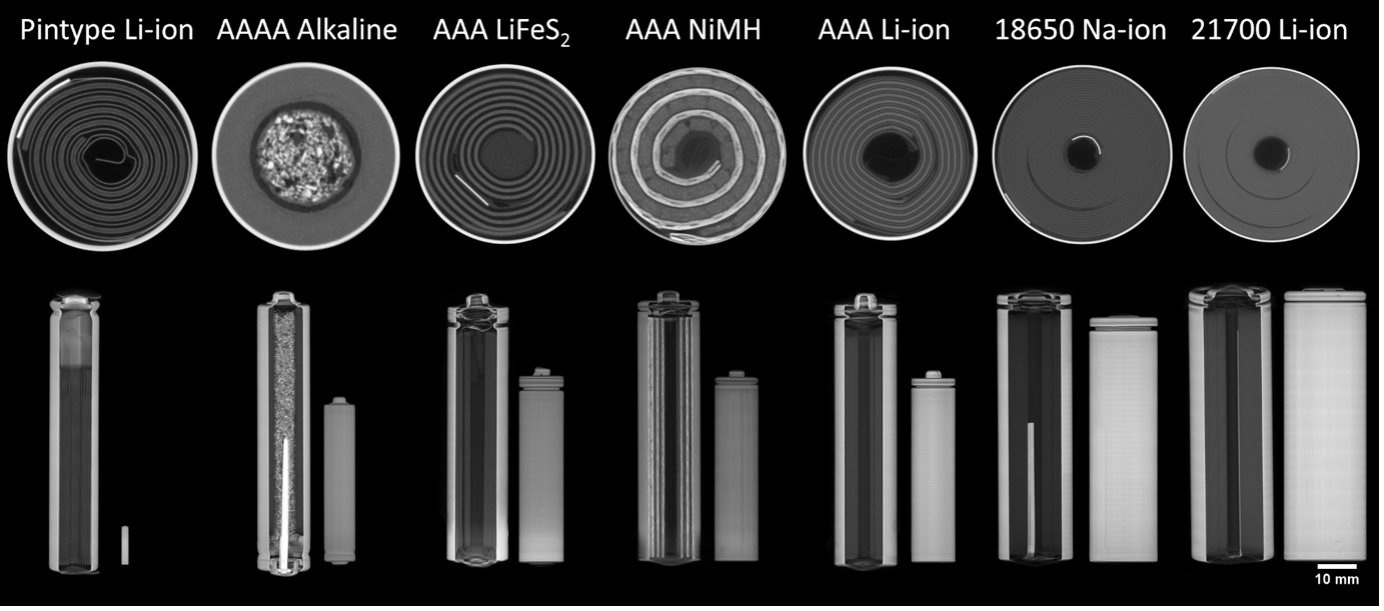 Figure 1. X-ray micro-CT data acquired from different battery chemistries and devices.
An open-source resource for the global scientific community
Beyond providing access to experimental data, the BIL was also designed to help researchers validate computational models; test image analysis software; facilitate the development of AI-driven approaches to battery research; and support learning by giving students and professionals practical data and workflows for training and education. Crucially, the library is not meant to be a static resource: any researcher can contribute data, and the authors hope the tool will continue to grow over time.
To make the vast collection of imaging easy to navigate, lead author Ronan Docherty, a PhD student in the Centre for Doctoral Training for the Advanced Characterization of Materials at Imperial College London, created a dedicated website, designed to make data easier to find, access and re-use.
Ronan said: "A major challenge with existing experimental datasets is simply finding what you need. We developed the library’s website to solve this problem, allowing users to browse the different modalities and quickly access the specific data relevant to their research."
Professor Sam Cooper, Professor of AI for Materials Design and Chief Scientist at Imperial spin-out, Polaron, said: "Open data is critical for training the AI models that will accelerate the next generation of scientific discovery. The necessary infrastructure has been available for sometime already, but the culture in the scientific community has lagged behind. I hope BIL will inspire other groups to follow suit."
Dr Antony Vamvakeros added: "Together with Professor Sam Cooper at Imperial, our ambition was to open up these complex imaging datasets to the entire scientific community. By sharing this extensive collection, we hope to accelerate the development of machine learning methods for experimental data. For example, researchers can use this resource to train self-supervised neural networks for data denoising, super resolution and data fusion."
------
Reference: Docherty, Ronan, et al. "Battery Imaging Library: Multi-length scale and multi-modal synchrotron and laboratory battery imaging data for all." Digital Discovery (2026). DOI: 10.1039/D6DD00321D.
Article text (excluding photos or graphics) © Imperial College London.
Photos and graphics subject to third party copyright used with permission or © Imperial College London.
Article people, mentions and related links
Wiktoria Tunska
Centres