Geology for net zero: Inspiring the next generation of girls in earth science
by Gege Li
/prod01/channel_4/imperial-news/media/news-images/3000X2000-main-article-images/Geology-net-zero-outreach-1.jpg)
“For one day, the students became young geologists on a mission to help the planet.”
The Department of Earth Science and Engineering (ESE) at Imperial College London recently hosted a hands-on outreach event titled “Geology for Net Zero,” funded by ESE’s International Day for Women and Girls in Science (IDWGS) fund. The event welcomed 15 secondary school students from Ditton Park Academy, Slough, to explore how geology contributes to climate solutions.
The students spent the morning at the Wohl Reach Out Lab, Imperial’s dedicated outreach facility, where they became “young geologists” on a mission to discover how excess carbon dioxide (CO₂) can be stored safely deep underground. The session opened with a mission briefing by outreach lead Farah Yusop and introducing the key geological concepts of reservoir and seal rocks. The session was structured around five interactive learning stations, each led by a PhD student from ESE, allowing the students to engage directly with researchers and experience hands-on geoscience in an accessible and inspiring way.
Station 1: Carbon Footprint Game
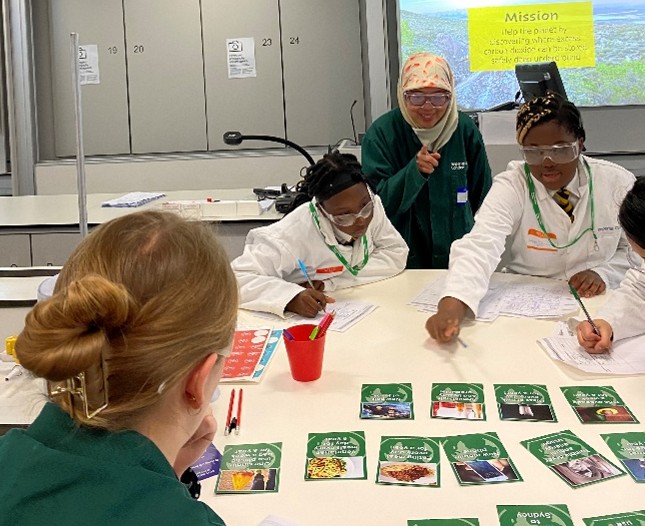 At the first station, students played the Carbon Footprint Game by Climate Stewards, guided by Phoebe Houldsworth-Bianek. The activity challenged students to guess the carbon footprint of everyday activities. This activity reinforced the idea that while large-scale technologies are essential for tackling climate change, individual choices and everyday actions also matter.
Station 2: What’s Under the Surface?
The second station, led by Valerie Locher, focused on visualising what lies beneath our feet. Students created layered models using sand, soil, and gravel to represent the subsurface. Acting as real geologists, they then extracted “cores” using straws then compared their models with real geological cores. Students gained insight into how scientists investigate the Earth’s subsurface and why coring is essential for understanding underground rock properties.
Station 3: Hidden Spaces: Investigating Porosity
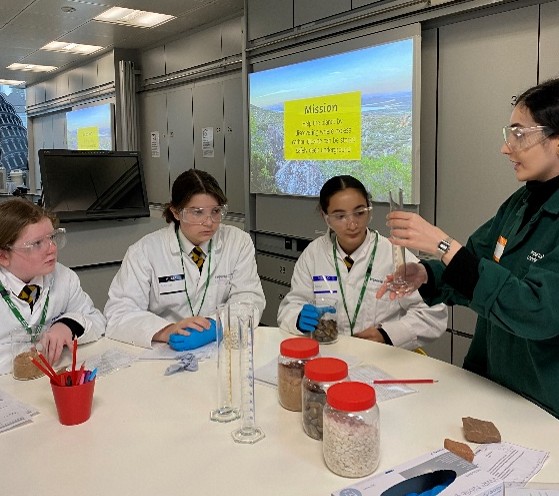 At the third station, Fatemeh Bozorgi introduced the concept of porosity. Using sand and gravel of different grain sizes in beakers, students filled them with water and observed how much each material could hold. This hands-on demonstration helped make an abstract concept tangible, showing that even rocks that appear solid can contain pore spaces capable of storing fluids and gases such as CO₂.
Station 4: Seep or Sleep? Testing Rock Permeability
The fourth station, guided by Sophie Davis, focused on permeability. Students examined a range of rock types – sedimentary, metamorphic and igneous rocks. They described their textures and grain sizes before testing how quickly water could pass through them. The activity demonstrated that rocks which allow water to move through very slowly act as effective seals, preventing stored CO₂ from escaping back to the surface.
Station 5: Injecting CO₂ Underground
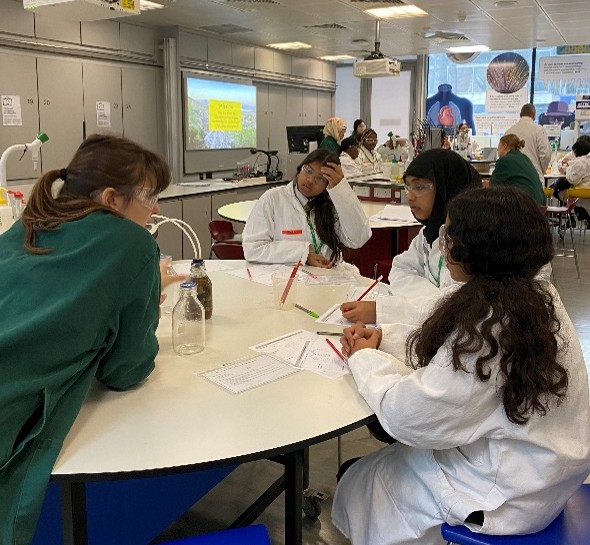 The final station brought the entire mission together. Led by Catherine Gower, students simulated CO₂ injection into a model reservoir using effervescent tablets and water. They observed how CO₂ displaces water and occupies pore spaces within the “rock,” mirroring real processes. This visual and dynamic experiment helped students understand why geology is essential for successfully storing CO₂ underground.
Inspiring the Next Generation
The event concluded with closing remarks from Professor Tina van de Flierdt, Head of the Department of Earth Science and Engineering. She shared her personal journey from growing up in the countryside to pursuing a career in Earth Science and becoming the first female head of the department, encouraging the students to believe in themselves and their potential.
To mark the completion of their mission, students received a small fossil souvenir and geology badges courtesy of the Geological Society of London, taking home a tangible reminder of their day as young geologists.
This outreach event successfully combined climate action, geology, and representation to inspire young women and demonstrate how Earth Science contributes to Net Zero. Through hands-on learning and meaningful interactions with researchers, the students gained new scientific knowledge, confidence, and insight into potential future pathways in geoscience.
Written by Farah Yusop, PhD Researcher, Department of Earth Science and Engineering.
Article text (excluding photos or graphics) © Imperial College London.
Photos and graphics subject to third party copyright used with permission or © Imperial College London.
Article people, mentions and related links
Gege Li
Faculty of Engineering