ESE outreach event brings global science adventure to Indonesian primary schools
by Gege Li
/prod01/channel_4/imperial-news/media/news-images/non-standard-dimensions/steam4girls_best_friend%5B1%5D.jpg)
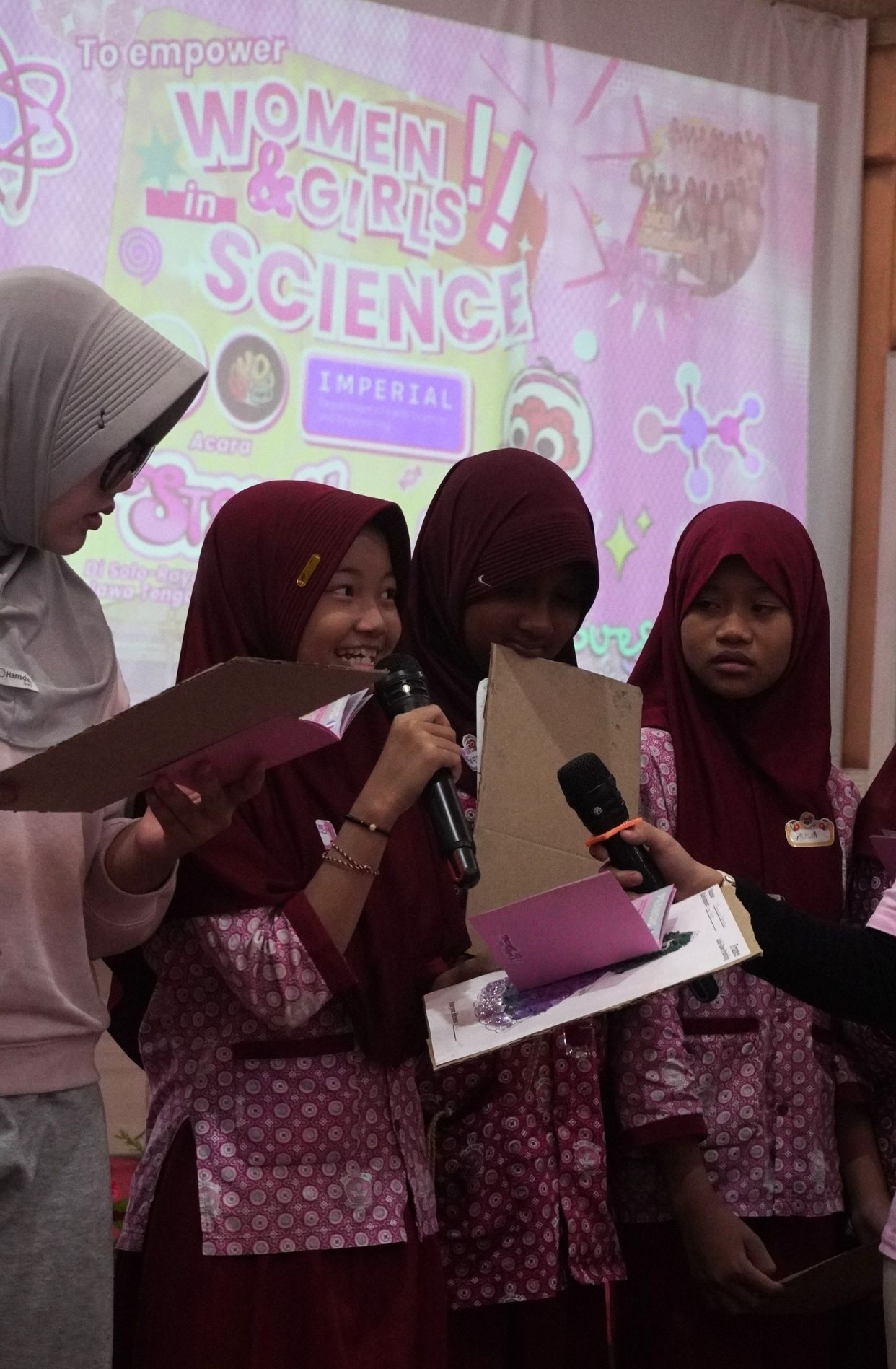
An innovative student-led event inspired by female scientists and inventors throughout history was recently launched for girls in Indonesia to pique curiosity and stimulate meaningful conversations about breaking barriers in STEAM (Science, Technology, Engineering, Arts and Mathematics).
Held on 8th August, in Solo, Java, the STEAM4GIRLS! event brought together more than 100 female students from five primary schools for a day of immersive science exploration. It was orchestrated by Yumna Afifah – a first-year Geology student in the Department of Earth Science and Engineering (ESE) at Imperial College London – and her team from Panoramind, a student-led non-profit organisation that she co-founded.
This event is a fantastic demonstrator of how our commitment to diversity in science translates into real-world impact. Sophia Quazi Equality, Diversity and Inclusion Co-ordinator, Department of Earth Science and Engineering, Imperial
The event was supported by ESE’s International Day of Women and Girls in Science (IDWGS) Outreach Fund, a dedicated departmental grant designed to encourage women and girls to pursue careers in science and engineering.
“In the Department of Earth Science and Engineering at Imperial, we have a longstanding commitment to supporting and developing a vibrant, diverse and inclusive community,” said Sophia Quazi, ESE’s Equality, Diversity and Inclusion (EDI) Co-ordinator.
“The IDWGS Fund, established in honour of the UN’s International Day of Women and Girls in Science, provides a direct avenue for ESE students and postdocs to kickstart and expand outreach efforts, and this event is a fantastic demonstrator of how our commitment to diversity in science translates into real-world impact.”
World tour of science
.jpg)
Themed as a global adventure, the main event involved five distinct ‘country stations,’ each offering a hands-on STEAM activity inspired by a pioneering woman scientist or inventor from that nation. Participants were divided into mixed groups, encouraging new friendships as they ‘flew’ between France, the USA, UK, Japan and China.
In ‘France,’ the students explored acid-base chemistry by testing everyday liquids with a natural pH indicator, and created mosaic art. The ‘USA’ station – which spotlighted Mary Anderson, who invented the windscreen wiper, and Florence Lawrence, inventor of car turn signals and brake lights – focused on energy and electricity, where participants built and wired their own DIY Formula-1 cars.
In the ‘UK,’ they delved into hydraulic engineering by constructing miniature cranes, inspired by engineer Beatrice Shilling, whose expertise on aircraft engines were pivotal in World War II. The ‘Japan’ station introduced aerodynamics and Japan’s first female astronaut, Chiaki Mukai, through the creation and testing of Koinobori (carp streamers).
Lastly, ‘China’ challenged the students to build a light-up lantern card using basic electronic circuits, inspired by entrepreneur Zhou Qunfei who founded the major touchscreen glass company, Lens Technology.
Yumna Afifah said: “The next innovator, engineer, scientist or changemaker could be sitting in one of these classrooms today. STEAM4GIRLS! was about showing these girls that science is already theirs – they just needed to be shown the way in!”
The next innovator, engineer, scientist or changemaker could be sitting in one of these classrooms today. STEAM4GIRLS! was about showing these girls that science is already theirs – they just needed to be shown the way in!
Building momentum
The initiative was preceded by two pre-events designed to build excitement and broaden its reach. On 31st July, a Panoramind Mengajar (Teaching Programme) outreach visit was held at a primary school in Mojokerto, Indonesia, where alumni introduced the organisation’s learning modules and gave students a preview of the main event through a detective-themed chromatography activity.
The team also launched ‘STEAMap’ on 26th July, an interactive online world map where people around the world can share and read inspiring STEAM stories, connecting the local Solo community with a worldwide network of changemakers.
The STEAM4GIRLS! event was supported by 36 volunteers from various organisations including Panoramind, BDG Action, Advocare Solo, and SMA Pradita Dirgantara.
A vision for inclusive science education
 Panoramind was established in 2024 from the Beasiswa Indonesia Maju Non-Degree Program and has since grown into a recognised force for educational change – in 2025 it earned the Ashoka Young Changemakers award, which recognises young people who have launched social initiatives to create change for the good of all.
“The organisation’s vision is to increase literacy and awareness of STEAM in an inclusive manner, opening opportunities for all students to develop a scientific mindset and deep curiosity,” said Yumna.
This initiative aligns strongly with ESE’s departmental values of being Supportive, Inclusive, and Inspiring, as well as its work to progress gender equality (such as through the Ada Lovelace Academy).
By funding and supporting students like Yumna, the Department of Earth Science and Engineering continues to build on its dedication to foster a more inclusive scientific community, and spotlight bright talent and diverse perspectives.

STEAM4GIRLS! Pre-event outreach visit

STEAM4GIRLS! USA activity

STEAM4GIRLS! Japan activity

STEAM4GIRLS! China activity
Article text (excluding photos or graphics) © Imperial College London.
Photos and graphics subject to third party copyright used with permission or © Imperial College London.
Article people, mentions and related links
Gege Li
Faculty of Engineering