
Engineering
by Gege Li, Simon Levey
/prod01/channel_4/imperial-news/media/news-images/3000X2000-main-article-images/1767944972440.jpg)
An international team co-led by Imperial College London has obtained the longest ever sediment core from beneath the Antarctic ice – a multimillion-year record that will help predict critical sea level rise in our rapidly warming world.
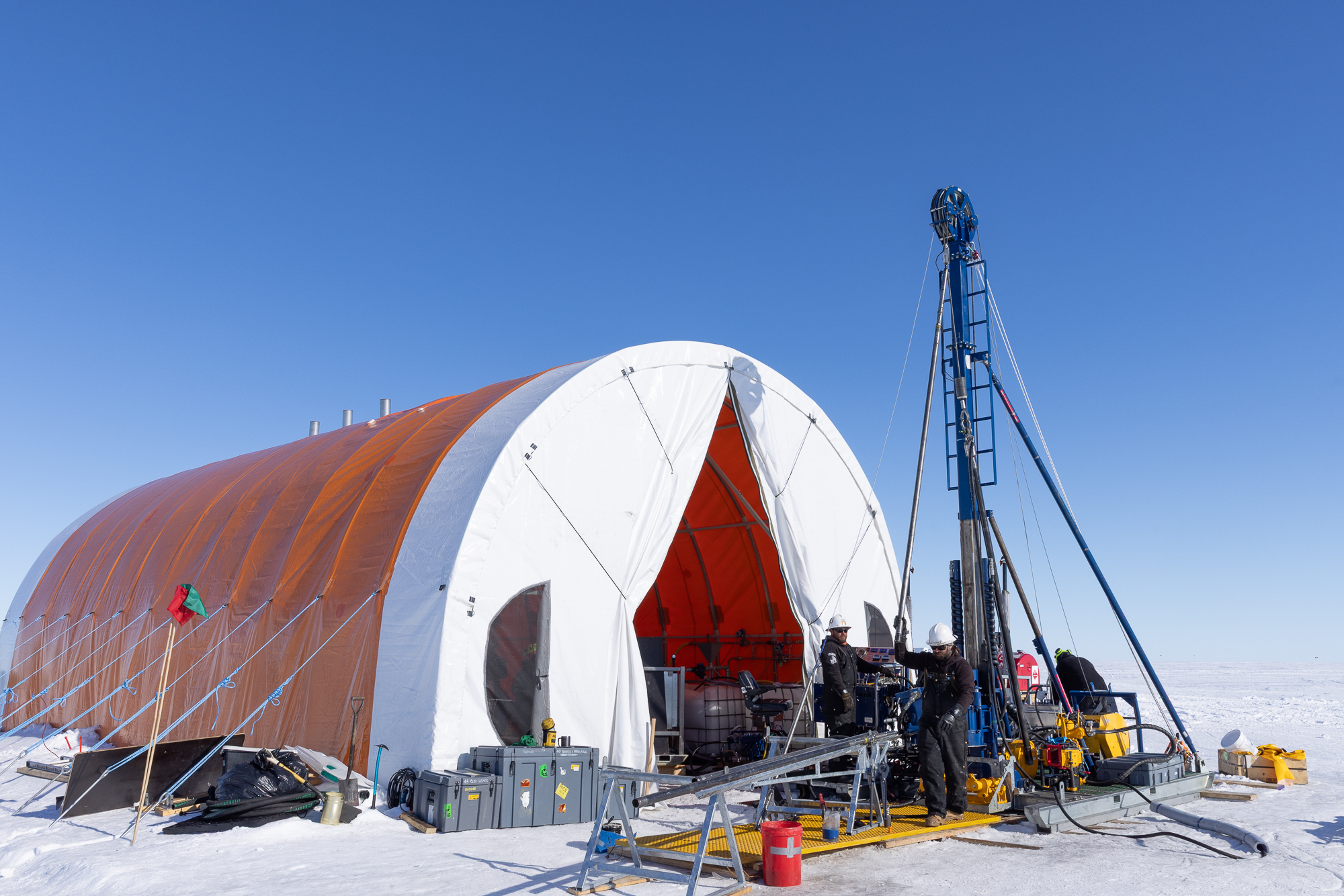
In an unprecedented achievement, scientists have extracted a 228 metres-long sample (known as a ‘core’) of ancient mud and rock from under the West Antarctic Ice Sheet (WAIS) – at the remote Crary Ice Rise site near the centre of the frozen continent. The scientists first had to drill through 523 metres of ice to reach their sample.
The newly drilled core is packed with secrets from the past and will allow climate scientists to calculate how global temperature has affected the size of ice sheet. The West Antarctic Ice Sheet holds enough frozen water, if melted completely, to raise global sea level by four to five metres.
This accomplishment was a long-awaited success by the SWAIS2C (Sensitivity of the West Antarctic Ice Sheet to 2°C) project, which embarked on its third expedition to Antarctica last November. The team of 29 scientists, drillers, engineers and polar specialists, included Dr James Marschalek from Imperial’s Department of Earth Science and Engineering (ESE).
By helping us understand how the West Antarctic Ice Sheet might behave in rising temperatures, this sediment core will provide the most comprehensive picture yet of our possible future, for one of the most significant consequences of climate change: global sea level rise. Prof Tina van de Flierdt Head of Department, Earth Science and Engineering, Imperial
“This is a hugely exciting accomplishment that has involved years of international collaboration, careful design and planning, not to mention physical effort – and we’re thrilled to see it finally pay off!” said Professor Tina van de Flierdt, Head of the Department of Earth Science and Engineering at Imperial, and Co-Chief Scientist at SWAIS2C, who was part of its previous two expeditions to Antarctica.
“By helping us understand how the West Antarctic Ice Sheet might behave in rising temperatures, this sediment core will provide the most comprehensive picture yet of our possible future, for one of the most significant consequences of climate change: global sea level rise.”
Covering around 8% of the Earth’s surface, the WAIS has been losing mass at an accelerating rate, but it remains uncertain what amount of warming will trigger a total collapse – and whether it would exceed the 1.5-2°C limit set in the Paris Agreement.
Until now, the only geological records available to reconstruct ice sheet retreat under warmer temperatures had been obtained from next to the ice sheet, below floating ice shelves and sea ice, or in the open Southern Ocean.
However, in this game-changing scientific and technological achievement, the scientists and engineers have managed to drill into the layers of sediment deep below the ice at Crary Ice Rise, hundreds of kilometres from the open ocean – first using a hot-water drill to melt through the ice, then lowering a ‘riser’ and ‘drill string’ pipe down the hole – to pull up the core in lengths up to 3 metres long.
The core consists of many different types of sediment, from fine-grained muds to firmer layers embedded with gravel and larger rocks, and, most interestingly of all, shell fragments and tiny marine fossils. Initial indications are that the sediment layers span the past 23 million years – a period in Earth’s history when, at times, the global average temperature was much higher than it is today.
“This exciting discovery shows there were times when the site was covered by the ice sheet – like it is today – indicated by layers rich in gravel and rocks,” said Dr Marschalek. “At other times, the ice sheet was much smaller and further away from our drilling site, indicated where we saw muds and shells deposited. These telltale materials are the first in-situ evidence of open ocean conditions – and therefore of past ice sheet retreat – recovered from near the centre of West Antarctica.”
A wider team of scientists from the 10 countries collaborating in the SWAIS2C project will now apply a range of techniques, including isotope geochemistry at Imperial’s MAGIC laboratory, to refine initial interpretations.
At Crary Ice Rise, the team knew that success was far from certain. SWAIS2C’s first two drilling attempts had experienced technical setbacks, but that came as little surprise – no one had ever drilled geological samples this deep beneath an ice sheet, or this far from any major base of resources.
“We have geological records from the edges of the Antarctic continent, but we have never recovered such a deep sediment core from the interior of an ice sheet. It was impressive watching the drill team overcome the technical challenges to retrieve this record,” said Dr Ed Gasson, Associate Professor at the University of Exeter, and a member of the SWAIS2C Science Team.
“This sediment core is important because it tells us directly that this part of the ice sheet, which we think is especially vulnerable to a warming climate, retreated in the geological past leaving behind open seawater. We could see this as soon as the core started coming up.”
Dr Gasson, who works on future projections of sea level change using computer models of ice sheets, said there is now a lot of work to do to work out exactly when this retreat happened. Using this new record, the team can finally test these computer models and see how well they can reproduce past retreat like that gleaned from the Crary Ice Rise core.
“This record was incredibly hard won but vital to determining how vulnerable we are to future sea level rise,” said Dr Gasson.
Dr Marschalek added: “Watching the first cores coming up was a very special time. Partly knowing that the huge effort made by a lot of people had paid off, and partly knowing we were recovering something with massive potential to change our understanding of how the West Antarctic Ice Sheet works and how it will continue to raise global sea level.”
This groundbreaking work was supported by logistical contributions from two national Antarctic programs. Antarctica New Zealand provided the traverse capability to tow the custom-designed drilling system and field supplies 1100km across the Ross Ice Shelf. This team then established and operated the remote field camp through a nearly 10-week season. The National Science Foundation’s United States Antarctic Program also provided critical airlift and other logistical support. Weather presented a significant challenge, with the drillers’ and scientists’ flights into camp delayed by weeks due to freezing fog at the site.
The core has been transported back to New Zealand via Antarctica’s busy Scott Base. Samples will be sent to SWAIS2C scientists around the world, including at Imperial, for further analysis.
This project has proved to be an inspiring story of resilience, overcoming technical challenges, and not giving up in pursue of answering one of the most pressing questions of our time – how much and how fast will the Antarctic ice melt, and what preparation is needed for future generations. Prof Tina van de Flierdt Head of Department, Earth Science and Engineering, Imperial
“Our multi-disciplinary team will soon begin work extracting climate data from the core, providing critical information on the vulnerability of the West Antarctic Ice Sheet to catastrophic warming and required adaptation along our coastlines,” said Professor van de Flierdt.
“This project has proved to be an inspiring story of resilience, overcoming technical challenges, and not giving up in pursue of answering one of the most pressing questions of our time – how much and how fast will the Antarctic ice melt, and what preparation is needed for future generations.”
Article text (excluding photos or graphics) © Imperial College London.
Photos and graphics subject to third party copyright used with permission or © Imperial College London.
Faculty of Engineering

Administration/Non-faculty departments

Health

Health

Science

Science
Campus and community
Imperial Global
Health
Discover more Imperial News
Search all articlesDiscover more Imperial News
Search all articles