'Sensational' designs: study reveals how the human hand perceives shape-changing technology
/prod01/channel_4/imperial-news/media/news-images/3000X2000-main-article-images/hand_grip_3.jpg)
Imperial researchers have measured how accurately people perceive devices that physically change shape, providing practical guidance for future handheld devices that communicate through touch.
Imagine holding a device that changes shape in your hand to communicate information, perhaps guiding a person with visual impairment around a city, representing the form of a virtual object, or signalling a direction in a video game through touch.
What can the hand detect?
Shape-changing haptic interfaces are an emerging way for people to interact with technology through touch. Unlike familiar haptic feedback, such as the vibration of a phone or games controller, these devices communicate by physically shifting, expanding or rotating against the hand.
Engineers still have limited evidence about how accurately people perceive these transformations. Without it, designers have little basis for deciding how far a device should move, how finely it needs to be controlled or how a user should hold it.
Researchers Qihan Yang, Dr Xin Zhou and Dr Ad Spiers, from the Manipulation and Touch Lab in Electrical and Electronic Engineering set out to provide some of those measurements. Their latest study examines three forms of shape-changing feedback and provides data that engineers can use to guide the design of future devices.
"We hope that this work will make the field less daunting to designers. In particular, our goal is to move the field from intuition and trial and error towards focused development with evidence about human perception.” – Dr Ad Spiers
Putting touch to the test
 The team built three high-precision handheld devices, each producing a different sensation: one shifted sideways beneath the fingertips, one expanded or contracted between the fingers, and one rotated beneath the hand.
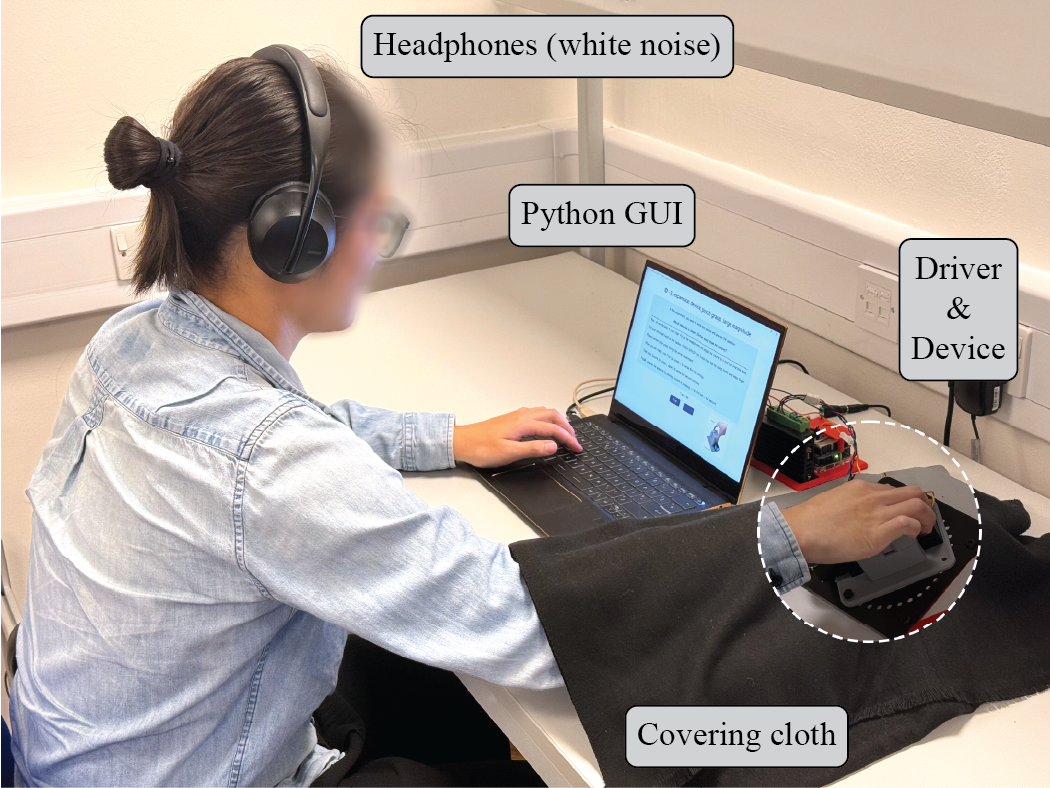
Eighteen volunteers compared subtle and larger movements using either a two-finger pinch or a three-finger “tripod” grasp. Their hands and the devices were hidden beneath black cloth and motor noise was masked by headphones, ensuring they relied on touch alone.
Each participant completed around 100 minutes of testing, producing more than 12,000 individual comparisons across the study.
An unexpected result – a matter of scale
What surprised the researchers was what happened as the movements became larger.
Qihan ‘Jack’ Yang, a PhD student, explains: “For sensations such as vibration, brightness and weight, Weber’s law describes a familiar pattern: the difference needed for us to notice a change generally grows with the size of the original stimulus. A 10 g difference is obvious between 10 g and 20 g, for example, but much harder to detect between 1,000 g and 1,010 g."
“What we found with shape-change was different. Across all three devices, the relative difference people needed to tell two movements apart became smaller as the movements became larger. In other words, their relative sensitivity improved, rather than staying roughly constant as Weber’s law would predict.
“That was unexpected, and it potentially gives us a really useful insight into how these devices should be designed.”
The researchers don't yet know exactly why the effect occurs. Qihan adds: “One possibility is that larger transformations create richer patterns of contact across the fingertips and involve more joints in the hand, giving the nervous system additional information. But we’ll need further studies to understand what is actually driving the effect.”
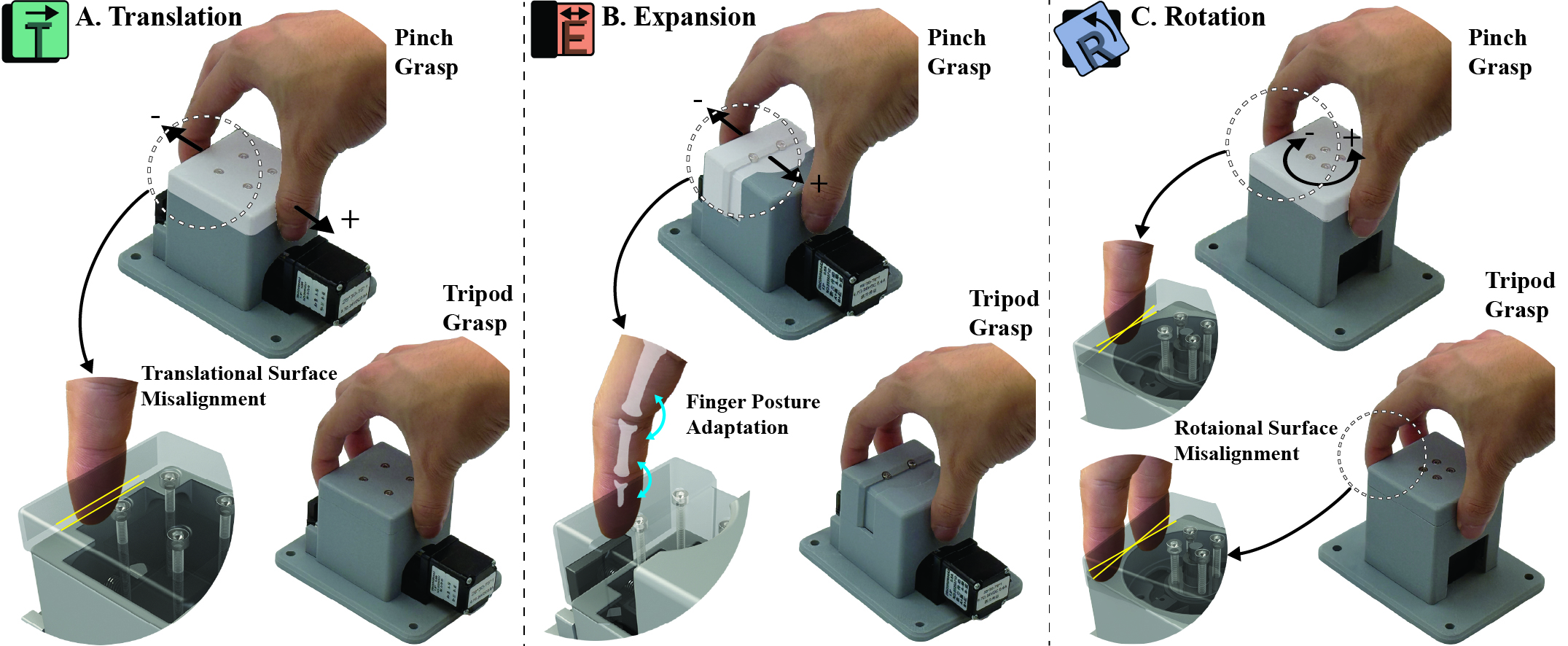
The study also found that using more fingers did not consistently improve perception: a two-finger pinch was generally sufficient, with only limited potential benefits from a three-finger grasp in some conditions. Within the millimetre-scale range tested, participants distinguished linear shifts more precisely than expansion, while translation and rotation showed no clear directional bias.
What this means for designers
The findings begin to turn those perceptual measurements into practical design choices. Engineers now have evidence to help decide how far a device should move, how finely its movement needs to be controlled and whether a more complex grasp actually improves what the user can distinguish. In the devices tested, larger movements improved relative perceptual sensitivity, while a simple pinch was often enough.
That matters for devices that need to communicate information clearly through the hand. Potential applications include navigation aids for people with visual impairments, virtual and augmented reality systems that convey the form of digital objects, and robotic devices that communicate information through physical changes in the hand.
What comes next?
Dr Ad Spiers, Associate Professor in Robotics and Machine Learning, says: “The three categories of shape-change that we have investigated represent are really isolated, fundamental stimuli, and a small part of the larger shape-change design space. There are many other potential changes in geometry that could be explored and it is unknown how these perceptual findings transfer from high-precision laboratory testbeds to handheld or wearable devices to be used in practical scenarios.
“One important idea here is that shape-changing haptics is an emergent technology with many advantages, and we hope that this work will make the field less daunting to designers. In particular, our goal is to move the field from intuition and trial and error towards focused development with evidence about human perception.”
The study, Investigating the Perception of Shape-Changing Haptic Interfaces, by Qihan Yang, Xin Zhou and Adam J. Spiers, is published as Early Access in IEEE Transactions on Haptics.

Article text (excluding photos or graphics) © Imperial College London.
Photos and graphics subject to third party copyright used with permission or © Imperial College London.
Article people, mentions and related links
Jane Horrell – Department of Electrical and Electronic Engineering
Faculty of Engineering
