The Fleming Initiative and Johns Hopkins combine forces against AMR
/prod01/channel_4/imperial-news/media/images/landscape-3000X2000/flemming-initiative-and-john-hopkins-university-collaboration.jpg)
The Fleming Initiative will collaborate with Johns Hopkins University to tackle antimicrobial resistance (AMR).
The Fleming Initiative has further reinforced its role as a global convener and driver of efforts to tackle antimicrobial resistance (AMR), following a recent strategic visit by Lord Darzi to the US where he signed a Memorandum of Understanding (MoU) with Johns Hopkins University.
Lord Darzi, the Executive Chair of the Fleming Initiative, was invited to the renowned Johns Hopkins University (JHU) in Baltimore, Maryland to meet leaders and discuss how, together, both organisations can support pioneering efforts to tackle antimicrobial resistance (AMR).
While on the visit, Lord Darzi met with leading experts including Professor Amita Gupta and Professor Anthony So. Lord Darzi outlined the bold vision for the Fleming Initiative during a special lecture at the Bloomberg School of Public Health.
In addition to meetings with faculty across the Schools of Medicine and Public Health, key talks focused on how JHU can become a part of the Fleming Initiative as the Centre for the United States.
Johns Hopkins has a long and foundational history in infectious disease and continues to drive pioneering work in this area. It shares the Fleming Initiative’s ethos of interdisciplinary solutions to address AMR. There is clear alignment between the two organisations on clinical trials, AMR technologies and future opportunities to co-convene stakeholders.
Speaking on the signing, Lord Darzi commented: “I am delighted to be bringing these pioneering institutions together, collaborating on vital work to tackle AMR and build upon our shared legacy of pioneering work within infectious diseases.
“I am hopeful that solidifying this relationship will lead to expanded research and impact that can be seen in the UK, US and further afield.”
A Global Convener
The Fleming Initiative, founded through a partnership between Imperial College London and Imperial College Healthcare NHS Trust, has grown to encompass partners across continents, sectors and disciplines.
It has been supporting efforts and is expanding programmes with collaborators internationally across prevention, diagnosis, therapeutics and AI. This has included recent efforts to convene key global opinion leaders and actors as part of a consortium examining the role of diagnostics, and is further supporting efforts to incorporate AMR into formal education curricula.
The US: a vital piece of the AMR puzzle
The United States forms an important part of the global health ecosystem.
Fostering greater collaboration internationally, including with the US, is a priority for the Fleming Initiative, underpinned by the growing global threat posed by resistant bacteria and fungi. In addition to the US being home to some of the leading efforts to reduce the burden of antimicrobial resistance, it is also contending with rising rates of resistant infections.
During the United Nations General Assembly High-Level Meeting on AMR, the Fleming Initiative’s ‘Every 11 Seconds’ Times Square billboard campaign helped to raise awareness of this issue amongst local New York City audiences. Offering a unique platform, the billboard highlighted that someone in the US contracts an antibiotic resistant infection every 11 seconds on average and helped to engage the New York City public with global leaders’ conversations on AMR at the United Nations.
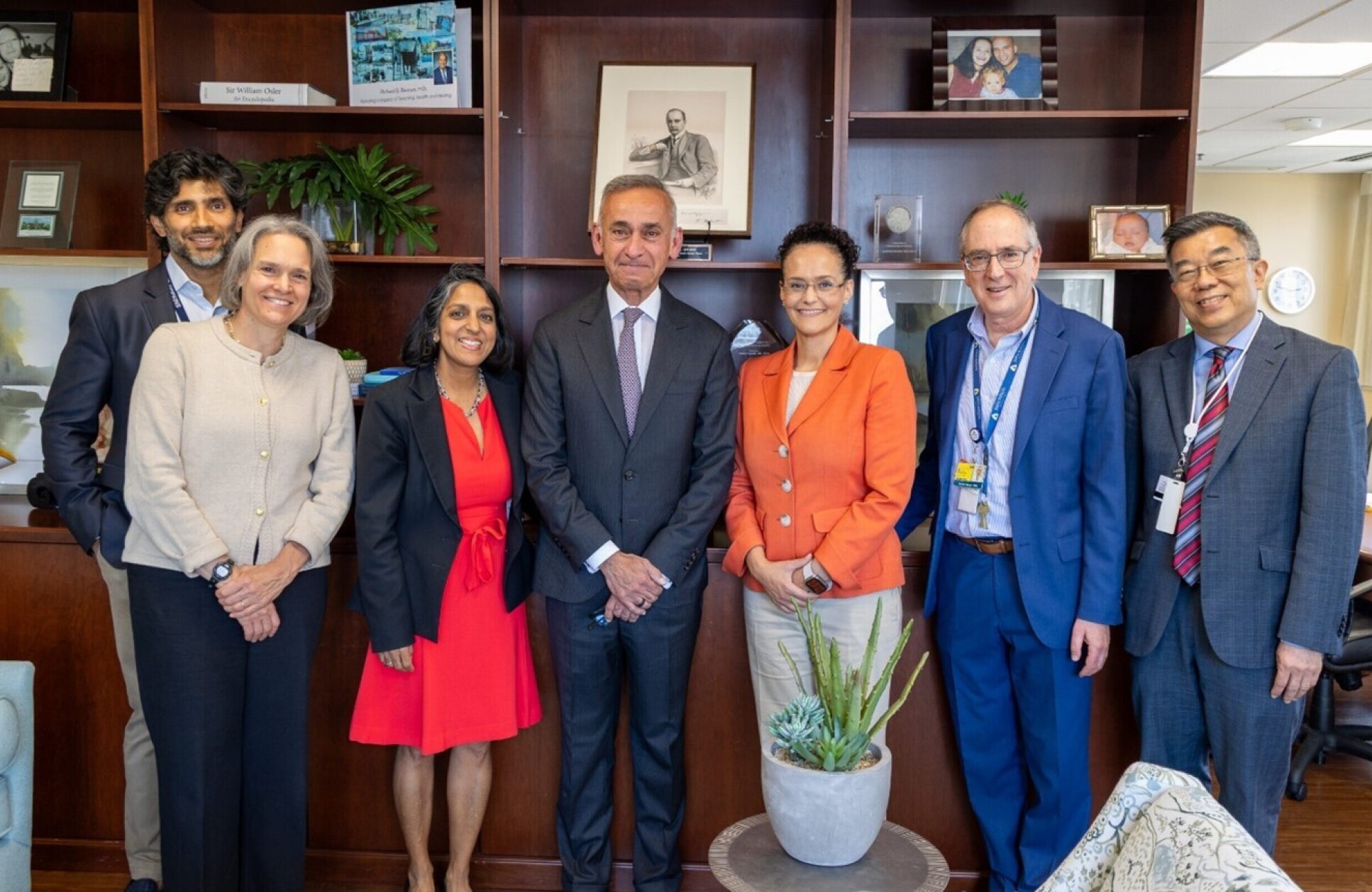
Photos courtesy of Johns Hopkins University. Taken from the signing ceremony with Drs. Nadia Hansel, Antony Rosen, Anthony So (JHSPH), Sara Cosgrove (ID), Amita Gupta (ID), Sunil Solomon (ID), and Lord Darzi (as pictured in the first photo).
Article text (excluding photos or graphics) © Imperial College London.
Photos and graphics subject to third party copyright used with permission or © Imperial College London.
Article people, mentions and related links
Wiktoria Tunska
Centres