Calvin Bailey MP visits Imperial to hear latest advances in prostate cancer research
/prod01/channel_4/imperial-news/media/news-images/3000X2000-main-article-images/CB-visit-CB-gel-loading-2.jpg)
On Wednesday 19 November, Dr Claire Fletcher and her team welcomed Calvin Bailey MP to Imperial to hear about the cutting-edge prostate cancer research within the Division of Cancer.
Mr Bailey, Chair of the All-Party Parliamentary Group on Prostate Cancer and a leading advocate for men’s health, is supporting Prostate Cancer Research’s campaign for a nationwide targeted screening programme for men at increased risk of the disease - particularly Black men and those with a family history.
During the visit, Dr Fletcher, Assistant Professor in Molecular Oncology at the Department of Surgery and Cancer, outlined her team’s work investigating how obesity and the fat surrounding the prostate may drive more aggressive forms of prostate cancer. She also showcased collaborative efforts with the Department of Chemistry to develop novel prostate-targeted therapeutics for men with advanced disease.
Dr Fletcher and the team also discussed their work to overcome drug resistance and develop less impactful therapeutics: “Our laboratory is focussed on improving the treatment options available to men with the advanced disease, not only to improve survival, but to combat drug resistance and develop ‘kinder’ therapeutics that avoid the considerable quality-of-life-impacting side-effects that are frequently experienced upon treatment with currently-available drugs”.
Professor Charlotte Bevan, Professor of Cancer Biology at the Department of Surgery and Cancer, provided further insight into ongoing biomarker research with colleagues at the Institute of Cancer Research (ICR), highlighting promising developments that could improve early detection for high-risk men.
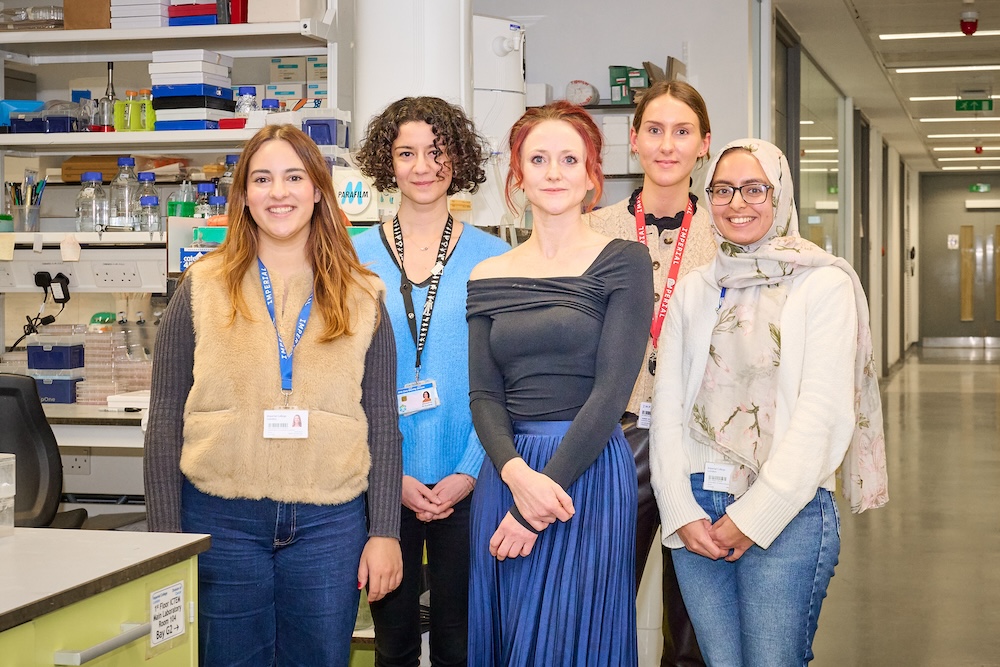
Mr Bailey spent time in the laboratory meeting PhD students and postdoctoral researchers, observing experiments, and even trying his hand at some bench work. Discussions throughout the visit focused on the shared goal of improving outcomes for men through earlier diagnosis and more effective, kinder treatments. Targeted screening has the potential to reduce the number of men diagnosed at incurable late stages, potentially saving thousands of lives each year.
The visit came days before of the National Screening Committee advised that it does not currently recommend a screening programme for all men, as there are concerns that the harms caused by screening outweigh the benefits. It has recommended that men with confirmed faults in BRCA1 and BRCA2 genes aged between 45 and 61 should be screened every two years.
Responding to the Committee’s report, Professor Hashim Ahmed, chief investigator of the TRANSFORM trial, Professor of Urology at Imperial’s Department of Surgery and Cancer and Chair of Urology at Imperial College Healthcare NHS Trust said: “The National Screening Committee’s draft recommendations show that large scale trials such as TRANSFORM are crucial. They provide the critical evidence needed to determine whether a national screening programme for prostate cancer should be delivered in the UK in the future.
“By testing new ways to diagnose the disease and studying the tests we currently use, TRANSFORM will reveal the best way to screen men for prostate cancer, so the disease is diagnosed earlier, minimising harms and ultimately saving more lives. We strongly encourage anyone who is invited to take part to get involved and help shape the future of prostate cancer screening.”
Research in Dr Fletcher’s lab is funded by Prostate Cancer Research, Prostate Cancer UK and the Prostate Cancer Foundation of the US.
Article text (excluding photos or graphics) © Imperial College London.
Photos and graphics subject to third party copyright used with permission or © Imperial College London.
Article people, mentions and related links
Benjie Coleman
Faculty of Medicine