
Science
by Meesha Patel
/prod01/channel_4/imperial-news/media/news-images/3000X2000-main-article-images/Long-Servers-Awards-023-(1).jpg)
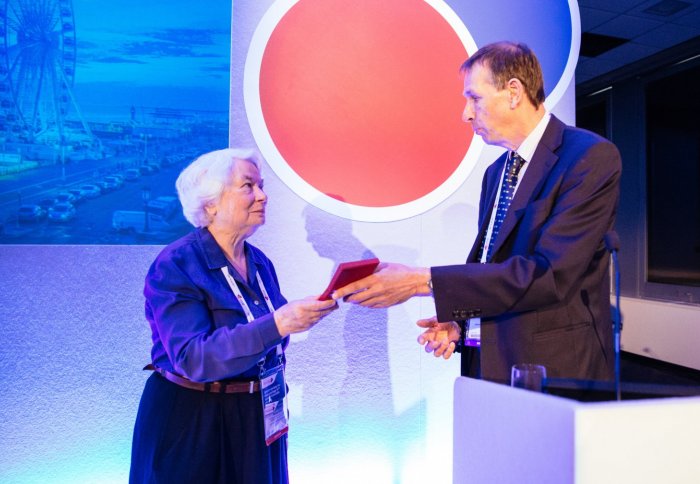
As Professor Barbara Bain becomes Emerita Professor in the Department of Immunology and Inflammation, we reflect on her remarkable contributions to haematology and medical education.
Professor Barbara Bain is Professor Emerita of Diagnostic Haematology in the Department of Immunology and Inflammation and is internationally recognised for her contributions to teaching in the field of Haematology.
At the start of her career, she trained in general medicine in Australia before joining Hammersmith Hospital and the Royal Postgraduate Medical School in 1971. Since then, in a career spanning five decades, Professor Bain has become a renowned haematologist known for her influential textbooks and dedication to training future haematologists first at St. Mary’s Hospital Campus and then also at Hammersmith Hospital Campus.
She received a lifetime achievement award from the British Society of Haematology in 2017 and became a Member of the Order of Australia (AM) in the 2020 Queen’s Birthday Honours list for her significant contributions to medicine and medical education.
In this conversation, Professor Bain shares insights from her career spanning decades, her passion for teaching, and her thoughts on the future of the field.
Looking back at your career, why were you drawn to pursue haematology?
The advantage of haematology as a career is that it encompasses everything, from the scientific basis of medicine to hands-on treatment of patients. When I did my training, all that was covered. People trained in laboratory haematology and became expert at looking down microscopes at blood films and bone marrows, and they also became expert at looking after patients. So, it had a very good merge of science and medicine.
Since then, things have changed. People now may be more narrowly trained, and their practice may be much narrower, either mainly laboratory haematology or mainly clinical. That’s a disadvantage, but almost inevitable because the field has become so big and complex.
Another advantage of laboratory haematology is that there’s an element of discovery. Patients present you with diagnostic problems you may solve, and sometimes they present something completely unknown and you may make a new discovery. This idea of the haematologist as a detective is what I find quite attractive.
Was there a defining moment that sparked your interest in haematology?
No, I trained in general medicine first, as one does. Then I became interested in immunology while living and working in Brisbane, Australia. We had a visit from someone from Sydney who was an immunologist, and that made the field seem very interesting. But when I looked at it, it seemed a very narrow career with not much opportunity. This was pre-HIV and pre-AIDS. Years later, immunology became a major specialty. Then I thought haematology shared a lot of the same characteristics, and maybe that was what was meant for me.
Were there pivotal turning points or mentors who influenced your career?
I had some important mentors. I first came to Hammersmith Hospital and the Royal Postgraduate Medical School at the end of 1971 on a scholarship from the Royal Australasian College of Physicians. I worked in the academic department of haematology for a year, and some of the nation’s most important haematologists were on staff - Professor Sir John Dacie, Dr Mitchell Lewis, Professor David Galton, and Victor Hoffbrand. Later, I worked at St Mary’s under Professor Mollison, a leader in blood transfusion, and then Professor Wickramasinghe. I had the advantage of learning from many highly competent, knowledgeable people.
You’ve held academic positions at Imperial College London for over four decades. What has been most fulfilling about teaching?
I’ve always been keen on teaching because if you see something interesting or discover something unusual, you want to share it. A lot of my teaching has been hands-on at the microscope, and I’ve also taught in more traditional ways, from blackboard and chalk to modern technology. I’ve always tried to keep my teaching practical, relevant to day-to-day practice, and clearly delivered.
I’ve taught undergraduates, haematology trainees, general medical trainees, and postgraduates internationally. I’ve lectured on every continent except Antarctica. Teaching internationally has been fascinating, and you see different types of haematology in different environments.
What advice would you give to emerging haematologists today?
The challenge nowadays is that the subject is enormous and complex. I’d advise everyone to get a good training in the basics in both laboratory and clinical haematology for a couple of years, so they understand the whole field. Then they’ll inevitably narrow down, but whichever they focus on, they can’t afford to forget the other. If you’re in the lab, you need to know what clinicians need and if you’re clinical, you need to understand what the lab is telling you.
Of the many initiatives and roles, you’ve undertaken, what do you consider your most enduring legacy?
Probably my books. I’ve published 21 books, some in multiple editions and translated into many languages - Italian, German, Spanish, Japanese, Russian, Indonesian, Greek and French. They’ve spread their influence worldwide. If I go into a laboratory anywhere, there’s bound to be one or two of my books on the shelves. Books have gone out of fashion a bit, which is a mistake. I hope they continue to play an important role in education.
If you could give one piece of advice to your younger self, what would it be?
I don’t think I’d change anything. A lot of it was pure chance, where you end up, which hospital you join, but all the chances worked out well. Opportunities arose, and if I liked the look of them, I took them. None of the jobs I did were unsatisfactory.
Any final thoughts?
Teaching is something all haematologists and all doctors should be involved in. We should always want to share our knowledge. It’s important that people have the time and energy to do that. The future of medicine depends on experienced professionals being motivated to teach. And in so doing, they keep learning themselves.
Article text (excluding photos or graphics) © Imperial College London.
Photos and graphics subject to third party copyright used with permission or © Imperial College London.
Faculty of Medicine
Science

Science

Health
.jpg)
Health
Cross-faculty
Health
Engineering
Discover more Imperial News
Search all articlesDiscover more Imperial News
Search all articles