
Engineering
by Meesha Patel
/prod01/channel_4/imperial-news/media/news-images/3000X2000-main-article-images/260121_Imperial_College_Professor_Aubrey_Cunnington_Brendan_Foster_Photography-36-53.jpg)
We had a conversation with the Head of Department on his vision, priorities, and hopes for the future.
A long‑standing member of the Imperial community, Professor Aubrey Cunnington has recently begun his role as the new Head of the Department of Infectious Disease.
Throughout his career, he has built clinical and research expertise in paediatric infectious disease and developed a strong commitment to global health. These experiences have shaped his vision for how the department can drive meaningful impact through research, education, and innovation.
In this conversation, he shares more about his background, his priorities for the department, and what continues to motivate his work.
I’m a clinical academic in paediatric infectious disease, Professor of Paediatric Infectious Disease, and an Honorary Consultant in Paediatric Infectious Disease at Imperial College Healthcare NHS Trust and West London Children’s Healthcare.
I trained in medicine at the University of Oxford and completed a PhD at the London School of Hygiene and Tropical Medicine. I joined Imperial College in 2013, initially supported by what was then the equivalent of the ISSF scheme. After that, I received an MRC Clinician Scientist Fellowship, which allowed me to start my own independent research. I later became a Clinical Senior Lecturer, then Head of Section in 2019, and was promoted to Professor in the 2022 promotions round.
My research focuses on malaria, particularly the pathogenesis of malaria, and increasingly on diagnostics for infectious diseases. This includes novel approaches that use the body’s response to infection to make a diagnosis, rather than trying to detect the pathogen itself. I’m especially interested in how this can be used in low‑ and middle‑income settings, particularly in Africa, where access to advanced diagnostics is extremely limited and where these tools could have transformative impact.
The short story is that I did my medical elective in Kenya, in Kilifi, where there is a joint research unit supported by the University of Oxford, Wellcome Trust, and the Kenyan Medical Research Institute. The big focus there was malaria, and I was fascinated by the challenges and by what we didn’t know. That interest carried through from my medical school years into my PhD, which was in malaria immunology. I was trying to understand why people with malaria are susceptible to bacterial infections on top of the malaria infection.
Malaria is also a massive global problem with more than 200 million cases each year and more than 600,000 deaths, despite the disease being preventable and treatable. Some of the barriers are linked to poverty and health systems; others stem from the parasite and mosquito vector evolving resistance to our treatments and control measures.
My main motivation is that we have an amazing department in terms of people, research, and education. Leading a department like this is both a pleasure, because of what already exists, and an opportunity to add value, particularly by helping us achieve impact from our work. I’m keen to join up activities and develop new initiatives that build on our strengths so we can have greater impact aligned with the university and Faculty strategies around Science for Humanity.
In short, the department can be a powerful force for good at a time when the world feels quite uncertain. Infectious diseases and antimicrobial resistance remain major threats to humanity, and I believe we are extremely well placed to help tackle them.
We have several core strengths. One major area is antimicrobial resistance, which is a smouldering crisis that’s already having major impacts. We have experts across the entire spectrum: discovering new antibiotics, improving use of existing ones, optimising clinical management and diagnostics, and preventing infections through vaccination. Working closely with the Fleming Initiative will provide great opportunities for impact.
We also have strong and growing work in vaccinology, with momentum building towards what we hope will become a centre for precision vaccinology.
Another strength is our work on understanding disease susceptibility and mechanisms of disease, from structure and function of key molecules to the systemic effects on the host. We also have tremendous strengths in core areas of virology, bacteriology, and mycology, along with newer disciplines like synthetic biology. In the pandemic science space, the department played an enormous role during the COVID‑19 pandemic. The learning from that means we are well equipped to respond rapidly to any future pandemic, provided we consolidate that expertise and ensure the structures are in place.
Globally, we have colleagues working on trials in areas like tuberculosis, neonatal sepsis, and malaria. We are also world leaders in controlled human infection models, which allow for highly controlled study of disease processes and efficient testing of new vaccines and drugs.
I want the department to be a happy, supportive, diverse, and inclusive environment where we attract talented individuals, deliver world‑leading education, research, and innovation, and address critical challenges in understanding, diagnosing, treating, and preventing infectious diseases.
We will be reviewing all areas of departmental operation, from our managerial processes to our research and education strategies. I’m hopeful that we will develop new courses that attract brilliant students to Imperial and equip them to contribute to tackling global challenges, as education is a major part of how we can have an impact on humanity.
For research, we will be developing our strategy further, and I am keen to involve stakeholders across the department. On the innovation side, we need to recognise the value of intellectual property and be open to collaboration with industry where it can help translate our ideas into tools that benefit the world.
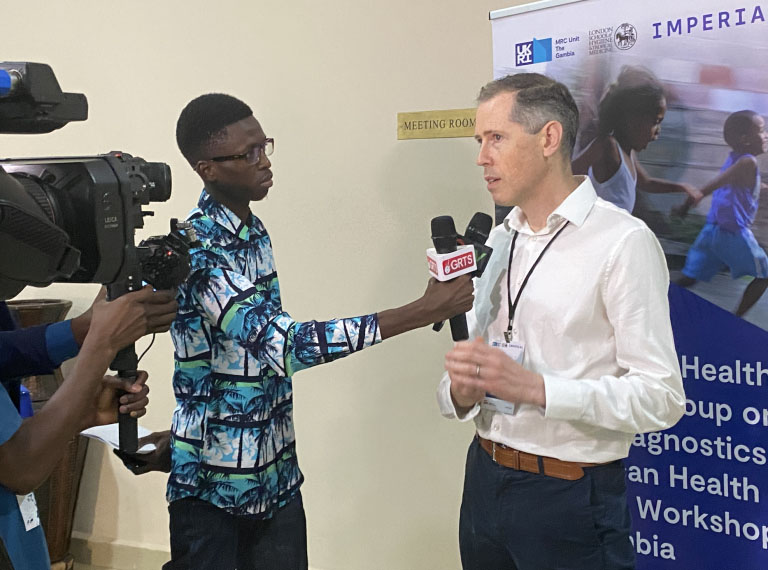
I want the department to be a safe and supportive environment where everyone can achieve their full potential. It’s critical that it is free from bullying and harassment, and that we build a diverse and inclusive department through deliberate processes, especially in recruitment, promotions, and outreach.
We already have an exceptional People and Culture Committee, and an increasingly strong early‑career researcher community. The support from our ECR champions is going above and beyond expectations and I want early‑career researchers to feel nurtured and supported. I’d like us to invest more in that as a department.
This is something I spoke about in my inaugural lecture. Ultimately, I want to do things that are interesting and exciting, to work with people I enjoy working with, and for the results to make a positive difference to people’s lives.
The idea of science for humanity and that Imperial exists to be useful really aligns with my own values. That’s part of why I felt drawn to the Head of Department role. It’s a chance to amplify the impact I can have, not just through my own research and teaching but by fostering an environment where the whole department’s work has greater impact for humanity.
Article text (excluding photos or graphics) © Imperial College London.
Photos and graphics subject to third party copyright used with permission or © Imperial College London.
Faculty of Medicine

Engineering

Health

Health

Health
Science
Science
Campus and community
Discover more Imperial News
Search all articlesDiscover more Imperial News
Search all articles