New organometallic dopants boost stability and efficiency of next-generation perovskite solar cells
/prod01/channel_4/imperial-news/media/news-images/3000X2000-main-article-images/NL_Header_3000X2000.jpg)
Researchers at Imperial have developed a new class of tuneable organometallic dopants that significantly enhance both the efficiency and stability of perovskite solar cells. This breakthrough could accelerate the technology’s path to commercial deployment.
Perovskite solar cells have quickly become one of the most promising options for cheap, lightweight and highly efficient solar power conversion. Unlike conventional silicon cells, perovskites can be solution-processed at low temperatures, which allows flexible devices, rapid manufacturing and a wide range of potential applications. Even as efficiencies have risen sharply over the past decade, long-term stability has remained a major hurdle.
A persistent challenge lies in the additives used in the hole transport layer, the uppermost part of the solar cell stack. These additives are typically hygroscopic and volatile, which makes them vulnerable to moisture and heat. These two stress factors significantly reduce device lifetimes.
A simpler way to achieve stability
Teams led by Professors Nicholas Long and Saif Haque, from the Department of Chemistry at Imperial, have now unveiled a new way to address this problem. Working with Professor Zhu Zonglong at City University of Hong Kong (CityU), they have designed single-component ferrocene dopants that can replace the complex mixture traditionally required to achieve high performance.
Their approach, described as a comprehensive doping strategy, was published last week in Joule, and follows from their chemical design strategy published earlier this year in Energy and Environmental Science. Their work challenges long-standing assumptions about what perovskite hole-transport layers need to function effectively, providing design rules for future chemical design. Researchers in the field have for years relied on temperamental procedures involving complex dopant mixtures and hours of dry oxygen exposure to optimise charge transport. Although effective, this mixture degrades quickly when exposed to water and heat, breaking down and limiting device lifetimes.
The new dopants, however, allow researchers to replace this with extremely small amounts of a single ferrocenium compound, tailored precisely for doping applications. The resulting solar cells show improved stability and efficiency, achieving state-of-the-art performance in the widely used n-i-p device architecture.
This work builds on a long and productive collaboration between the groups of Professor Long and colleagues at CityU. Their earlier ferrocene-based materials, highlighted in a 2022 Science publication that has now attracted almost 1,000 citations, demonstrated the strong potential of organometallic systems in perovskite photovoltaics. This latest advance expands those possibilities even further.
Professor Long commented, “We are seeking to push perovskite solar cell performance by achieving molecular-level control over macroscopic device properties. Our chemistry-first approach elucidates structure-function-performance relationships for future materials development in the field.”
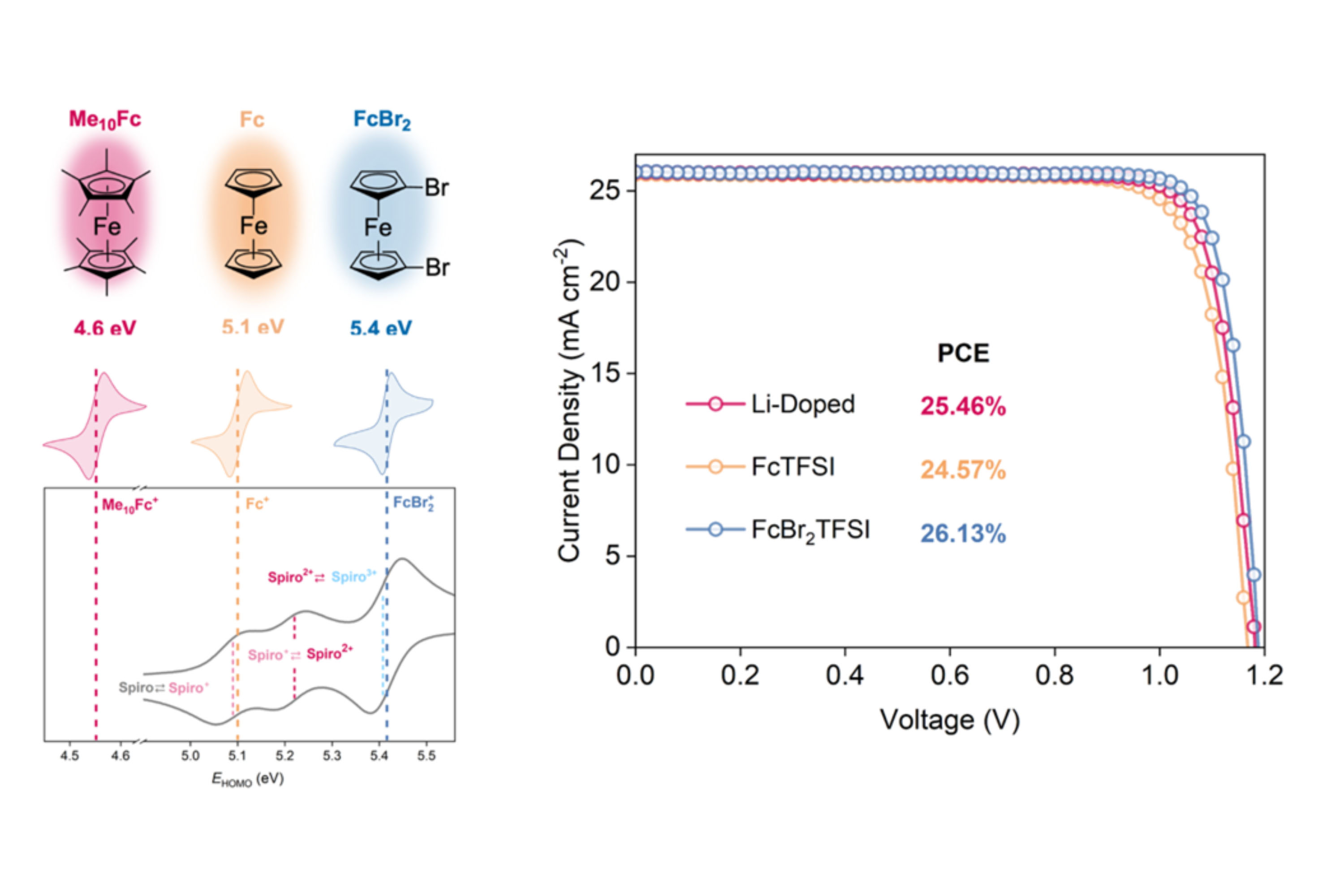
Opening new doors for next-generation photovoltaics
The discovery strengthens Imperial’s position at the forefront of perovskite research and highlights the important role that synthetic chemistry can play in advancing renewable energy technologies. With the new dopants offering a less volatile and more scalable alternative to traditional additives, the work provides a promising route toward durable and commercially viable perovskite modules.
The team is now exploring how the ferrocene-based dopants behave in larger area devices and under real-world operating conditions. These include device applications in organic light-emitting diodes and photodetectors, with Imperial Chemistry collaborator Dr Nicola Gasparini. These steps are essential for translating laboratory breakthroughs into commercially relevant technologies.
Article text (excluding photos or graphics) © Imperial College London.
Photos and graphics subject to third party copyright used with permission or © Imperial College London.
Article people, mentions and related links
Saida Mahamed
Faculty of Natural Sciences

- Nanoscale soft interaction-engineered perovskite heterojunctions for highly efficient and reproducible solar cells
- Complex formation of ferrocene derivatives with electron transport layers enables improved performance and photostability in organic solar cells
- Modulating Perovskite Surface Energetics Through Tuneable Ferrocene Interlayers for High‐Performance Perovskite Solar Cells
- Ferrocene Derivatives Enable Ultrasensitive Perovskite Photodetectors with Enhanced Reverse Bias Stability
- Highly Efficient and Scalable p-i-n Perovskite Solar Cells Enabled by Poly-metallocene Interfaces