
Health
by Emily Govan
/prod01/channel_4/imperial-news/media/news-images/3000X2000-main-article-images/Cuckoo---Joe-Tobias.jpg)
Human-driven changes to landscapes worldwide are ‘thinning out’ the ecological services supplied by wild birds, eroding the functions that support stable and resilient ecosystems.
A new study led by Imperial College London researchers in the Department of Life Sciences, Silwood Park, shows that land-use change is undermining ecosystem stability by reducing the functional diversity of bird communities.
Published in Nature, the research compiled data for nearly 3,700 bird species from 1,200 sites across the world, revealing that habitat modification, such as urbanisation and agricultural expansion, reduces the number of species performing vital ecological roles including pollination, seed dispersal and predation.
In natural communities, these essential services are performed by multiple different species, a concept known as functional redundancy. Redundancy provides crucial ‘insurance’ for ecosystems, offering back-up when individual species decline or are lost altogether. When ecosystems contain many species performing similar ecological roles, they are more resilient to disturbance.
Using computer-based extinction simulations, the team showed that land-use change removes this buffer, leaving ecosystems increasingly vulnerable to future biodiversity loss.
Lead author Thomas Weeks, a PhD student in the Department of Life Sciences, said: ‘The decline in bird diversity after land-use change is well known, but until now it was generally thought that enough different types of birds survived for those degraded ecosystems to continue functioning as required. Our analyses challenge that idea by showing that humans modify landscapes in a way that tends to remove all the slack in the system, meaning that any future environmental shocks can potentially cause a collapse of the essential services provided by wildlife.’
"Our analyses show that humans modify landscapes in a way that tends to remove all the slack in the ecosystem, meaning that any future environmental shocks can potentially cause a collapse of the essential services provided by wildlife." Thomas Weeks Lead author
Drawing on detailed information about bird species, including diet, body size, beak shape and wing shape, the researchers assessed how birds contribute to ecological functions. They found that disturbed habitats tend to be dominated by relatively few disturbance-tolerant species occupying similar ecological niches. As a result, overall functional diversity declines and key roles may be left unfilled.
This simplification of ecological networks can trigger cascading effects, including reduced forest regeneration, diminished carbon storage and the proliferation of crop pests.
Importantly, the study shows that even when species richness and functional diversity remain relatively high, a loss of functional redundancy leaves ecosystems exposed to global change impacts. These patterns were consistent across the globe, from tropical forests to polar environments.
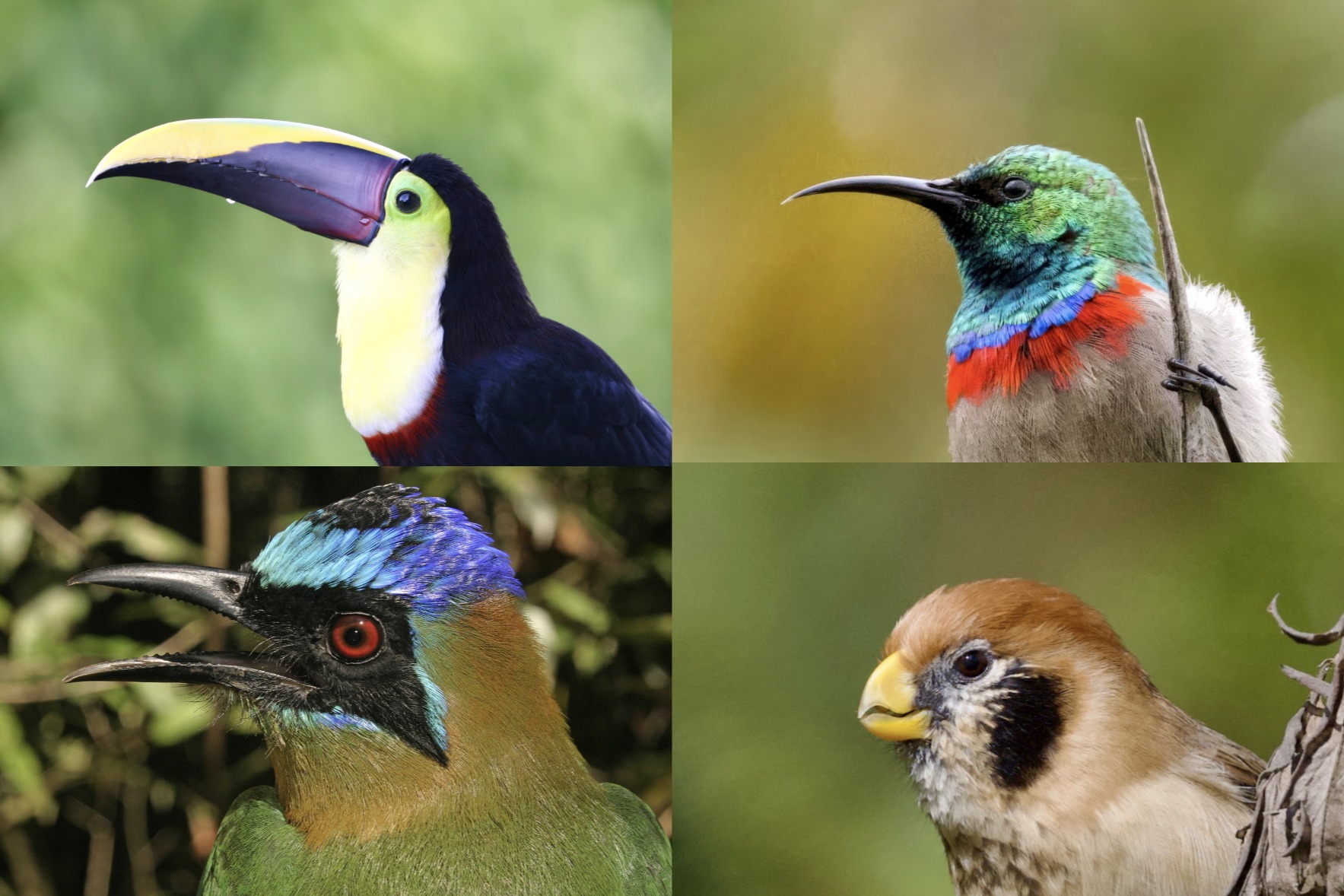
Spectacular variation in beak design provides information on the ecological roles and functions of birds, such as seed dispersal, pollination, and predation. The authors use measurements of all bird species – including toucans, sunbirds, motmots and parrotbills – to estimate impacts of land-use change on ecosystem resilience. Photos credit: Professor Joe Tobias
Senior author Professor Joseph Tobias, from the Department of Life Sciences, said: ‘With land-use change accelerating worldwide, our study highlights the urgency of managing and preserving functional diversity to ensure that future ecosystems continue to function in ways that help to support human life and economic stability.’
The study presents a new framework for assessing ecosystem vulnerability, offering techniques to guide conservation efforts. By focusing on the vital roles species play within ecosystems, policymakers can identify risks and safeguard ecological stability for the benefit of wildlife and people.
Article text (excluding photos or graphics) © Imperial College London.
Photos and graphics subject to third party copyright used with permission or © Imperial College London.
Faculty of Natural Sciences

Health

Health

Campus and community

Science
Cross-faculty
Health
Engineering
Discover more Imperial News
Search all articlesDiscover more Imperial News
Search all articles