Researchers call for urgent action on ecological feedbacks in Earth system science
by Emily Govan
/prod01/channel_4/imperial-news/media/news-images/3000X2000-main-article-images/forest-ecology-review.jpg)
A new review shows that ecological feedbacks, the ways that living organisms shape and respond to their environment, are essential for regulating the planet’s climate, chemical cycles and ecosystem stability, yet these processes are often overlooked in current research and modelling.
The new review from Imperial's Department of Life Sciences, published in Earth’s Future, brings together evidence showing how ecological feedbacks regulate climate, chemical cycles and ecosystem stability. Yet they are often missing or simplified in Earth System Models, the computer simulations scientists use to predict climate and ecosystem change.
Lead authors Dr Emma Cavan and Dr Jess Williams from the Imperial Department of Life Sciences, and Professor Eugene Murphy from the British Antarctic Survey, say this knowledge gap risks underestimating how climate change and ecosystem degradation could trigger rapid and potentially irreversible changes across the globe, making urgent research and integration of ecological feedbacks essential.
Ecology at the core of Earth system functioning
From forests regulating carbon uptake to marine plankton influencing atmospheric chemistry, organisms do not simply respond to environmental change, but actively shape it.
When these interactions form feedback loops, small disturbances can amplify or reduce environmental change. These feedback systems are increasingly disrupted by global warming, deforestation, pollution and biodiversity loss.
"The living organisms across our planet, from tiny soil microbes to enormous blue whales, are not background scenery, they are powerful forces whose behaviours and interactions with the physical and chemical world shape how our planet works." Dr Jess Williams Co-author
Dr Williams said: 'The living organisms across our planet, from tiny soil microbes to enormous blue whales, and from vibrant coral reefs to the vast Amazon rainforest, are not background scenery, they are powerful forces whose behaviours and interactions with the physical and chemical world shape how our planet works. Recognising ecological feedbacks as central drivers is essential if we’re to understand and prepare for the rapid shifts unfolding in the Earth system'.
The team synthesised evidence across marine, freshwater and terrestrial ecosystems, showing that feedbacks operate across spatial and temporal scales, from microbes in soil to forests, rivers, oceans, and global carbon cycling. Rivers, for example, connect land and oceans and are full of life. Changes in one ecosystem can have knock-on effects in another. During the annual wildebeest migration in the Mara, for instance, many animals die while crossing the river, delivering large pulses of nutrients that support river food webs and influence nutrient cycling downstream.
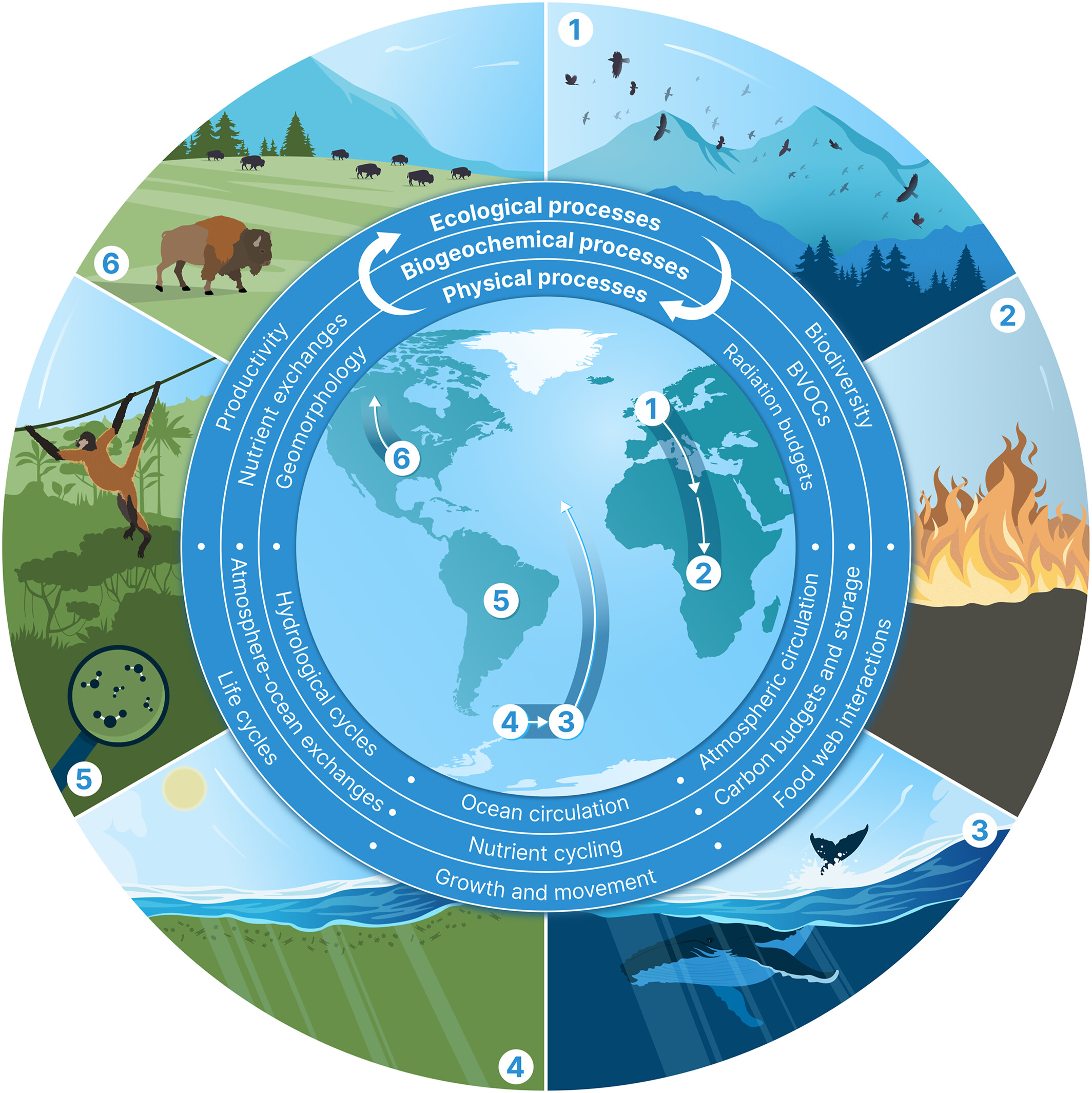
Examples of feedbacks involving interactions between ecological, biogeochemical, and physical processes at different scales in the Earth system (Figure 1 from the Review).
Addressing critical gaps in understanding
'Earth System Models are brilliant tools to predict future climate change - but it’s important that ecology and biological processing are appropriately represented, or we run the risk of inaccurate future projections of the state of our planet." Dr Emma Cavan Co-author
Despite decades of ecological research, the researchers identify a critical shortfall in understanding how ecological feedbacks interact across scales and influence tipping points, which are points where small changes can trigger sudden, large-scale shifts in ecosystems or climate. For instance, deforestation can alter regional climate patterns, potentially converting forests to savanna, while ocean species like copepods and krill migrate vertically and over winter in the deep, moving carbon in ways that could shift depending on warming and habitat changes.
Dr Cavan said: 'Earth System Models are brilliant tools to predict future climate change, capturing physics, chemistry and biology across the globe and multiple decades or centuries. Their vast scale means simplifications have to be made – but it’s important that ecology and biological processing are appropriately represented, or we run the risk of inaccurate future projections of the state of our planet'.
The review highlights that ecological feedbacks are already being altered by climate change and human pressures. These changes could reshape how ecosystems respond to future warming, increasing the risk of unexpected or cascading impacts across regions and scales.
Integrating ecological feedbacks into Earth system models
Current Earth System Models underpin global climate projections and international policy advice, but researchers found that ecological processes are often simplified or omitted entirely.
To address these gaps, the international team highlight three priority actions. First, more ecological feedbacks need to be incorporated directly into global assessments and climate models. Second, feedbacks should be mapped across ecosystems and time scales to understand cross-scale interactions. Third, projections should be designed to inform policy and decision-making effectively.
The team also call for interdisciplinary modelling, expanded long-term monitoring, and the development of whole-ecosystem models that can be coupled with climate simulations, encouraging collaboration across terrestrial, freshwater, and marine ecological research communities, while integrating local and indigenous ecological knowledge to improve understanding of how feedbacks operate in real-world settings.
Advances in artificial intelligence and machine learning, alongside improved global data sharing, provide new opportunities to quantify complex ecological interactions at scale. Beyond technology, advances in inclusive science, including interdisciplinary collaboration and integration of local and Indigenous ecological knowledge, are essential for studying feedbacks across spatial scales.
Dr Cavan said: 'Using new powerful computational tools can help us observe patterns and feedbacks not possible with traditional statistical approaches. We must not lose sight though, of the need for more observations and experiments, particularly to measure rates (feedbacks) and not just states. There are known unknowns, but also unknown unknowns, it’s important we are able to identify soon processes that may have a large impact on the Earth System that we do not yet prioritise.'
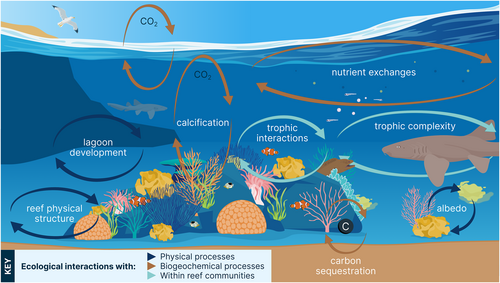
Examples of the diverse range of ecological feedbacks influencing the functioning of coral reef systems (Figure 2 from the Review)
Integrating ecological feedbacks into policy frameworks
The researchers emphasise that better integration of ecological feedbacks is essential for providing robust scientific advice to policymakers facing accelerating climate and biodiversity crises. Without improved understanding, projections may underestimate systemic risks and tipping points. Understanding ecological feedbacks also informs conservation and ecosystem management, from fisheries that recycle nutrients and sequester carbon, to managing wildlife movements such as the wildebeest migration that maintains nutrient flows into rivers.
The paper concludes that a systematic, scale-based approach that links terrestrial, freshwater and marine ecosystems is urgently needed to safeguard the ecological processes that sustain life on Earth.
Article text (excluding photos or graphics) © Imperial College London.
Photos and graphics subject to third party copyright used with permission or © Imperial College London.
Article people, mentions and related links
Emily Govan
Faculty of Natural Sciences