Study uncovers how bacteria load toxins into microscopic ‘speargun’
by Emily Govan
/prod01/channel_4/imperial-news/media/news-images/3000X2000-main-article-images/tiago-hospital-bacterium-1.JPG)
New research reveals how a hospital pathogen assembles its microscopic ‘speargun’, opening a new route to disarm infections.
Researchers from Imperial’s Department of Life Sciences working with Nanyang Technological University Singapore have uncovered how a dangerous hospital-associated bacterium loads toxic proteins into a microscopic ‘speargun’ used to attack other cells.
The discovery, published in Nature Microbiology, reveals a previously unknown step in how Pseudomonas aeruginosa builds this system and could point to new ways of disarming the bacterium without using traditional antibiotics.
Pseudomonas aeruginosa is a major cause of hospital-acquired infections and can be particularly dangerous for people with weakened immune systems or chronic lung diseases such as cystic fibrosis. It is also highly resistant to many antibiotics, making infections difficult to treat.
“We can now see, at near-atomic detail, how a bacterial toxin is physically captured and enclosed inside the building blocks of the T6SS. By understanding this mechanism, we not only uncover a fundamental principle of bacterial cell biology but also identify new ways in which these systems might eventually be disrupted or repurposed.” Dr Tiago da Costa
The bacterium survives by using a molecular injection system known as the Type VI Secretion System. This acts like a spring-loaded spear, firing toxic proteins directly into competing microbes and human cells to gain a survival advantage.
Until now, it was not clear how the bacterium selects and packs multiple toxic proteins into it before firing. The new study shows that the weapon is assembled in a highly organised, stepwise process, in which toxins are bundled into structured units and incorporated directly into the growing injection system.
This fills in a missing step in how the system is built, showing that the bacterium does not simply load toxins into a finished device, instead it constructs the firing system around its toxic cargo.
The researchers found that this allows multiple toxins to be packaged together and delivered in a single strike, giving the bacterium the ability to attack different targets at once and increasing its effectiveness during infection.
Working with colleagues at NTU Singapore, the Imperial team used high-resolution imaging and biochemical methods to reveal how this packaging process is coordinated inside the bacterial cell.
Co-leader of the study, Dr Tiago Dias da Costa from the Department of Life Sciences, said: ‘What is exciting about this work is that we can now see, at near-atomic detail, how a bacterial toxin is physically captured and enclosed inside the building blocks of the T6SS.
High-resolution 3D images obtained from cryo-electron microscopy reveal that toxin loading is not a passive process, but a highly organised assembly pathway in which the secretion tube forms around its cargo. This gives us a molecular explanation for how P. aeruginosa prepares a cocktail of toxic effectors before firing them into competing microbes or host cells. By understanding this mechanism, we not only uncover a fundamental principle of bacterial cell biology but also identify new ways in which these systems might eventually be disrupted or repurposed.’
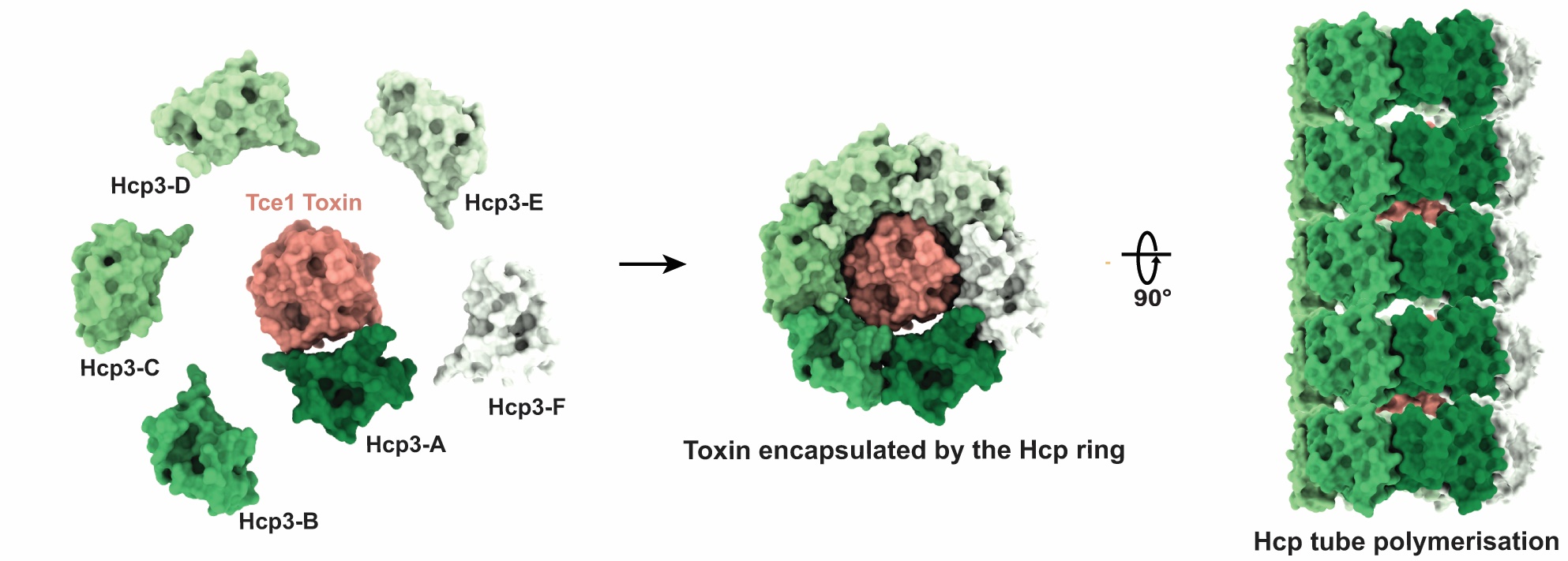
Six building blocks (in different shades of green) assemble one after another around the toxin (orange), wrapping it inside the growing structure. These loaded rings then stack together to form the tube used by the Type VI secretion system to deliver the toxin into target cells.
Professor Alain Filloux, co-leader from NTU-SCELSE, , said: ‘This bacterium does not just fire a single toxin. It loads a cocktail of toxins into a microscopic speargun and fires them in one strike, allowing it to attack different targets, including beneficial bacteria that normally live in the body, as well as the host’s own defence cells. This helps the bacterium colonise the host more effectively. If we can block this loading step in future, it could pave the way for approaches that disarm the bacterium and make it less able to cause disease.’
The findings suggest a potential new type of treatment strategy known as anti-virulence therapy, which aims to weaken pathogens rather than kill them outright. This approach could reduce the evolutionary pressure that drives antibiotic resistance, although further work is needed to test whether it can be developed into a clinical treatment.
By revealing how P. aeruginosa organises and delivers multiple toxins in a single attack, the study also provides new insight into how bacterial pathogens coordinate complex infection strategies.
The researchers say the next step is to understand how the system is switched on and controlled inside the cell, with the longer-term goal of identifying weaknesses that could be targeted in future therapies.
Beyond its medical relevance, the work improves fundamental understanding of how bacteria package and transport toxic molecules across the cell envelope, a process central to how many disease-causing microbes operate.
The research was supported by the UK Medical Research Council, the Wellcome Trust, the Singapore Ministry of Education, and Singapore’s National Research Foundation.
Article text (excluding photos or graphics) © Imperial College London.
Photos and graphics subject to third party copyright used with permission or © Imperial College London.
Article people, mentions and related links
Emily Govan
Faculty of Natural Sciences