
Health
/prod01/channel_4/imperial-news/media/news-images/3000X2000-main-article-images/fig2_stratocumulus_clouds-edit.jpg)
Imperial researchers uncover hidden nighttime effects of human activity and pollution on marine clouds.
Researchers from Imperial’s Department of Physics have uncovered valuable insights into how human activity is changing cloud behaviour, and in turn influencing the climate.
Their study reveals the impact of aerosols on stratocumulus clouds and how this varies significantly between day and night, a phenomenon largely unexplored in previous research.
The study was published last week in PNAS.
Clouds play a vital role in regulating Earth’s climate, and even small changes in their behaviours can have significant consequences.
At their core, clouds consist of countless tiny droplets, each formed from airborne particles called aerosols. These particles can come from natural sources but many are ‘secondary’ aerosols formed from chemicals emitted by human activities such as industrial emissions and vehicle exhaust.
Since the Industrial Revolution, aerosol levels have risen drastically, causing today’s clouds to contain more droplets than they did two centuries ago that are smaller in size. While previous studies have shown that clouds polluted with more aerosols behave differently, until now researchers have disagreed on where and how the effects are strongest. This knowledge gap has limited the accuracy of climate models.
By developing a new measurement method, the team revealed nighttime processes as a crucial part of the puzzle, helping reconcile previous studies and improve future climate predictions.
Stratocumulus clouds are vast low-lying formations that cover large areas of the world’s oceans. The team focused on them because of their critical role in regulating Earth’s temperature by reflecting sunlight during the day and trapping heat at night. Scientists believe they are also particularly vulnerable to pollution as they sit close to the Earth’s surface.
Often forming near coastlines, these clouds gradually break up as they drift out to sea – a process scientists believe is strongly influenced by rainfall. However, when aerosol levels rise, droplets in these clouds become smaller and collide with each other less effectively, resulting in less precipitation. This reduces rainfall, slows the breakup process and allows the clouds to persist for longer.
Stratocumulus clouds follow a diurnal cycle, meaning their behaviour changes between day and night. Yet most studies up to now have focussed on daytime conditions as clouds are easier to observe in visible light. This approach, however, only told half the story.
“Like people, the clouds’ state in the morning has a strong influence on their daytime behaviour.” Co-author Dr Edward Gryspeerdt, Associate Professor of Atmospheric Physics at Imperial said, “It is processes that happen during the night that set [these states].
“Getting this right is vital if we want to accurately simulate the human impact on climate with climate models.”
Like people, the clouds’ state in the morning has a strong influence on their daytime behaviour. It is processes that happen during the night that set [these states]. Dr Edward Gryspeerdt Associate Professor of Atmospheric Physics
To understand this difference, the team used satellites and computer models to track clouds over several days, focussing their observations at the beginning and end of the night. By using infrared sensors, the satellites were able to capture cloud formations during these critical nighttime windows when visible light isn’t available.
Computer models complemented the satellite data, simulating cloud movements and aerosol interactions throughout the day-night cycle. This method allowed researchers to observe the nighttime behaviours of clouds firsthand.
Contrary to previous assumptions, the team discovered that aerosols don’t stop clouds from breaking up during the day. Instead, their biggest impact happens overnight. During this time, polluted clouds come back together after splitting apart, making them thicker and brighter by morning. While aerosols do slow the cloud breakup process, they do so by helping clouds recover at night rather than directly stopping the breakup.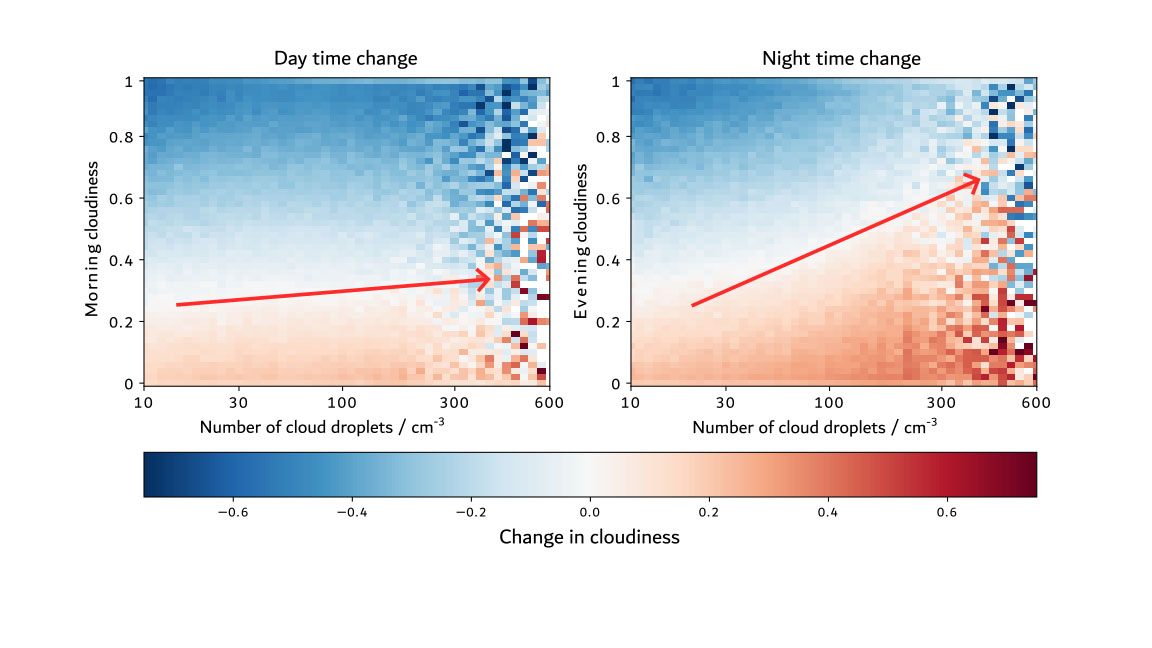
The red arrow below shows the point at which cloudiness goes from increasing to decreasing (red to blue). During the nighttime this is much more sensitive to the number of cloud droplets compared with the daytime (highlighted by steepness of the line; Pugsley et al, 2025)
These insights mark a pivotal step in improving climate models and reducing uncertainty about how pollution affects clouds. By understanding aerosol impacts across the full day-night cycle, scientists can more accurately predict future climate change and guide strategies on air quality and emissions.
Co-author Geoff Pugsley, Research Postgraduate in the Department of Physics, underscored the importance of continued research, explaining, “Our findings demonstrate the need to consider both day and nighttime cloud behaviour in order to build up a complete picture of cloud processes.
This is key to reducing uncertainty about how pollution affects clouds, and it’s something future climate strategies and cloud modification projects must take into account.”
Article text (excluding photos or graphics) © Imperial College London.
Photos and graphics subject to third party copyright used with permission or © Imperial College London.
Faculty of Natural Sciences

Health
.jpg)
Health

Cross-faculty

Health
Engineering
Imperial Global
Engineering
Discover more Imperial News
Search all articlesDiscover more Imperial News
Search all articles