Imperial instrument marks key milestone for ESA Comet Interceptor mission
/prod01/channel_4/imperial-news/media/news-images/3000X2000-main-article-images/ESA-resized.jpg)
Imperial College London’s magnetometer is part of the first flight instrument delivered for the European Space Agency’s (ESA) Comet Interceptor mission.
The FGM-B2 magnetometer, led by Imperial with a major hardware contribution from the Austrian Space Research Institute (IWF), is a key component of the Dust, Field & Plasma (DFP-B2) instrument on probe B2.
The DFP-B2 flight instrument was delivered this month to Spanish aerospace company Sener, which will build the probe. Essential post-transport tests were successfully completed on Thursday 14 May. This marks the first flight instrument delivery for the mission.
Exploring a pristine comet for the first time
Comet Interceptor, part of ESA’s Cosmic Vision programme, will be the first mission to explore a “dynamically-new” comet as it enters the inner Solar System. By targeting an as-yet undiscovered object, the mission aims to capture unprecedented data on material from the earliest stages of Solar System formation.
The mission comprises a main spacecraft A and two probes B1 and B2, enabling a multi-point measurement approach. This original approach will allow scientists to build a three-dimensional picture of the comet’s environment and better understand its interaction with the solar wind.
Professor Marina Galand, lead for the magnetometer on probe B2, said: “The magnetometer, designed to measure the magnetic field, is the only in-situ instrument present on all three spacecraft. This is very exciting, as it offers the opportunity to disentangle temporal from spatial variations and to build a 3D picture of the magnetic boundaries.”
Coordination between all three magnetometer teams - TU Braunschweig for spacecraft A, Kyoto University for B1, and Imperial College London for B2 - will be critical to maximise the mission’s scientific return.
Imperial’s role in a rapid-response mission
Comet Interceptor is ESA’s first rapid-response mission, designed to target a newly identified comet in space. Rather than launching towards a known target, the spacecraft will travel to the Sun-Earth L2 point and wait until a suitable comet is identified, potentially only a year before encounter.
This approach allows the mission to intercept a pristine object that has not been altered by previous passes near the Sun, offering rare insights into the early Solar System.
The Dust, Field & Plasma consortium, led by the Space Research Centre of the Polish Academy of Sciences (CBK PAN), is composed of research teams from Austria, Czech Republic, France, Germany, Italy, Sweden and the United Kingdom. It includes two multi-sensor instruments, DFP-A on spacecraft A and DFP-B2 on probe B2.
The FGM-B2 fluxgate magnetometer, part of DFP-B2, is led by Imperial in partnership with the Space Research Institute (IWF) of the Austrian Academy of Sciences and TU Braunschweig. The FGM-B2 activities at Imperial are funded by the UK Space Agency.
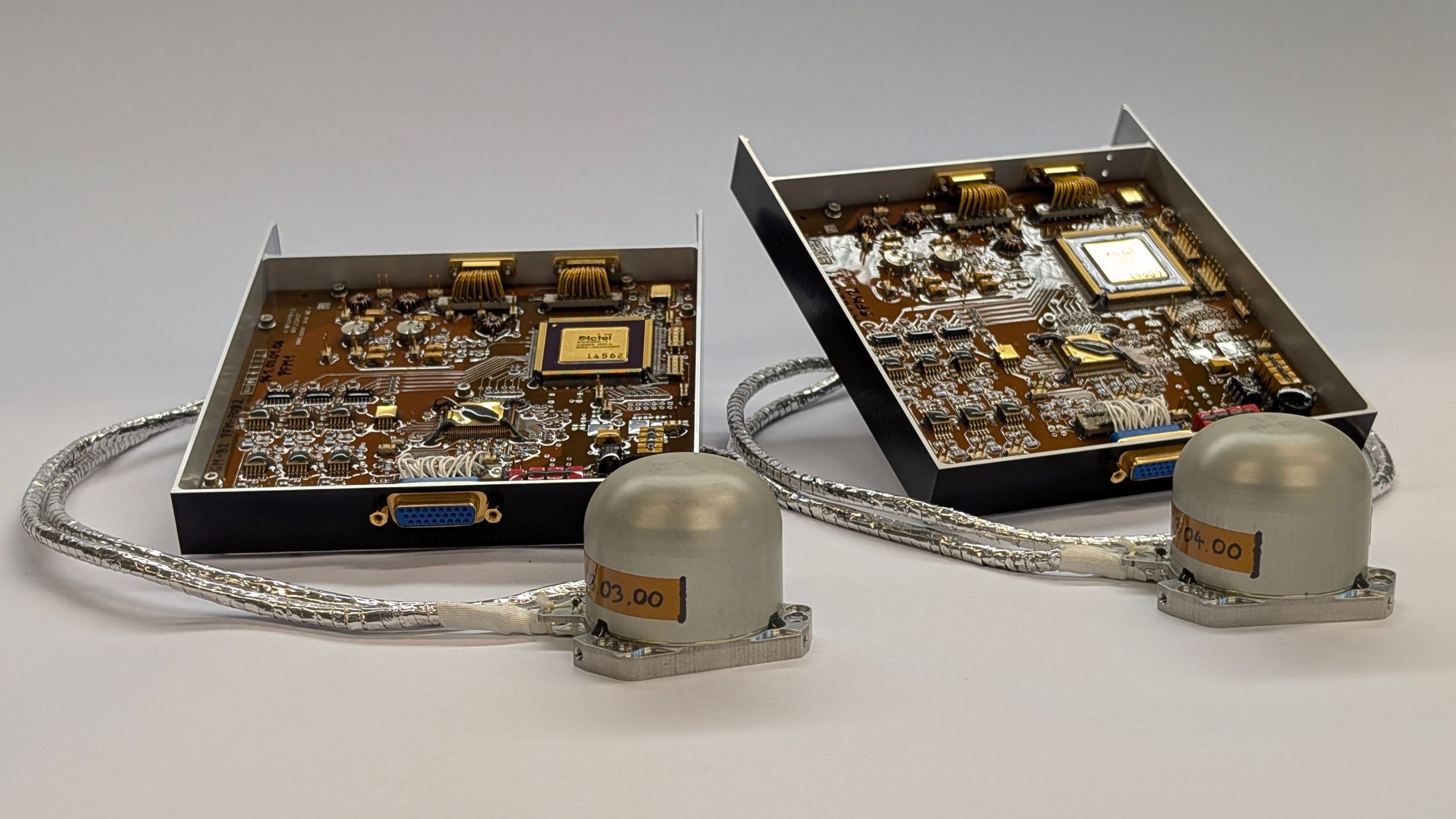
Imperial-led magnetometer for the Comet Interceptor mission. It includes the flight sensors and associated electronic boards (credit: IWF)
Emanuele Cupido, instrument manager, said “Each mission poses its own technical challenges which the instrument engineering team must overcome. Additionally, for Comet Interceptor, the first of ESA’s F-Class missions, we had to account for a shorter development cycle and lower budget cap.”
The next stage will see the instrument integrated onto probe B2 in summer 2026, ahead of environmental testing and final assembly with the main spacecraft.
A target yet to be discovered
The mission will target a long-period comet, ideally one entering the inner Solar System for the first time, although interstellar objects such as 3I/ATLAS are also possible candidates.
Comet Interceptor is unique in many ways. For one, it is very unusual not to know the target. Professor Marina Galand Professor in Planetary Science
Scientific teams coordinated by the University of Edinburgh are developing procedures to select a suitable target, alongside extensive observations for detecting potential candidates using facilities such as the Vera Rubin Observatory.
Professor Galand said, “Comet Interceptor is unique in many ways. For one, it is very unusual not to know the target.”
In preparation, the cometary team at Imperial has been developing and refining models of comet environments, building on expertise from ESA’s Rosetta mission.
The spacecraft will encounter its target close to Earth’s orbit, where heat from the Sun causes the comet’s ices to sublimate and form a cloud of gas and dust. This creates an obstacle in the path of the solar wind - a continuous stream of charged particles escaping the Sun - making it an ideal environment to study how comets interact with space plasma.
Professor Galand added, “Such a cometary environment represents a dynamic and exciting natural laboratory on a scale that cannot be reproduced on Earth. We are very interested in deciphering this interaction and understanding the physics at play.”
The mission is scheduled for launch on Ariane 6 rocket from Kourou, French Guiana, in 2028 or 2029.
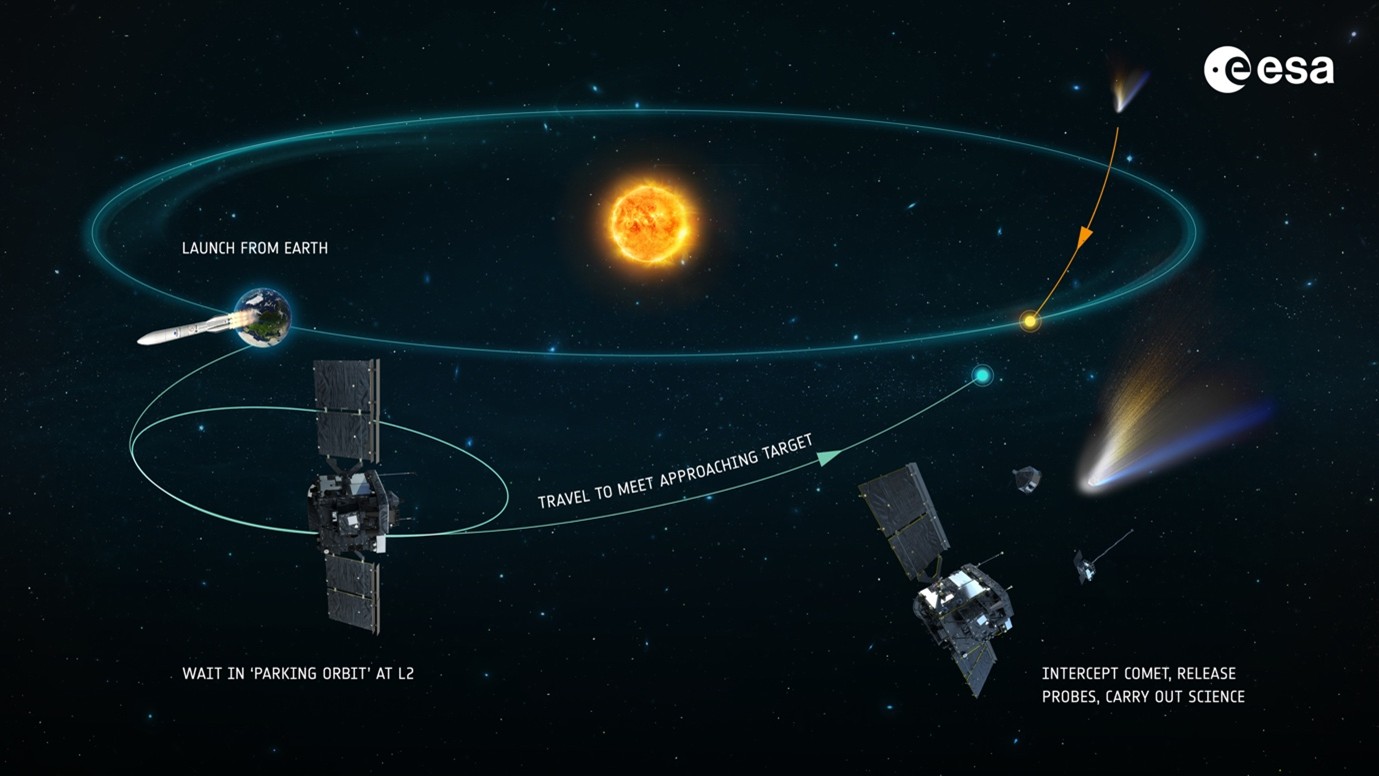
The journey of ESA Comet Interceptor mission from launch to parking at the Sun-Earth L2 point, thus transferring towards the comet and encountering it (credit: ESA)
Article text (excluding photos or graphics) © Imperial College London.
Photos and graphics subject to third party copyright used with permission or © Imperial College London.
Article people, mentions and related links
Eleanor Barrand
Faculty of Natural Sciences