
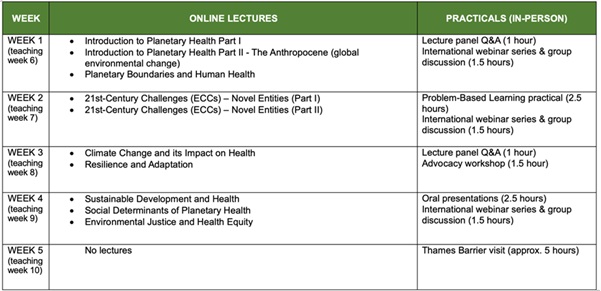
This module is divided into three parts, the module will first provide an overview of key planetary health concepts and give students an in-depth understanding of the underlying evidence and knowledge gaps for global environmental challenges, ranging from emerging chemicals of concern to climate change, and how these impact human health. It will then highlight links to the sustainable development goals and sustainability more widely, and strategies which promote resilience and support adaptation to environmental change.
A site visit to the Thames Barrier will provide a real-world example of adaptation to flood risk. In the final part, students will gain an understanding of the social and economic determinants which influence planetary health and the importance of equity. Throughout, students will hear a global perspective on planetary health challenges from international speakers, as well as learn how to communicate planetary health issues effectively in a policy space.
Module Aims and Learning Objectives
This module aims to provide students with an overarching knowledge of planetary health and its underlying environmental and social determinants, which they can apply to emerging and future challenges.
Intended Learning Outcomes (ILOs)
By the end of this module students will be able to:
- Recognise the interconnected nature of planetary health and its impact on public health.
- Apply a planetary health lens to various global environmental challenges, including climate change.
- Evaluate the social determinants that influence planetary health, including disparities in exposure to environmental risks and issues of environmental justice.
- Critically analyse adaptation case studies from real-world scenarios based on their ability to meet evolving challenges.
Dr Stephanie Wright is an Associate Professor in Environmental Toxicology in the Environmental Research Group, School of Public Health. She is also a member of the Medical Research Council Centre for Environment and Health. With a PhD in Biosciences, she has established a track record in microplastics and health research.
Dr Diana Varaden is an Assistant Professor in Environmental Social Science and Health in the Environmental Research Group with multidisciplinary skills in the fields of air pollution and social science. She is interested in interdisciplinary work bridging natural science, social and health disciplines and in identifying the benefits of involving lay individuals in the research process.
They both supervise research projects for masters programmes in the School of Public Health, teach on the BSc iSTEMM module ‘Creating Evidence-Based Solutions to Environmental Pollution and Health’, and are Fellows of Advance HE (Higher Education).
Module Leads
-
Dr Stephanie Wright
/prod01/channel_3/media/images/people-list/Stephanie-Wright-400X400.jpg)
Location
Sir Michael Uren Hub Building
White City CampusAffiliations
Environmental Research Group
-
Dr Diana Varaden
/prod01/channel_3/media/images/people-list/Diana-Varaden-400X400.jpg)
Location
Sir Michael Uren Hub Building
White City CampusAffiliations
Environmental Research Group
Module information
“The module was really interesting, and the module leads were very helpful in explaining concepts. I enjoyed the professional talks. The in-person one was particularly good”.
“The module explained the health and climate intersection very well and some of the guest speakers were great. Understood how important environmental justice is alongside mitigation and adaptation in relaying planetary health concerns/solutions”
Social media
Keep up to date by following us on our social channels
YouTube: Environmental Research Group


