COSMOS (Cohort Study of Mobile Phone Use and Health) is an international follow-up study investigating possible health effects from use of mobile phones and other wireless technologies. The study monitors the health of a large group of people over a long period of time to identify whether long-term use of mobile phones and other wireless technologies is associated with health conditions.
What is COSMOS?
- Why is this research being done?
- Who is behind the study?
- What is the history of the COSMOS study?
- How many people are taking part?
- Who funds the study?
- Additional Resources
Mobile phones have been widely used for many years, but both the technology and the ways in which people use their phones have changed rapidly. Despite extensive research, important questions remain about the potential long-term health effects of mobile phone use and other wireless technologies.
Many health agencies worldwide, including the World Health Organisation (WHO), have highlighted the need for robust, long-term studies in this area. Through COSMOS, we aim to provide reliable evidence to address these uncertainties and improve understanding of any possible long-term health impacts of mobile phone technologies.
In 2011, the International Agency for Research on Cancer (IARC) classified RF-EMF as possibly carcinogenic to humans [IARC 2011]. Early studies exploring possible links between mobile phone use and health outcomes, including brain tumours, often relied on retrospective reporting of phone use, which can introduce recall bias.
COSMOS helps address these limitations by using a prospective cohort design and, where participants’ consent, objective data from network operators. The WHO is undertaking a health risk assessment of RF-EMF to be published as a monograph in the Environmental Health Criteria Series. Many of the reviews conducted by the WHO are available in a special issue of Environment International [Verbeek et al Environ Int 2025]. COSMOS findings have contributed important evidence to the WHO assessment. Continued follow-up of COSMOS is essential to enable long-term surveillance of multiple health conditions and emerging RF-EMF technologies. This is because for some health conditions, such as cancers and neurodegenerative conditions, it may take many years for possible effects to become apparent.
The COSMOS study is led by researchers from institutions across Europe, including Imperial College London (UK), Karolinska Institute (Sweden), Utrecht University (The Netherlands), Institute of Cancer Epidemiology (Denmark), Tampere School of Public Health (Finland), and International Agency for Research on Cancer (France).
In the UK, the study is coordinated by the COSMOS team at Imperial College London within the National Institute for Health and Care Research (NIHR) Health Protection Research Unit (HPRU) in Radiation Threats and Hazards, held jointly with the UK Health Security Agency.
The UK arm of the International COSMOS Study (UK COSMOS) was established as part of the Mobile Telecommunications Health Research (MTHR) programme in 2010, funded jointly by government and industry, to investigate the possible long-term effects of mobile phone use on health.
Between 2009 and 2012, members of the public were invited to complete a baseline questionnaire about their health and the use of mobile phones and other wireless technologies. The questionnaire also collected information on factors that may influence health, including, sleep, lifestyle, environmental exposures such as air pollution and traffic noise ) and social and demographic factors.
Where participants’ provided consent, questionnaire data were linked to health registry records and mobile phone traffic data from the network operators. This data linkage is vital to provide us with objective measures of health and mobile phone use.
A follow-up survey was conducted in 2017 to track changes in mobile phone use, home addresses, and exposure to new wireless technologies, as well as changes in health and lifestyle.
A third questionnaire is now being undertaken to continue monitoring mobile phone use. This next phase will update information on participants’ mobile phone habits, including 5G use, social media, night-time phone use, and sleep. It will also collect data on lifestyle, symptoms, and mental and cognitive health.
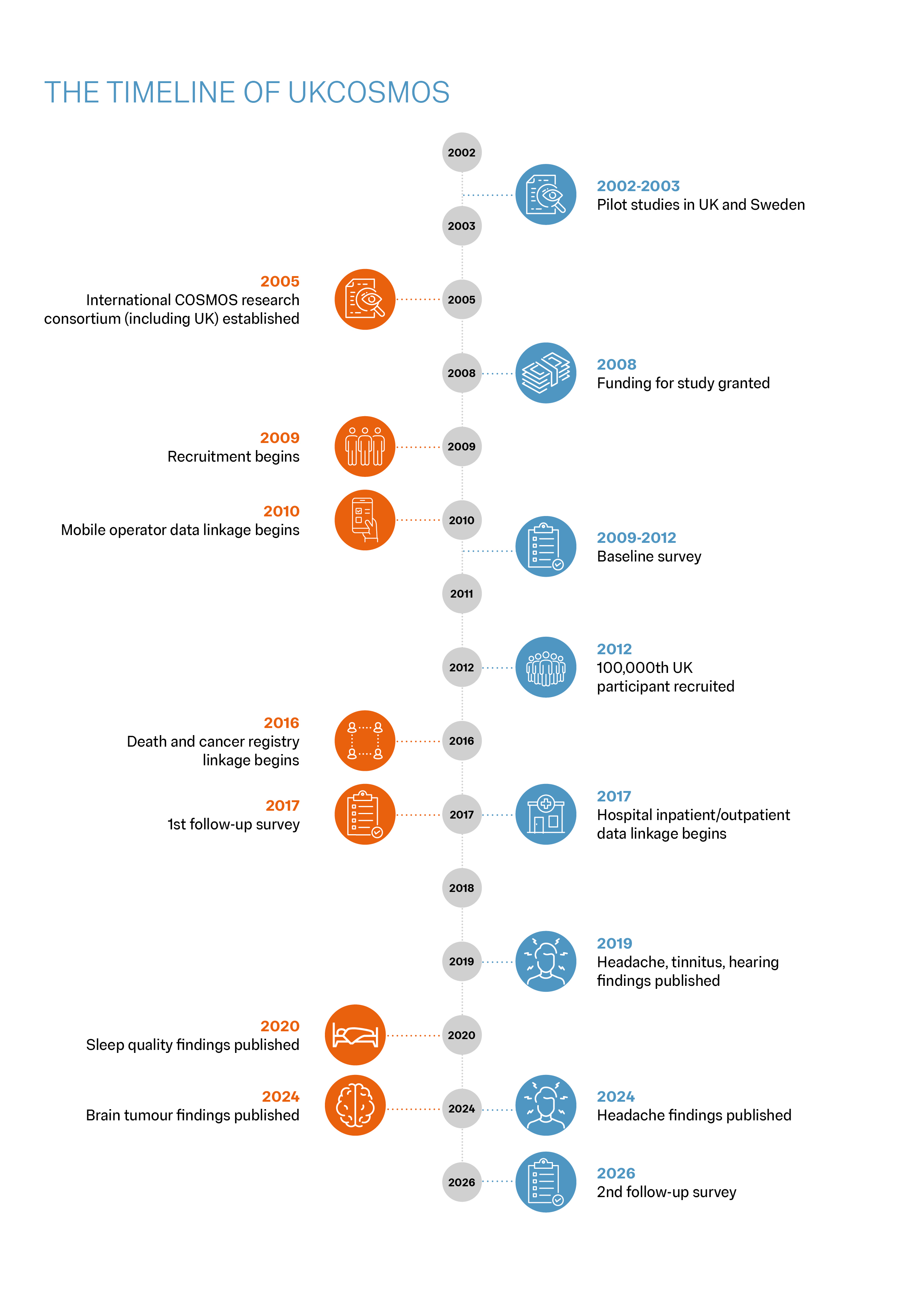
In the international cohort, approximately 300,000 people are taking part across Europe. The UK COSMOS cohort recruited 105,028 men and women aged 18 or older between 2009 and 2012 from across the UK. Participants were recruited from two main sources: 65% from mobile phone subscriber lists and 35% from the UK electoral register.
The participants in UK COSMOS are predominantly of White ethnicity (92%), with 53% being women. It represents a broad socioeconomic range, though the highest socioeconomic class is slightly overrepresented. Overall, the participants tend to be healthier than the general UK population, with lower rates of smoking and obesity. Mobile phone use varies across the cohort, and more than half of participants had been using a mobile phone for at least 15 years when they completed the first questionnaire (2009–2012). Most participants (97%) agreed to allow their records to be linked to health data sources, which helps provide reliable information on health outcomes over time. Further details about the cohort profile can be found in a published study here.
As noted above, the COSMOS Study was originally commissioned by the UK Department of Health and established as part of the Mobile Telecommunications Health Research (MTHR) programme (2001-2012) with joint funding from government and industry. UK COSMOS was subsequently funded by the UK Department of Health Policy Research Programme (PRP) (2014-2020) and received additional funding from the National Institute for Health and Care Research (NIHR) Health Protection Research Unit (HPRU) for Chemical and Radiation Threats and Hazards (2020-2025). UK COSMOS is currently funded through NIHR Policy Research Programme (2024-2026) and the NIHR HPRU in Radiation Threats and Hazards (2025-2030).
If you want to understand more about radiofrequency-electromagnetic fields (RF-EMF) mobile phone technologies and health, please refer to:
https://www.gov.uk/government/collections/electromagnetic-fields
WHO Special Issue in Environment International: