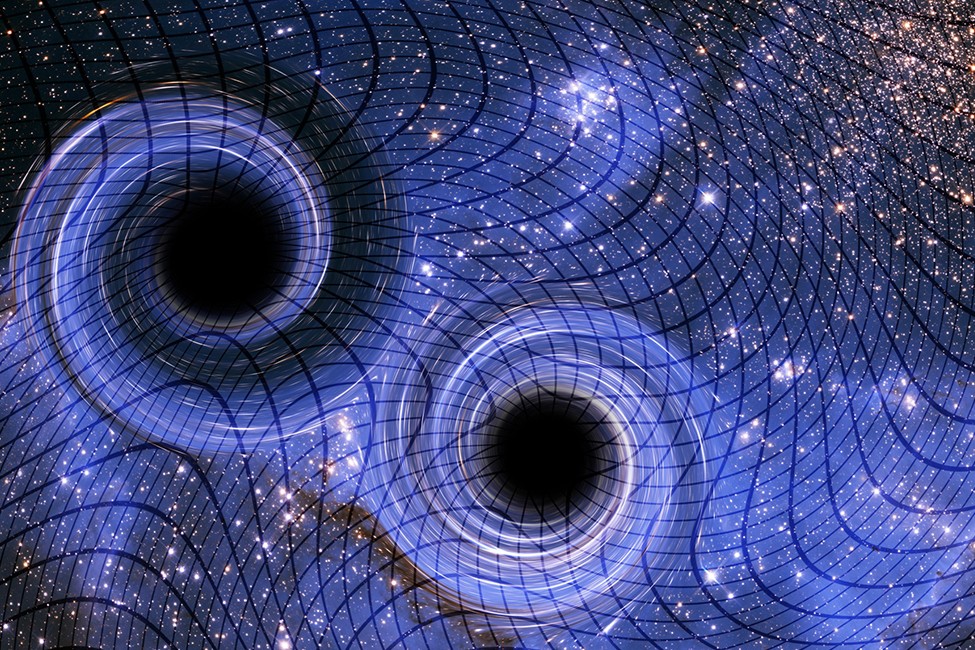
On 14 Sept 2015, the two detectors of the LIGO observatory registered a tiny ripple in spacetime: a gravitational wave produced by the merger of two black holes 1.3 billion light-years away. The signal lasted less than a second. It was the first direct detection of gravitational waves, confirming a prediction of Einstein's General Relativity made a century earlier, and it opened an entirely new window on the universe.
We are now in the era of gravitational wave astronomy. Dozens of binary black hole and neutron star mergers have been detected. Pulsar timing arrays have found evidence for a gravitational wave background permeating the entire universe. And the next generation of detectors, including the space-based LISA mission and the Einstein Telescope, promise to reveal gravitational waves from sources we have never seen before: supermassive black hole mergers, the early universe, and perhaps entirely new physics.
The Salam Centre is actively shaping the theoretical foundations of this new era, pioneering new test windows into the nature of gravity including atomic clock precision tabletop experiments, solar system tests and other astrophysical tests of fundamental physics.
The Gravitational Wave Background and Pulsar Timing Arrays
The Salam Centre works at the frontier of gravitational wave cosmology, developing theoretical frameworks for the stochastic gravitational wave background which encodes information about the early universe, including the physics of inflation, phase transitions, and cosmic strings and is inaccessible through any other observational channel.
The recent announcement by the NANOGrav, EPTA, PPTA, and CPTA collaborations opened a new chapter in gravitational wave astronomy, which directly relies on the theoretical work being carried out at the Centre.
Other sources of Gravitational Waves from the Early Universe
Some of the most exciting gravitational wave sources are cosmological: phase transitions in the early universe, cosmic strings, and preheating after inflation can all produce gravitational wave backgrounds with distinctive spectral shapes, which is directly relevant to the Centre’s work on non-perturbative QFT in the early universe. Studies by Members of the Salam Centre have shown how vacuum phase transitions during inflation and the dynamics of preheating provide theoretical predictions for the gravitational wave backgrounds that these processes would produce. The MoEDAL experiment at CERN is also exploring the possibility that magnetic monopoles, some models of which were pioneered by members of the Centre, if they exist, could leave distinctive signatures in gravitational wave detectors through their cosmological production history.
In parallel, the Salam Centre maintains strong connections to the Simons Observatory, SPIDER, LIGO-Virgo-KAGRA, and LISA collaborations, ensuring that the theoretical work derived at the Centre is directly connected to the observational frontier.
Testing Einstein's Theory with Gravitational Waves
The detection of gravitational waves is not just a confirmation of General Relativity, it is also a powerful tool for testing it and further testing fundamental physics. Do gravitational waves travel at exactly the speed of light? Do they have the polarization structure predicted by Einstein? Does the graviton have a mass? Does it interact non-minimally with the dark sectors of the Universe?
A key aspect the Centre is addressing is the development of a consistent theoretical frameworks for testing these questions with current and future gravitational wave observations, astrophsysical tests, solar system tests, cosmological tests and lab tests of gravity and fundamental physics. In particular the Centre explores how other polarizations of gravitational can be screened in dense environment or how gravitational waves would propagate differently from Einstein's prediction, for example, through gravitational rainbows (frequency-dependent propagation speed) caused by the mass of the graviton or by dark energy interactions. This has led to the development of new methods to construct exact solutions and test gravitational waveforms in modified gravity theories, providing a first proof of concept for multiband detections of gravitational waves.
Members of the Centre also explore how Galileons (scalar field theories that capture the essence of many theories of modified gravity) predict scalar gravitational radiation from binary systems such as binary pulsars or black hole mergers, in ways that are consistent with current observations but may lead to a fifth force imprint in future surveys. Leveraging on the Centre’s unique leadership in numerical gravity, numerical simulations in non-trivial theories of modified gravity are also being pioneered.
Testing Gravity in the Lab
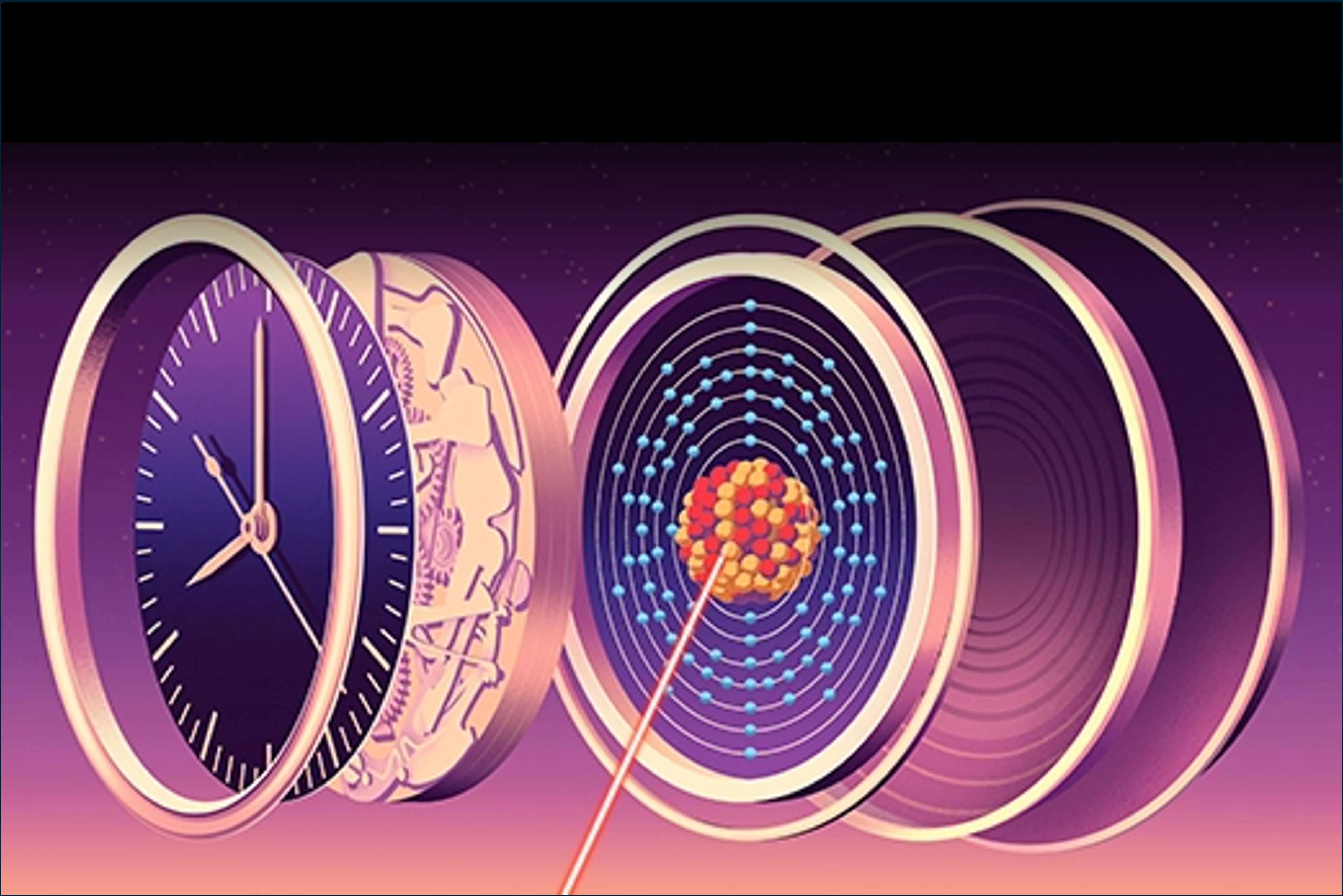 One of the most exciting new frontiers is the possibility of testing theories of modified gravity not just with telescopes and gravitational wave detectors, but with precision atomic clocks and atom interferometers in the laboratory.
The Salam Centre has joined forces with experimentalists from Imperial's Centre for Cold Matter — one of the world's leading centres in cold atom physics — and with the team leading the AION experiment (the Atom Interferometer Observatory and Network). Together, they are developing a systematic theoretical framework for how theories of modified gravity, dark energy, and dark matter leave signals detectable in atomic and molecular clock frequency comparisons.
Forecasts show that a new tabletop Optical Clock Platform being built at Imperial, which can compare an ultracold strontium optical clock with a CaF clock, could put constraints on the graviton mass of order to about 100 times the current Hubble parameter, stronger than current constraints from ESA's Microscope satellite and competitive with Lunar Laser Ranging. This represents a remarkable convergence of the most abstract theoretical physics with cutting-edge experimental technology, all within the walls of a single institution.