Abstract
Solar energy is an abundant renewable energy source that can help meet the rising global energy demand while reducing resource consumption and emissions. As a result, photovoltaic (PV) solar panels adorn roofs and fill vast sunlit fields. However, this technology can only convert a small part of the incident sunlight to useful electricity with the rest being lost to the environment as waste heat, a particular frustration when about half of global energy demand comes from keeping us warm.
Hybrid PV-thermal collectors, a solar technology whose outputs can include, beyond electricity, also heat, cold and even clean water are a potentially better solution. Yet their market is small due to performance limitations that are inherit in traditional designs. For this technology to become useful, fundamentally new design and innovation approaches are required.
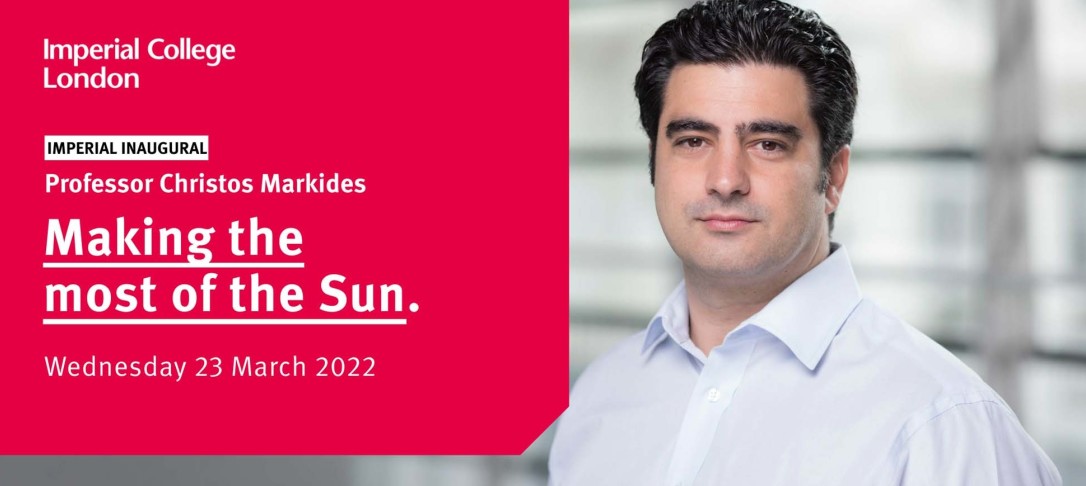
Christos Markides has been working on a new set of design principles for solar technologies based on optimising the true value of the solar energy resource. In his inaugural lecture he will discuss its application to hybrid PV-thermal systems, but also to anything that involves light or radiation capture and where overall efficiency improvements or cost reductions are sought.
Biography
Christos Markides is Professor of Clean Energy Technologies in the Department of Chemical Engineering of Imperial College London, where he heads the Clean Energy Process (CEP) Laboratory and leads the Energy and Environmental Engineering research theme. He is also the theme lead of the cross-faculty Energy Futures Lab’s Energy Infrastructure research theme. He is, amongst other, the Editor-in-Chief of journal Applied Thermal Engineering on the Editorial Board of the UK National Heat Transfer Committee, the Scientific Board of the UK Energy Storage SUPERGEN Hub and is a member of the Global Energy Association and the International Energy Storage Alliance.
He specialises in applied thermodynamics, fluid flow and heat transfer processes as applied to high-performance devices, technologies and systems for thermal-energy recovery, utilisation, conversion or storage. His research interests include heating, cooling and power, with a particular focus on solar energy and waste heat applications.
To-date, he has written close to 300 journal and more than 300 conference articles across this range of topics. Highlights include Applied Energy’s “Most highly cited original paper” award, which he won twice (2017, 2018), IMechE’s Donald Julius Groen outstanding paper prize (2016), IChemE’s Global award for “Best Research Project” (2018), the Engineers without Borders ‘Chill Challenge’ award in 2020, and Imperial President Awards for Teaching in 2016 and Research Excellence in 2017.
COVID-19 guidance
We are adopting a public health approach that we believe will keep our students and staff safe, and ensure that we can continue teaching, undertaking research and running events. Please take a look at our College webpages for more information.
We encourage all members of our community and visitors to continue wearing face coverings in most indoor settings on campus. Wearing a face covering is particularly important in crowded, enclosed spaces where you may come into contact with people you do not normally meet.
For the comfort and reassurance of all our guests we encourage guests to take a lateral flow test within 48 hours of the event. Rapid lateral flow tests can be ordered for free from the government website until 1 April.
To help control the spread of respiratory infections within the College and to keep our community safe, please do not attend this event if you or anyone in your household is showing symptoms.