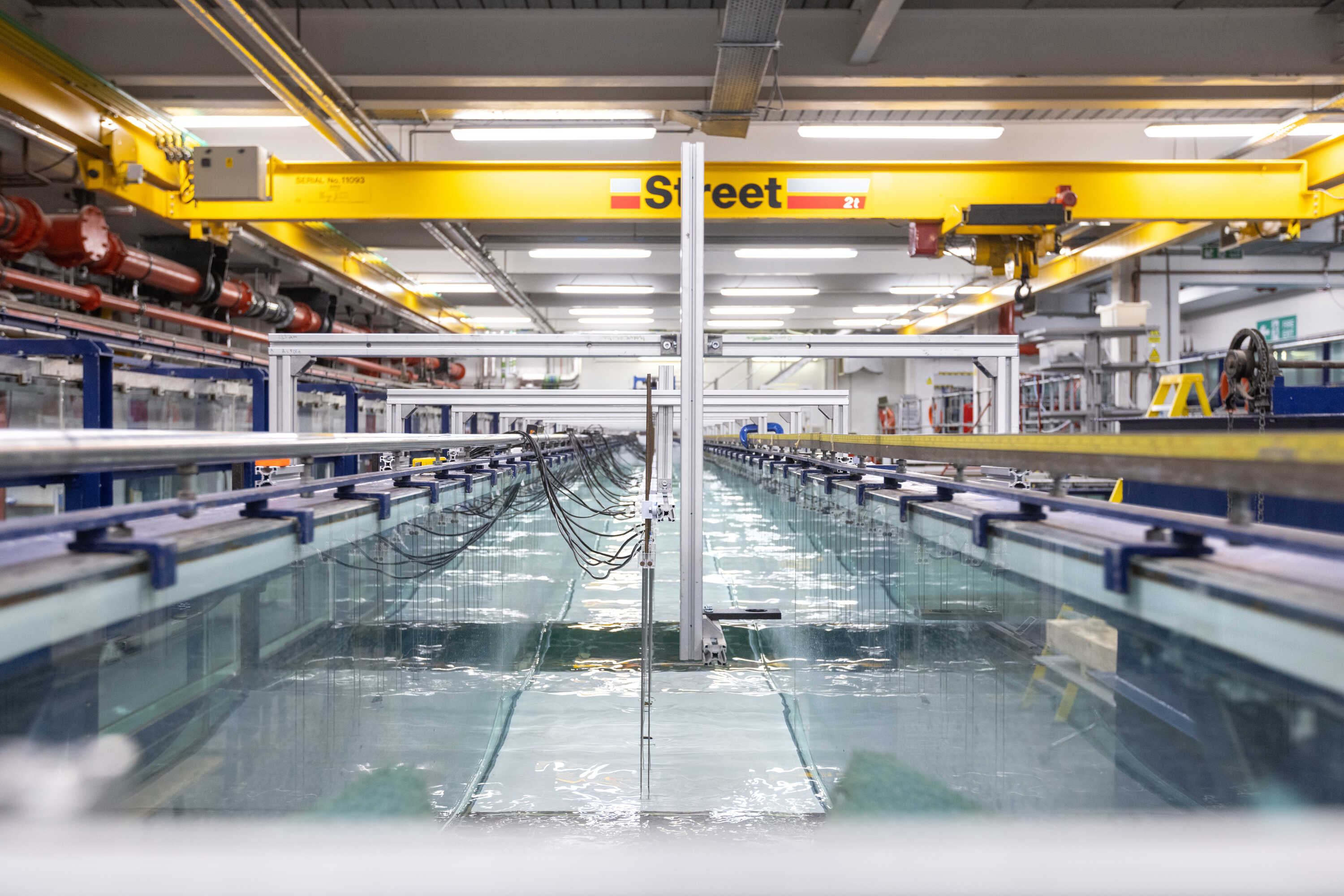
The coastal flume is a 23m long, 0.6m wide facility, designed to reproduce waves in intermediate and shallow water depths. The flume is equipped with a piston-type wave paddle and can be operated in a wide range of water depths (0.4-0.7m) and incident conditions (regular, random and custom). The wavemaker can accurately represent waves generated in the intermediate and shallow water depth regime and uses force-feedback, active absorption technology to minimise reflections. The waves can propagate over the original flat bed configuration or over custom built bed slopes of variable angles. At the downstream end, the waves are effectively absorbed by an adjustable, perforated beach which is enhanced by a 3D geotextile. Present research focuses on the accurate generation of random waves in the nearshore environment, the evolution of waves in finite water depths (nonlinear interactions and wave breaking), the design of coastal structures and sediment transport. Measurements that are typically performed in this flume include: water surface elevation at multiple location s along the flume, wave run-up and overtopping, forces and pressures on coastal structures, wave kinematics, wave breaking, sediment transport and beach evolution.

Find us on social media


Want to see more of our lab?
Contact Fluid Mechanics
Fluid Mechanics
Civil and Environmental Engineering
Skempton Building
Imperial College London
South Kensington Campus
London, SW7 2AZ
Telephone:
+44 (0)20 7594 5990
Email: r.naessens@imperial.ac.uk
Alternatively view our people lists
We are located in the Skempton Building (building number 27 on the South Kensington Campus Map). How to find us