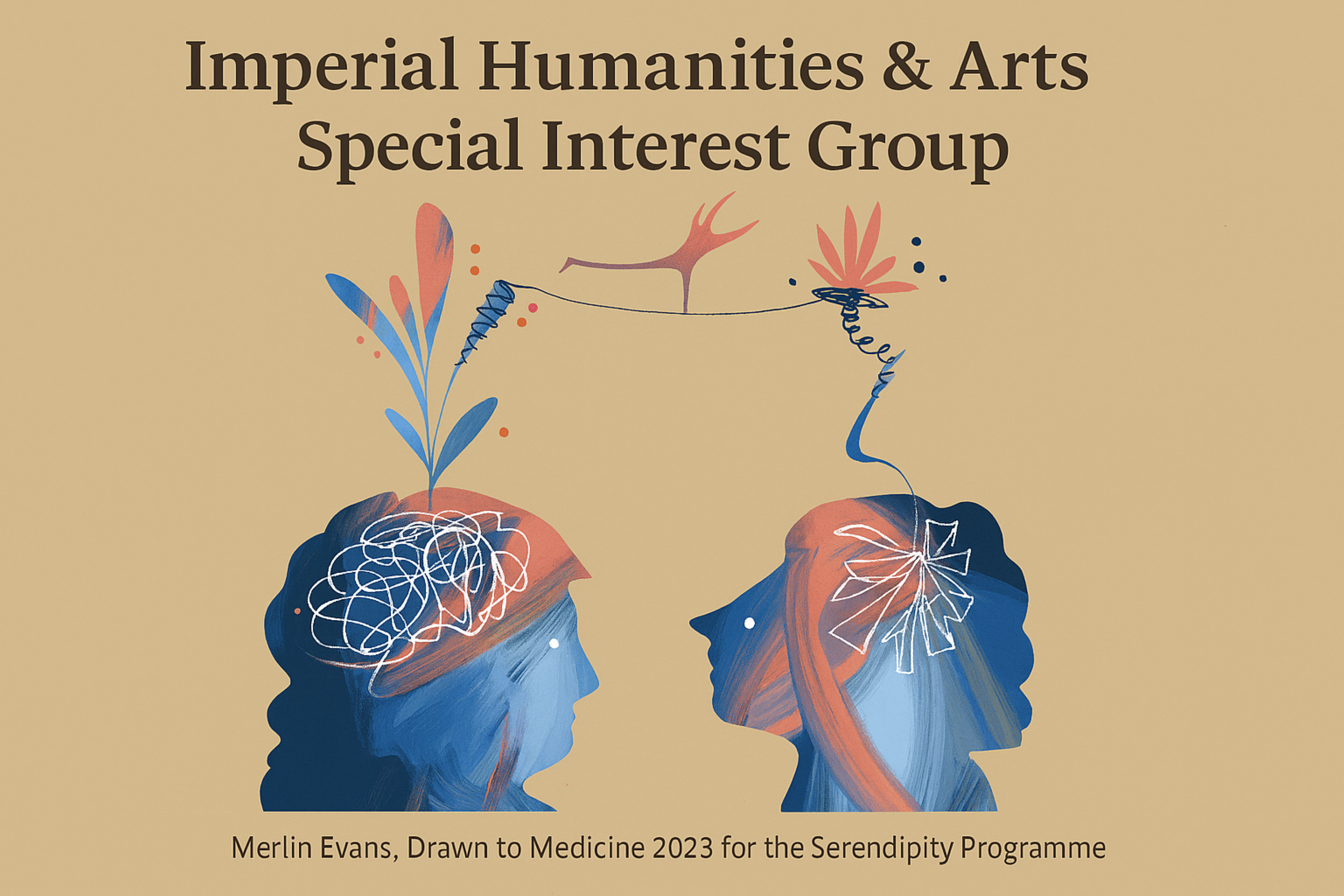
Humanities and the arts are fundamental expressions of human curiosity and creativity, our capacity for imagination, storytelling, reflection, analysis, and meaning-making.
This SIG aims to surface and connect ideas, expertise, and colleagues across Imperial, developing collaborations between the Humanities and STEM, while building a supportive and engaged community. We welcome contributions from anyone with a passion for the humanities or arts who wishes to channel it into wider impact, regardless of formal qualifications or roles in these fields.
This year, the SIG is co-led by:
-
Dr Michael Weatherburn, Centre for Languages, Culture and Communication
-
Dr Giulia Frezza, Centre for Performance Science and Department of Surgery & Cancer
Meeting Schedule:
The SIG will be primarily focused on a termly discussion seminar, with opportunities for combining different specialisms within the humanities and the arts, and between the humanities, arts and STEM.
Communication Channels:
Our primary communication platform is Microsoft Teams. Here, you'll find updates on upcoming events (General Channel).
If you would like to join the SIG, fill out the form here to be added to the mailing list. You will then be informed about future activities.
Meeting history 2026
Summary
'Humanizing the MIT Undergraduate Curriculum'
Professor Ros Williams outlined MIT’s historically evolving but often polarised relationship between science, engineering, and the arts, framed by a long-standing commitment to “broad humanism.” Founded in 1865 with Schools of Engineering, Science, and Architecture, MIT formally incorporated the humanities in the 1930s as a service division, a status reshaped after WWII by the influential Lewis Report (1947–49), which asserted that education should prepare students for life and emphasised the social and human consequences of science and technology. This led to the creation of the School of Humanities and Social Sciences (SHASS) in 1950, later explicitly incorporating the Arts, and today responsible for roughly a quarter of MIT’s undergraduate curriculum through the General Institute Requirements. Beyond SHASS, initiatives such as the MIT Human Insight Collaborative (MITHIC) and the Social and Ethical Responsibilities of Computing (SERC) reflect a shift toward “human-centred” research and education, supporting courses like the Compass subject, interdisciplinary labs, paid non-credit learning labs, prizes, fellowships, and community-driven projects addressing climate, AI, and computing ethics. The discussion highlighted ongoing experimentation with new institutional “containers” (such as the Schwarzman College of Computing), evolving language around the humanities, funding through ethically grounded philanthropy, and current pedagogical challenges including participation levels and assessment methods in the age of generative AI.
Recording
The next meeting summary will appear here.
Meeting history 2025
Summary
In our first meeting of the Humanities & Arts SIG, members introduced themselves and shared their interests and ambitions. We heard three talks: Giulia Frezza (SIG co-lead) on Imperial’s Serendipity Programme; Oliver Gooch, Director of the Blyth Centre for Music and Visual Arts; and Michael Weatherburn (SIG co-lead) on CLCC’s work, particularly I-Explore and Horizons. The group expressed strong enthusiasm for future collaborations. We aim to use the SIG to connect colleagues and raise the profile of humanities and arts initiatives across Imperial. Future meetings may involve external organisations, other STEM universities, and potential social events to strengthen our network.
The next meeting summary will appear here.
Sign Up
If you are interested in receiving the Learning and Teaching Newsletter, please email education.office@imperial.ac.uk .
You can also view the issue archive online.

