
Composing and producing music on computers
Module details
- Offered to Year 2 students
- Mondays, 16.00-18.00
- Planned delivery: On campus (South Kensington)
- Two-term module, worth 5 ECTS
- Available to eligible students as part of I-Explore
- Extra Credit, or Degree Credit where your department allows
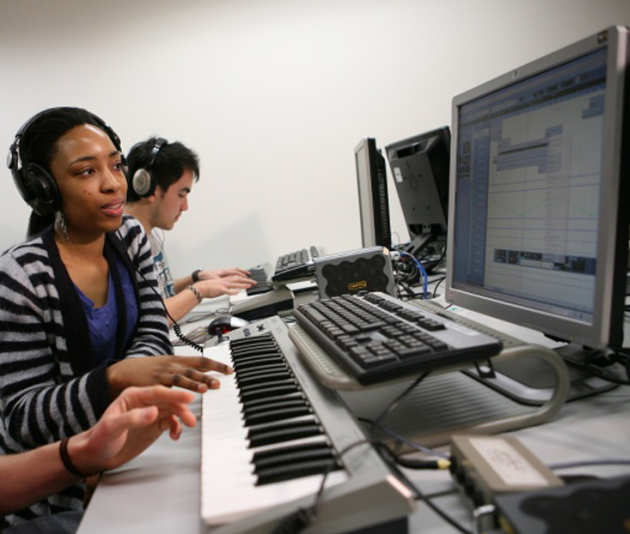
The Music Technology module offers you the opportunity to compose and create electronic music using state-of-the-art equipment.
The practical aspects of the module are embedded in a theoretical and analytical framework which encourages critical evaluation of contemporary music and its associated technology and an appreciation of the contributions made by the pioneering users of this technology.
The module combines skills acquisition with a high level of scholarship.
Restrictions on module selection: Please note that if you take this module in Year 2, you are not eligible to enrol on the Music Technology (Year 3 & 4) module during Years 3 or 4 of your degree.
Please note: The information on this module description is indicative. The module may undergo minor modifications before the start of the coming academic year.
Information blocks
 On completion of this module, you will be better prepared to:
- employ a wide range of music technology and compositional core skills;
- critically reflect on the cultural context in which these technologies were applied in the past, and are applied today;
- critically analyse musical repertoire;
- present creative ideas and judgement;
- demonstrate the ability to work both independently and as part of a group.
- The cultural contexts in which music technologies have been applied since c.1948.
- The theory and practice of audio/ MIDI sequencing.
- Physics of sound, human hearing and the basics of psychoacoustics.
- Digital audio, the audio interface and digital audio formats.
- The theory and practice of sound synthesis.
- The theory and practice of sampling: sample manipulation, using found sound, creating sampled instruments.
- The theory and practice of sound capture.
- Specific production techniques such as compression, equalisation, reverb and delay.
- Creative production techniques such as side-chain compression, bit reduction, saturation, resampling.
- Compositional analysis: noise, silence, musique concrète.
- The studio as a musical instrument.
- Interrogating assumptions about modes of musical production, genres, styles and audience expectation, in order to focus compositional intentions.
- Developing aural sensitivity and compositional assurance by the practice of active, analytical listening.
- Exploring approaches to arrangement and compositional structure.
We deploy an array of digital tools in this module:
- We use playlists as a teaching and learning tool.
- We use an online discussion tool to encourage your engagement.
- We allow and encourage you to borrow equipment such as midi keyboards, portable recorders and microphones, so that you can work independently outside the music technology lab.
All summative assessments are submitted through an appropriate Virtual Learning Environment (VLE).
At the start of the spring term, students receive written feedback in the VLE on their work-in-progress composition (their first submission) and this feedback is intended to inform their work on the completed version of the same composition, which they are expected to submit as one of the two compositions in their final portfolio - which is submitted at the end of the spring term.
It is permitted to submit two new compositions in the final portfolio (i.e. not completing the work-in-progress composition), as long as the student justifies this decision in the write-up of the final portfolio.
- Coursework: Work-in-progress portfolio (one composition of 3-5 minutes), plus PDF write up (300-600 words). (20%)
- Coursework: Final portfolio submission (two compositions of 3-5 minutes each), plus PDF write up (600-1200 words). (50%)
- Practical: Individual contribution to a 5-minute group presentation. (20%)
- Practical: Participation based on constructive class contribution, completion of soundwalk and soundwalk reflection, and good preparation. (10%)
In-progress music portfolio: Composition in MP3 format of 3-5 minutes duration, plus a write-up of 300-600 words in PDF format.
Final portfolio music submission. Two compositions in MP3 format, each of 3-5 minutes duration, plus a write-up of 600-1,500 words in PDF format.
Individual contribution to group presentation: You will be asked to prepare a PowerPoint or video presentation in which you will develop a critical analysis of a composition, selected from a list provided.
Participation is based on constructive class contribution, completion of soundwalk and soundwalk reflection, and good preparation.
- Requirements: You are expected to attend all classes and undertake approximately 85 hours of independent study in total during the module. Independent study includes reading and preparation for classes, researching and writing coursework assignments and preparing for other assessments.
- This module is designed as an undergraduate Level 5 module. For an explanation of levels, view the Imperial Horizons Level Descriptors page.
Module materials
Module materials will be accessible via Imperial's Library Services.
"Definitely the best module I have ever taken at Imperial. Challenging but very rewarding."
"I love this module, it's such a breath of fresh air from the regular STEM stuff. Very pleased imperial offer this as an option so thank you!"
"It's nice to learn about the progression of music technology and listening to experimental music is always an interesting experience."
"I really enjoyed the relaxed atmosphere of the classes. There was tremendous enthusiasm from each lecturer and the classes were very engaging."
"My favourite module I have ever taken by far. Balance of theory and application has made it so enjoyable and has opened me up to things I never knew existed. Happy to work for the assessments and the challenge is so rewarding."
