
Imperial is committed to reducing waste and moving towards a more circular economy.
Waste Directory - Dispose of something now...
The explains your responsibilities, what facilities are in place and how to dispose of your resources. Please check this when disposing of waste to ensure what you are doing is correct.


Contact us
Soft Services team (waste and recycling service)
Sonata Petrauskaite, Waste and Recycling Officer
+44 (0)7590 250 447
Waste and Recycling at Imperial
We generate many different types of waste, but our biggest waste streams are general waste, food waste, and dry recyclables (clean and dry paper, cardboard, glass, recyclable plastic). The diagram on this page shows our largest streams by mass (general, dry mixed recycling), the materials they contain (food, cardboard), and their end-of-life destination (incineration, recycling).
Where does our waste go?
Our food waste is taken to anaerobic digesters where it is used to generate green energy and a nutrient-rich digestate which is used as an agricultural fertiliser. Dry mixed recyclables are taken to a recovery facility in SE London, where materials are segregated, bailed, and sent on to reprocessors for recycling.
Even though glass and paper/card can go into the ‘Dry Mixed Recycling’ bin, we have some separate bins for these streams because we are charged a lower rate for single-material collections.
Our general waste is taken to SELCHP (South East London Combined Heat and Power) where it is incinerated with energy recovery. Although this returns energy to the grid, all the materials are lost which is a shame if they could have been used again.
About half of our waste is general waste, and about half of our general waste is recyclable material which could have gone on to have another life if it had ended up in the right bin! We are working to ensure that only non-recyclables end up in general waste, and that our non-recyclable waste generation shrinks year-on-year though changing procurement.
Waste and recycling at Imperial
Waste and Recycling at Imperial
Our Priorities
Imperial is committed to wasting less and moving towards a circular economy where materials are used for as long as possible.< We will achieve this by:
- by shifting our procurement away from single-use, non-recyclable items towards items which are designed for reusing, repairing and recycling, and;
- by improving engagement on waste and recycling (e.g. better bins and signage, circular economy fresks) to achieve better segregation of materials.
Together, these actions will cut the amount of waste we generate and ensure that, when we do generate waste, more products and materials will go on to have another life. Explore Imperial's Waste Initiatives on this web page.
Our Progress
In 2025, we have:
- Written a Waste Strategy, with quantitative targets and KPIs.
- Given our waste comms a new look, with a bolder design and clearer information to make recycling easier.
- Installed a new general waste compactor at South Kensington so we have better data on how much general waste we are generating.
- Undertaken a waste composition analysis to understand what was in our general waste (read about it in this story).
-
Run a successful coffee recycling pilot in Weeks Building in partnership with student group Re:Gen (watch the reel here), which we are now expanding to our Silwood Park Campus.
-
Set up coffee grounds recycling at South Kensington and Hammersmith Hospital Campus to divert coffee grounds from general waste.
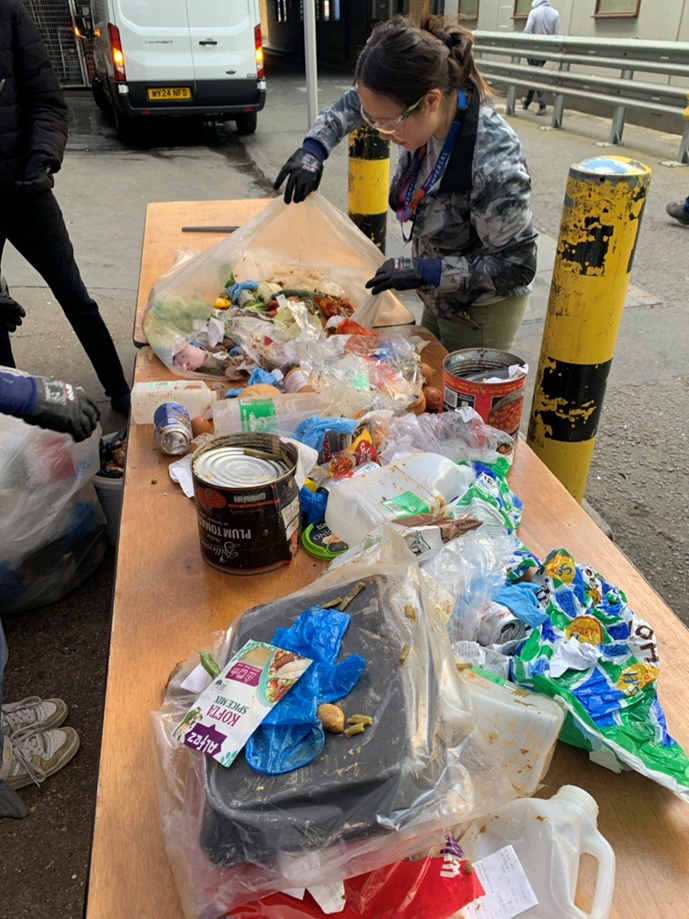
Dr Jasmin Cooper, Research Associate in the Department for Civil and Environmental Engineering, sorting general waste by material type in our waste composition analysis project.
Contact us
If you have any waste and recycling questions or suggestions, please contact Florence Hale, Waste and Recycling Manager, florence.hale21@ic.ac.uk or reach her on +44 7599 816 187.