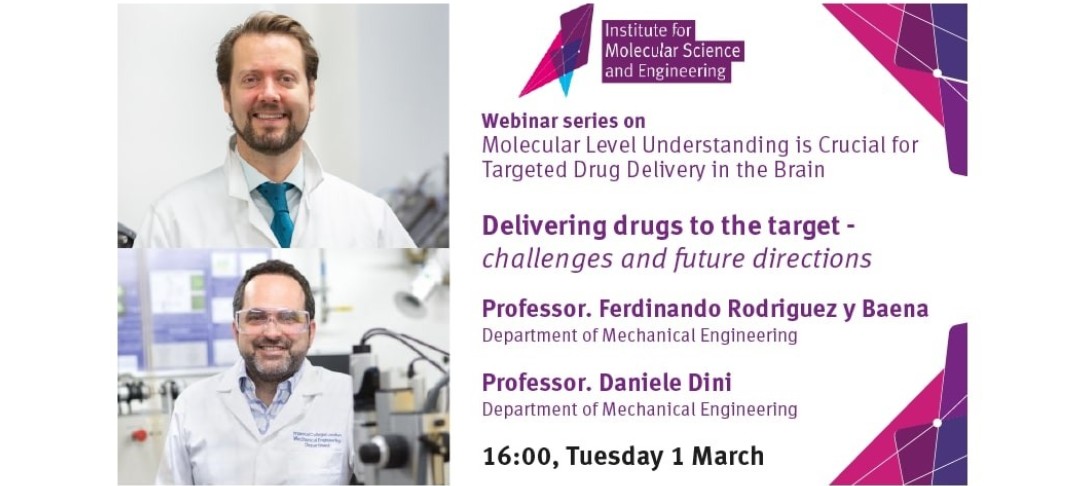
This webinar will be held on zoom. The structure of the event will be a presentation followed by audience Q&A. Please register to be sent the joining instructions. You can pre-submit questions for the Q&A section when registering.
This webinar is part of the series
Molecular Level Understanding is Crucial for Targeted Drug Delivery in the Brain
The theme discussed in this webinar will be:
Delivering drugs to the target – challenges and future directions
Biography
Professor Ferdinando Rodriguez y Baena
Faculty of Engineering, Department of Mechanical Engineering, Co-Director of Hamlyn Centre, Professor of Medical Robotics
Ferdinando Rodriguez y Baena is Professor of Medical Robotics in the Department of Mechanical Engineering at Imperial College, where he leads the Mechatronics in Medicine Laboratory and the Applied Mechanics Division. He has been the Engineering Co-Director of the Hamlyn Centre, which is part of the Institute of Global Health Innovation, since July 2020. He is a founding member and great advocate of the Imperial College Robotics Forum, now the first point of contact for roboticists at Imperial College.
His 20-strong team of staff and PhD students has a translational focus, though their work encompasses both “blue skies” research and “near-to-market” development. He is the Chair of the Programme Committee for the International Society for Computer Assisted Orthopaedic Surgery (CAOS International), CAOS UK, and the Hamlyn Symposium; He is also the founding Chair of the IET’s recently established Communities Committee for Technical Networks (CC TN), a Leverhulme Prize winner (engineering), a former ERC grant holder, and the coordinator of an €8.3M European project on robotic-assisted neurosurgical drug delivery (EDEN2020). He has published over 160 papers and secured in excess of £12M in research funding to date.
Professor Professor Daniele Dini
Faculty of Engineering, Department of Mechanical Engineering, Professor in Tribology
Professor Daniele Dini, FREng, D.Phil., CEng, FIMechE, FInstP, FSTLE and FHEA holds a post as a Professor in Tribology. Prior to joining Imperial College in 2006, and after receiving an M.Eng. in Mechanical Engineering from the Politecnico di Bari (Italy) in 2000, Professor Dini studied for a D.Phil. in the Department of Engineering Science at the University of Oxford (2004).
Professor Dini is Head of the Imperial College Tribology Group, one of the largest tribology groups in the world (about 60 full time researchers). Its mission is to perform world-leading research, support the application of tribology in industry and train the next generation of tribologists. In 2008 the Group was awarded the annual Imperial College Rector’s Research Excellence Award which recognises an outstanding research group in the College. He leads the advanced modelling research within the Tribology Group and collaborate closely with its experimentalists. His passion for research and mentoring has been recognised at Imperial College by a Medal in Research Supervision (2012) and two other Teaching awards. His current individual research portfolio supports a team of 16 researchers focused on studies related to the modelling of tribological systems and materials. Most of these projects are multidisciplinary and range from atomic and molecular simulation to the modelling of machine or biomechanical components. His industrial collaborators include: Afton Chemical, Bosch, BP, Caterpillar, Element Six, Ford, Rolls-Royce, Shell, SKF, Tenaris, Toyota, Volvo. He has academic partners at various institutions: Politecnico di Bari, Politecnico di Milano, Universities of Swinburne, Warwick, Cambridge, Oxford, Warwick, Modena and Reggio Emilia, Salento, Saarland, Michigan Ann Arbor, Sao Paulo, KIT, Lanzhou Institute of Chemical Physics.
Professor Dini’s research centres on the application of advanced modelling strategies to applied mechanics, materials, physics, chemistry, biomechanics and structural integrity, with a particular focus on tribology. It consists of three basic elements: (i) development of advanced numerical tools for the solution of tribological and related problems, including molecular dynamics simulations and fluid and solid mechanics solvers (ii) development of multi-scale strategies to couple molecular-, meso- and macro-scale solvers, (iii) application of advanced numerical tools, both at a fundamental level to understand the underlying mechanisms governing tribological behaviour and for practical use in design, troubleshooting and virtual testing. His work is published in major international journals in the fields of tribology, solid mechanics, computational and experimental material science, soft matter physics, physical chemistry and biomechanics. Professor Dini has published over 250 journal papers presented a number of keynotes and invited talks and contributions at conferences on these subjects in the last decade.
About The Institute for Molecular Science and Engineering
The Institute for Molecular Science and Engineering (IMSE) is one of Imperial College London’s Global Institutes, drawing on the strength of its four faculties to address some of the grand challenges facing the world today. The Institute’s activities are focused on tackling problems where molecular innovation plays an important role.
If you have any questions about accessibility requirements please email events.imse@imperial.ac.uk