PLEASE NOTE: This seminar is a hybrid event taking place in-person and online. You can choose to order an in-person ticket or a virtual attendance ticket when registering to attend.
For those attending in person, refreshments will be served immediately after this seminar in RSM 3.24 (Staff Common Room).
Title:
A tale of two motilities: adaptive locomotion in complex, changing environments
Abstract:
Natural environments are heterogeneous and can fluctuate with time. As such, biomechanical systems from proteins to whole organisms have developed strategies to sense and deal with considerable spatial and temporal variability.
I will discuss two (quite different!) broadly successful locomotive modes: flagellated motility in bacteria and walking in panarthropods. (1) A bacterium’s life can be complicated: it must swim through fluids of varying viscosity as well as interact with surfaces and other bacteria. We characterize the mechanosensitive adaptation in bacterial flagella that facilitates these transitions by using magnetic tweezers to manipulate external torque on the bacterial flagellar motor. Our model for the dynamics of load-dependent assembly in the flagellar motor illustrates how this nanomachine allows bacteria to adapt to changes in their surroundings. (2) Panarthropods are a diverse clade containing insects, crustaceans, myriapods and tardigrades. We show that inter-limb coordination patterns in freely-behaving tardigrades replicate several key features of walking in insects across a range of speeds and substrates.
In light of these functional similarities, we propose a simple universal locomotor circuit capable of robust multi-legged control across body sizes, skeletal structures, and habitats.
Biography:
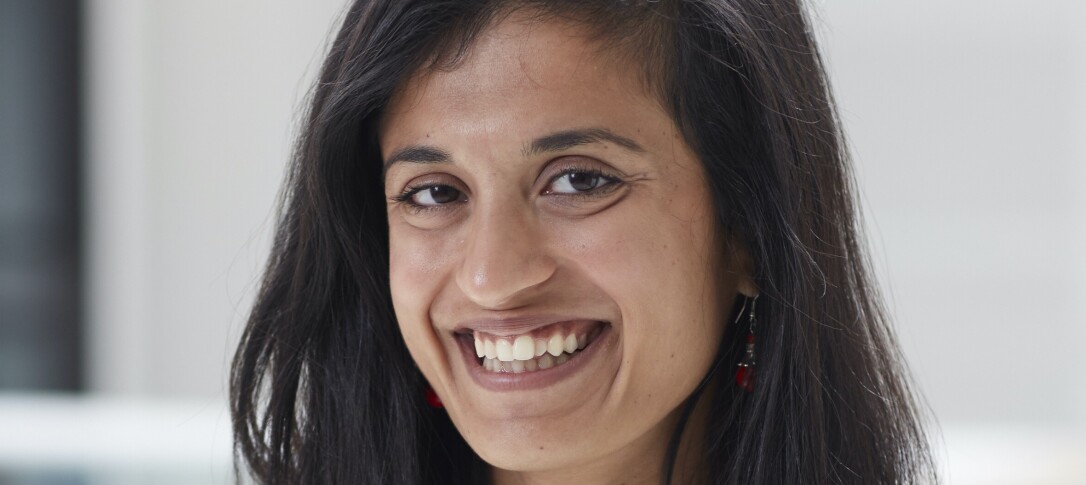
Jasmine Nirody is an Assistant Professor in Organismal Biology and Anatomy at the University of Chicago. She received a BA in Mathematics and Biology from New York University, and PhD in Biophysics from the University of California, Berkeley. Most recently, she was an Independent Fellow in Physics and Biology at The Rockefeller University and a Post-Doctoral Research Fellow of All Souls College, University of Oxford.
Her research sits at the interface of biophysics, behaviour, and evolution. She studies the physical interactions between organisms and their environments, and how these interactions shape organismal form and behaviour. Her work focuses on understanding morphology and performance within the context of an organism’s ecology and evolutionary history.
She has worked with a wide range of organisms, and her current research is grounded in (though certainly not limited to) two broadly-defined systems: flagellated bacteria and walking panarthropods.