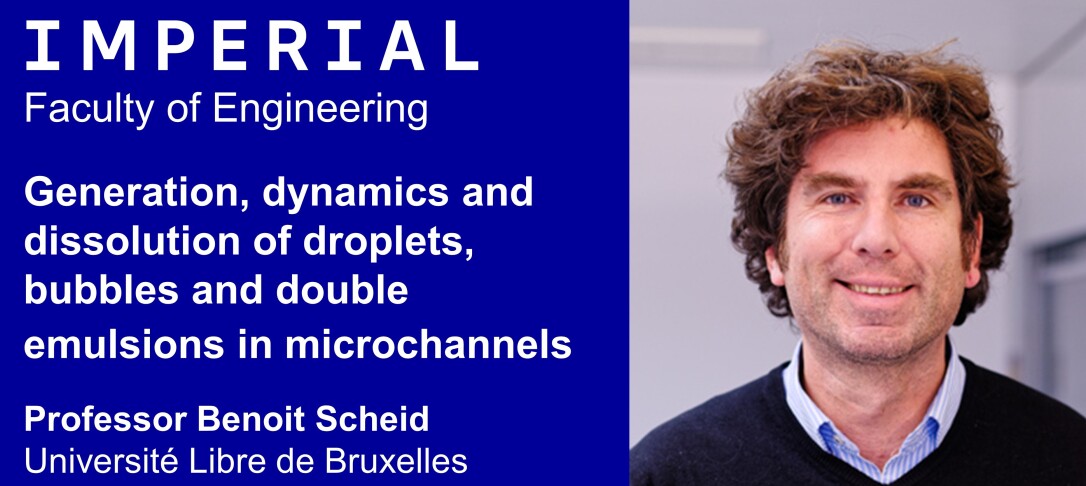
Join us for our upcoming Seminar. Discover the latest research in microfluidics aims at exploring the capabilities of lab-on-a-chips, i.e. developing chemical or biological processing at small-scale.
Abstract
We present a non-embedded co-flow-focusing device, called Raydrop, for single and double-emulsification in microfluidics. Experimental results demonstrate the universality of the device in terms of the variety of fluids that can be emulsified, as well as the range of droplet radii that can be obtained, without neither the need of surfactant nor coating. In a first part, a quasi-static model is developed and shows excellent predictive capability for the size of the droplets. Our results also demonstrate that the mechanism for the dripping-to-jetting transition in this quasi-static limit is intrinsically nonlinear and differs from the absolute-to-convective transition of the Rayleigh-Plateau instability for a jet. In a second part, we focus on the dynamics of droplets and bubbles in microchannels, and specifically on their equilibrium position and velocity, while assessing the influence of their deformability. We then present stability maps for the centred position showing that non-deformable objects dominated by inertial effects are only stable if large enough, whereas deformable objects dominated by capillary effects can be stable for much smaller sizes, except for intermediate viscosity ratios for which deformability also plays a destabilizing role, as for inertia. In a third part, we investigate mass transfer around bubbles and drops flowing in a cylindrical microchannel. We show different concentration patterns and the dependence of the Sherwood numbers for five different regimes in terms of the Péclet number. We finally show some practical examples of micro-encapsulation with double emulsions.
Biography
Benoit Scheid is FNRS Research Director and Professor at the Université Libre de Bruxelles (Belgium), where he got his PhD in 2004 on theoretical modelling of hydrodynamic instabilities. In 2005, he was awarded the Ilya Prigogine Prize for its PhD dissertation on dissipative wave patterns. In 2007, he got a postdoctoral research position at Harvard University, where he performed research on glass processing in collaboration with Saint-Gobain Research. He got an academic position in 2011 at ULB from the National Foundation for Scientific Research (F.R.S.-FNRS). His research aims at improving the current expertise in interfacial dynamics and surface rheology, and to make it unique in answering scientific and technological questions applying to material processing and microfluidics, with potential impact in material, pharmaceutical, chemical, biological and medical sciences. Professor Benoit Scheid is also co-founder, executive chairman, and scientific advisor of the company Secoya Technologies, active in production of pharmaceutical compounds.