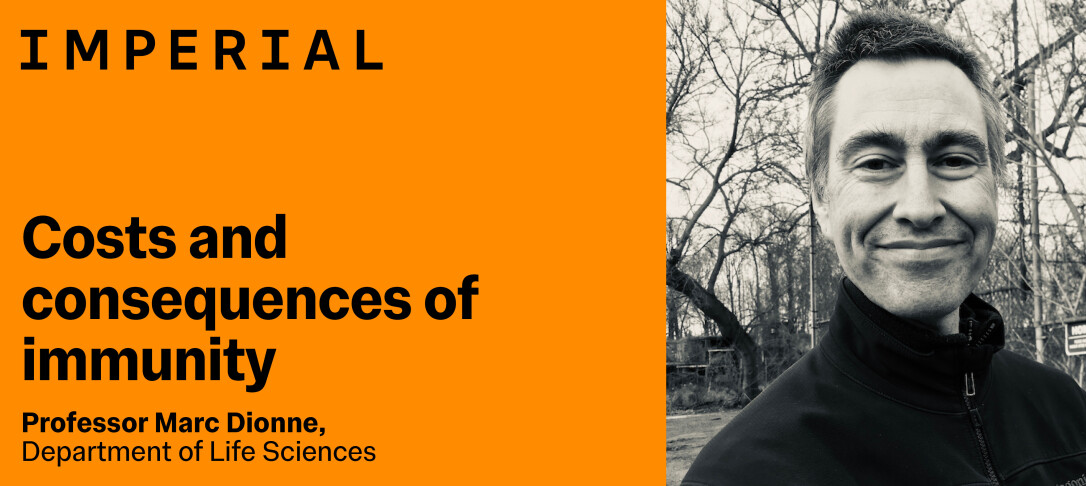
Professor Marc Dionne, Professor of Innate Immunity in the Department of Life Sciences, shares how the body fights infections, the hidden costs of immune defence, and what his research reveals about why some immune responses succeed while others fail.
Please register to attend in person. A live stream link for online attendance is available here.
We look forward to seeing you on Wednesday 3 December!
Imperial Inaugurals are term-time lectures that celebrate our newest Professors, recognising their academic journey and showcasing their research.
Abstract
All organisms need immune systems to fight infection, but immunity comes at a cost. The molecules and cells deployed to fight invading bacteria and viruses will damage the host as well. Producing these molecules and cells requires diversion of metabolic resources from other important biological functions. These costs are exacerbated by uncertainty: many infections require specific immune responses, but the host cannot usually identify the infecting organism with any precision. This is aggravated by the fact that infectious threats change over time: new pathogens enter host populations, and pathogens already present change. This means that, upon infection, hosts will activate broad suites of immune responses, increasing the cost of immunity, but in any specific infection, some of these responses will help the host, while most will be ineffective or harmful. How and why do animals control metabolism in response to infection? Which immune activities are critical to fight any specific infection, and which are useless? How can this system function when hosts frequently encounter new infections?
Marc Dionne is Professor of Innate Immunity at Imperial College London. He has devoted his career to understanding how hosts control bacterial infections. Using fruit-flies as hosts, and studying different bacterial infections, he and his group have established how and why the host changes its metabolic activity to help deal with specific infections, what specific molecules are produced to control these infections, and why these mechanisms are ineffective against other infections. In his inaugural lecture he will explain these findings in the context of his own career and discuss some of the remaining unanswered questions in infection biology.
Biography
Marc Dionne grew up in Southern California. He studied mathematics and physics and performed research in physical chemistry as an undergraduate at Yale University. This convinced him that he did not want to be a physicist. He then did a PhD in molecular and cell biology, focusing on mouse developmental genetics, at the University of California, Berkeley. This convinced him that he did not want to be a mouse developmental geneticist. He began to study the biology of infections as a postdoctoral fellow at Stanford University. He came to the UK to start his own research group as a lecturer at King’s College London in 2007 and moved to Imperial in 2015. He was promoted to Professor in 2022.