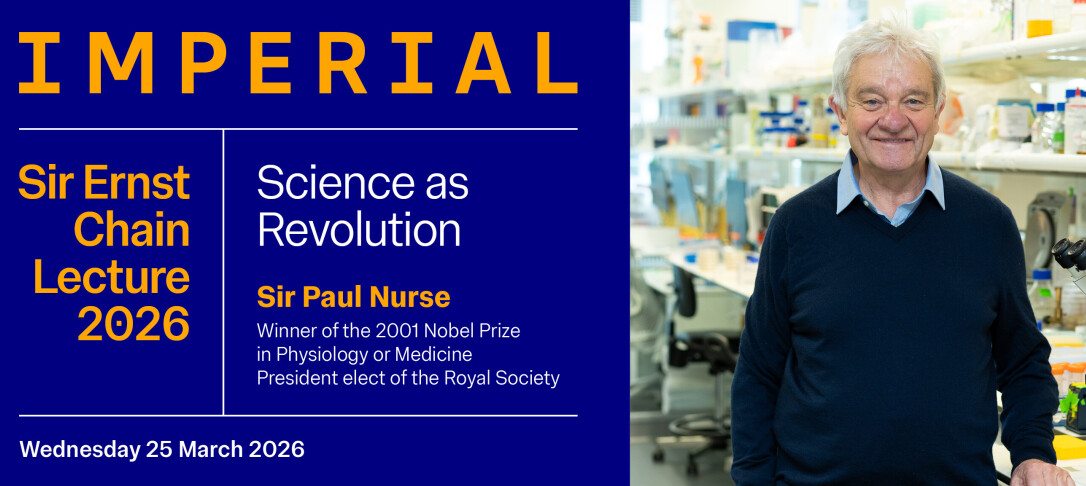
Abstract
Science has brought about revolutionary changes in our understanding of ourselves and the natural world, which have acted as major drivers of our culture and civilisation. This scientific knowledge has in turn brought about revolutions in the ways that we live and in the technologies that support society. A case can be made that science is the most revolutionary activity of human-kind.
Biography
Paul Nurse is a geneticist and cell biologist who works on how the eukaryotic cell cycle is controlled. His major work has been on the cyclin dependent protein kinases and how they regulate cell reproduction. He is Honorary Life President of the Francis Crick Institute in London, Chancellor of the University of Bristol, and President of the Royal Society. He has previously served as President of the Royal Society, Chief Executive of Cancer Research UK and President of Rockefeller University. He shared the 2001 Nobel Prize in Physiology or Medicine and has received the Albert Lasker Award, the Gairdner Award, the Louis Jeantet Prize and the Royal Society’s Royal and Copley Medals. He was knighted in 1999, made a Companion of Honour and awarded the Order of Merit in 2022 for services to science and medicine in the UK and abroad, received the Legion d’honneur in 2003 from France, and the Order of the Rising Sun in 2018 from Japan. He served for 15 years on the UK Council of Science and Technology, advising the Prime Minister and Cabinet, and was a Chief Scientific Advisor for the European Union. In 2020 he wrote “What is Life” which has been published in 22 countries. Paul flies gliders and vintage aeroplanes and has been a qualified bush pilot. He also likes the theatre, hill-walking, going to museums and art galleries, and running very slowly.
Sir Ernst Chain Lecture
The Sir Ernst Chain Lecture is an annual event held by Imperial’s Department of Life Sciences, commemorating the achievements of Sir Ernst Chain for humankind. In 1945 Ernst Chain, Alexander Fleming and Howard Florey received the Nobel Prize for Physiology or Medicine for the discovery and isolation of penicillin. Fleming made the original famous observation of the production of an “anti-bacterial agent” at St Mary’s, but it was Ernst Chain who developed the process to isolate penicillin.