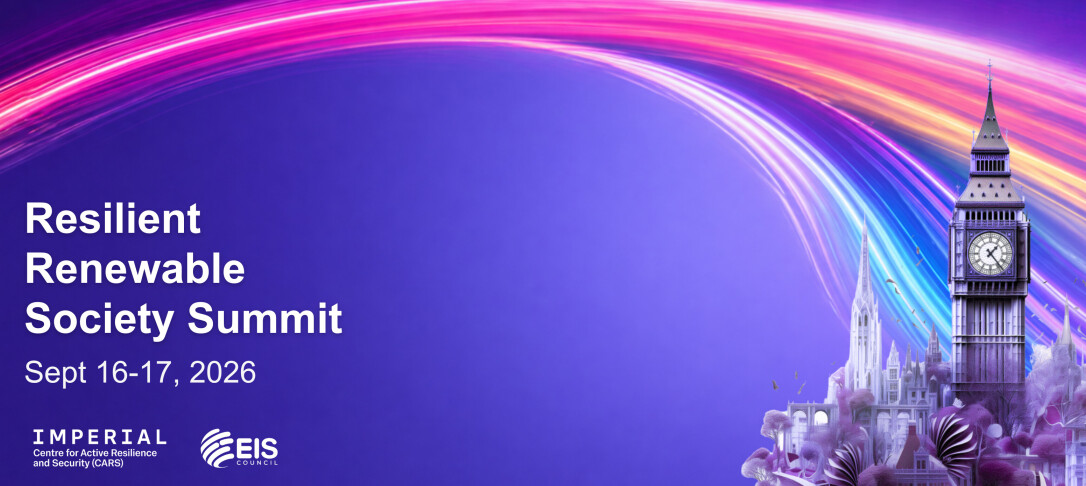
Image of Big Ben clock. Wrapped in London landmarks with name and date of event

Registration page

Date: 16-17th September 2026 

Time: 09.00 to 17.00 

Location:


  • Day 1 – 16th September, Plenary session, Royal Society, SW1Y 5AG 

  • Day 2 – 17th September, Extreme events exercise and workshops, EEE Building, Imperial College London, SW7 2AZ


The Resilient, Renewable Society (RRS) Summit is a two-day conference that brings together leaders from academia, NGOs, government, policy, and the private sector to learn from recent crises, stress-test future scenarios, and shape resilience strategies together. Across three thematic sessions, the global summit explores resilience in natural disasters, energy system disruption, and emerging threats, with particular attention to whole-of-society approaches, critical infrastructure, Low- or Middle-Income Country (LMIC) perspectives, and the links between resilience, security, and public trust. 


From catastrophic floods and blackouts to cyber attacks and “unthinkable” crises, today’s risks are interconnected and fast-moving. RRS Summit on 16-17th September 2026 in London, is a global, cross-sector conference designed for hands-on collaboration. It will bring together global and local voices to turn those challenges into shared solutions. Delivered by Imperial College London’s Centre for Active Resilience and Security (CARS), EIS Council and the leading partner organisations in the resilience arena, the Summit brings together years of experience in addressing some of the most complex challenges facing society today. 


DAY 1 at Royal Society: What are the painful societal resilience lessons we’ve learned? What do they tell us about our future, and what can we do about it?


Session One  Natural Disaster Preparedness – will explore how societies can strengthen preparedness for climate-related and other natural hazards before disruption occurs. It focuses on the relationships between risk governance, local adaptive capacity, critical infrastructure, community resilience, and public preparedness.  


Session Two  Human Miscalculations and Energy Systems Resilience  will explore how human error, governance failures, planning assumptions, and system complexity can amplify disruption across energy systems, public services, and communities. It will examine resilience not only as a technical problem, but also as a question of leadership, coordination, finance, public trust, the design of public services, and place-based approaches.  


Session Three – Manmade Hazards, Emerging Threats, and Geopolitical Risk – will consider how emerging threats challenge societal and infrastructure resilience. It explores how resilience frameworks must adapt to a threat environment shaped by digital dependence, strategic competition, and increasingly interconnected systems.  


Session Four – Pulling the Threads Together  will draw together the major themes of the day to reflect on what resilience should mean in practice for societies undergoing environmental, technological, and geopolitical change. 

DAY 2 at Imperial College: From Challenge to Implementation: Workshops, Simulation, and Summit Action

Parallel Workshops


Workshop Track 1 Natural Disaster Preparedness  

Workshop Track 2 Energy Systems Resilience   

Workshop Track 3 Emerging Threats / Cyber / Geopolitical Risk 


Simulation Exercise: Stress-Testing Resilience 


The simulation tests how well the lessons from Day 1 and the ideas generated in the workshops hold up under time pressure, uncertainty, and interdependent system stress. It encourages participants to think across sectoral silos and examine decision-making, communications, coordination, and escalation pathways.  


Implementing the Vision: Implementing Group reporting back from the workshops and simulation exercises

Synthesis from Workshop Facilitators and simulation findings on emergency communications, resilience and redundancy, and capabilities.

Confirmed speakers include:

  • Professor Emma Howard Boyd, Former Chair of the Environment Agency and Chair of the National Heat Risk Commission
  • Professor Rosehanna Chowdhury, CEO of the UK Resilience Academy
  • Rick Cudworth, Board and Executive Director of Resilience First
  • Professor Caroline Field, Co-Founder & Executive Director of Centre for Whole of Society Resilience
  • Helen Goulden OBE, Innovation & Partnerships Lead at Lloyds Banking Group
  • Hannah Gurga, Director General of the ABI
  • Lord Toby Harris, Chair, National Preparedness Commission
  • Matt Killick, Chief Operating Officer, St John Ambulance
  • Professor Jerry John Kponyo, Director / Office of Grants and Research, Kwame Nkrumah University of Science and Technology
  • Amb. Dr Hoffman Ronen, President of EIS Council
  • Professor Bryan Wells, Chair of the Board of Directors of the von Karman Institute of Fluid Dynamics
  • Professor Joseph Awetori Yaro, Provost of the College of Humanities and Professor of Human Geography, University of Ghana
  • Professor Małgorzata Zachara-Szymańska, Jagiellonian University 

Spaces are limited and early registration is advised You can register for your free place by following the link below. 


We look forward to welcoming you to the event! 


Warm regards, 

Imperial College Centre for Active Resilience and Security (CARS) / EIS Council  

Registration page