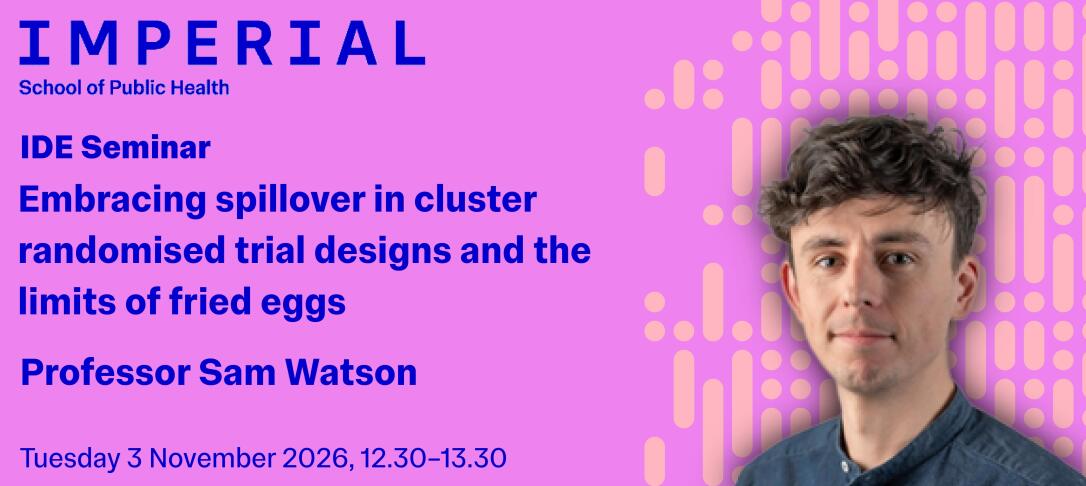
Sam Watson is a Professor of Biostatistics in the Department of Applied Health Research. His interests are in evaluation of interventions for public health, health services, and policy. He leads methodological research into novel approaches to evaluation, including evaluation of interventions exhibiting spatial effects and adaptive cluster trial designs. He is also currently PI of the NIHR funded BRIDGE study evaluating virtual wards for patients with COPD in the West Midlands; and statistical lead for trials of: improving cancer referrals in primary care in Kenya and Nigeria (PRIMED; NIHR), mental wellbeing intervention for patients with type I diabetes (D-STRESS; NIHR), and, continuous monitoring for women in labour in Nigeria, Rwanda, Pakistan, and India (IMPALA-2; Gates Foundation).
Abstract: Cluster randomised trials randomly allocate groups of participants, such as villages, schools, or hospitals, to treatment and control conditions. A motivation for cluster-level randomisation is that treatment may spillover to control participants in groups. Recent work highlights that many interventions, particularly in infectious diseases and public health, exhibit spatial effects that also spillover between clusters. The widely used approach to this issue is a “fried egg” design that places a buffer zone between cluster areas sufficient to prevent spillover.
In this talk, I will consider new approaches to evaluating interventions that vary over space and time and the potential limitations to fried egg-type designs. Where intervention effects can spread from treated to untreated participants and locations, a wider range of estimands can be defined, including different types of direct and indirect effects. A standard fried-egg design tries to eliminate indirect effects between clusters and so may underestimate a treatment effect under a universal roll out. I will describe modifications to trial designs to generate sufficient variation in indirect exposure to treatment to allow for the estimation and identification of a wide range of estimands.