SIDeTools - Smart Infrastructure Design Tools is a research project funded by UKRI through an Impact Acceleration Account (EP/X52556X/1) that took place at MAGE between November 2023 and June 2025. The research team included Dr. Agustin Ruiz-Lopez, Dr. Aikaterini Tsiampousi and Dr. David M G Taborda, supported by our industrial partners Seequent, Arup, Geotechnical Observations and Laing O'Rourke.
This project focussed on exploring ways of embedding surrogate models within Geotechnical Engineering workflows, as well as ways of streamlining their creation. Three areas were targeted in this project:
- the replacement of empirical curves used in geotechnical pre-designed by more higher accuracy surrogate models,
- the creation of tools for design optimisation,
- the development of early-warning systems for safety and proactive management of infrastructure.
Project outputs
A data-driven approach to predicting the long-term thermal performance of thermo-active piles. 3rd International Conference on Energy Geotechnics (ICEGT), Paris, France.
A novel adaptive sampling approach with batch selection for the automatic generation of surrogate models in geotechnical engineering, Data-Centric Engineering
SIDeTools closing event
On the 26th June 2025, an event was held at the Skempton Building of Imperial College London to bring together the SIDeTools industry partners and research team, as well as other researchers working in projects that resulted directly from SIDeTools. This event was held in a hybrid format, with about 60 attendees.
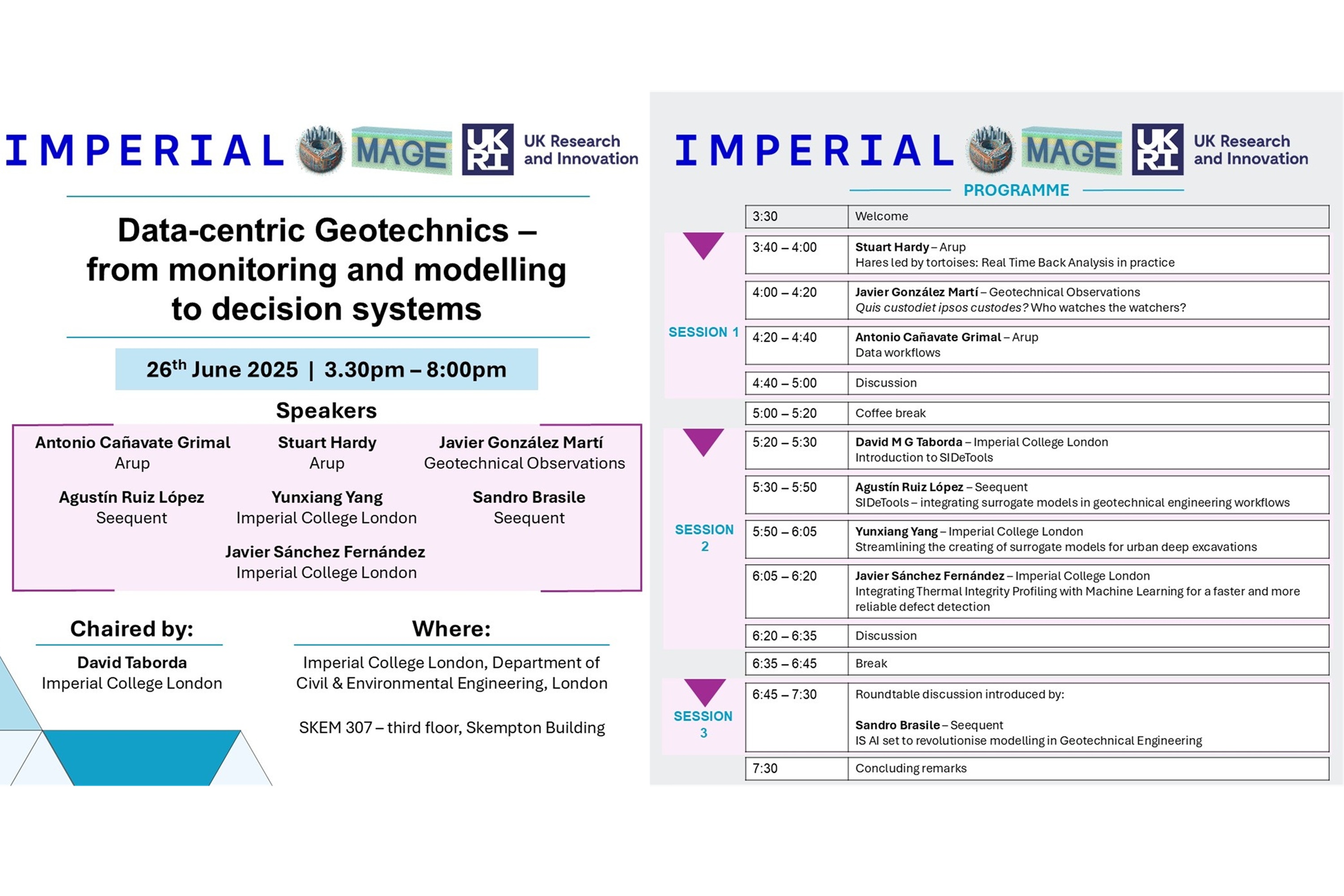

Session 1: Perspectives from industry and current practice
01 Introduction to the event

David M G Taborda (Imperial College London) introduces the SIDeTools closing event and provides an overview of research on data-centric geotechnics at Imperial College since 2020.
Read more:
Applying the observational method to a deep braced excavation using an artificial neural network.
Surrogate model for power output prediction of a single thermo-active pile.
Stuart Hardy - Hares Led by Tortoises
Who watches the watchers? by Javier Gonzalez Marti (Geotechnical Observations)
Javier Gonzalez Marti (Geotechnical Observations) explores the critical role of independent oversight in geotechnical monitoring. Through practical examples and industry reflections, transparency, checks and balances, and methodological rigour are explored as forms of enhancing trust in and effectiveness of instrumentation and monitoring in Geotechnical Engineering.
Session 2: SIDeTools and associated projects
SIDeTools by David M G Taborda (Imperial College London)
David M G Taborda (Imperial College London) presents the SIDeTools project, which bridges academic and industry needs in data-centric geotechnical engineering. This short presentation introduces the motivation behind the initiative, its collaborative approach, and its vision for enabling decision systems grounded in real-world data.
Surrogate models in geotechnical engineering
Agustín Ruiz López (Seequent) discusses how surrogate models—fast, approximate alternatives to complex numerical simulations—can enhance geotechnical engineering workflows. Three applications illustrate their versatility: predicting ground movements associated with shaft excavation in London Clay, modelling load-displacement behaviour of suction buckets in sand, and developing early warning systems for slopes under different future climate scenarios. Each case shows how surrogate models can support decision-making across project stages, improving efficiency and enabling more robust analysis in geotechnical design.
Read more:
Surrogate model predicting vertical displacements around newly excavated shafts in clay, Zenodo. [Dataset for this work is available on Zenodo]
A universal surrogate model for predicting ground movements resulting from shaft construction in London Clay, Zenodo. [Dataset for this work is available on Zenodo]
Streamlining the creation of surrogate models by Yunxiang Yang
Yunxiang Yang (Imperial College London) introduces CV-BASHES, a more efficient workflow for developing surrogate models to support deep excavation projects in complex urban environments. Key steps in automating the model development pipeline, including feature selection, training, and validation are described in detail.
Read more:
A surrogate model for predicting the response of a deep excavation in London supported by a multi-propped retaining wall, Zenodo. [Dataset for this work is available on Zenodo]
Integrating thermal integrity profiling with Machine Learning
Javier Sanchez Fernandez (Imperial College London) showcases an innovative approach to defect detection in deep foundations, using machine learning models to automate the interpretation of temperature data. This integration offers a step forward in quality assurance processes, reducing reliance on manual inspection and enabling more consistent assessment of defects in geotechnical structures.
Read more:
A novel machine learning-based approach to thermal integrity profiling of concrete pile foundations. Data-Centric Engineering, 2025. [Dataset for this work is availble on Zenodo]
Session 3: Roundtable discussion
Is AI set to revolutionise modelling in Geotechnical Engineering?
Sandro Brasile (Seequent) introduces the round-table discussion by exploring the transformative potential of artificial intelligence in geotechnical modelling. This talk examines how AI can complement traditional engineering judgement by handling complex, data-rich environments with greater speed and adaptability. The presentation invites reflection on how the geotechnical community might evolve its tools and mindset to harness AI’s growing capabilities without losing sight of fundamental engineering principles.
Contact Geotechnics
Geotechnics
Civil and Environmental Engineering
Skempton Building
Imperial College London
South Kensington Campus
London, SW7 2AZ
Telephone:
+44 (0)20 7594 6077
Email: j.otoole@imperial.ac.uk
Alternatively, you can find a member of Geotechnics staff on the Department of Civil and Environmental Engineering website.
Follow us on Twitter: @GeotechnicsICL
We are located in the Skempton Building (building number 27 on the South Kensington Campus Map). How to find us