Foraging baboons are picky punters
by Simon Levey
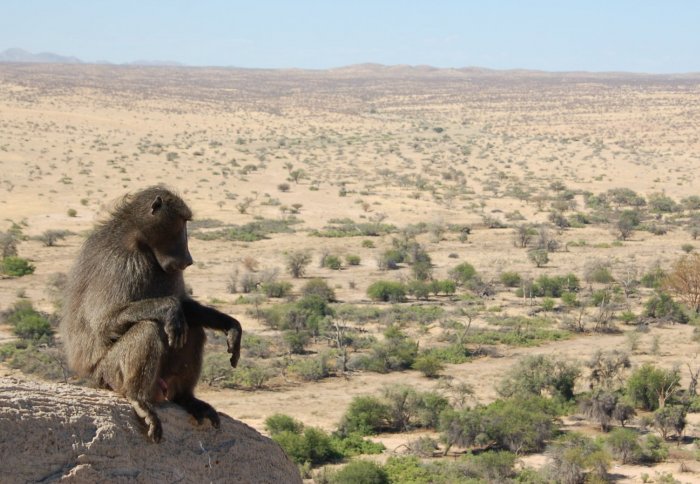
Baboon (Papio ursinus) at the ZSL Tsaobis Baboon Project in Namibia (Credit: Harry Marshall)
Baboons choose who to eat with depending on their position in the pecking order, suggests the results of a new study from Imperial and ZSL
Watch a video of Papio ursinus baboons foraging at the ZSL Tsaobis Baboon Project in Namibia >>>
Baboons choose who to eat with depending on their position in the troop pecking order, according to a new study published this week in The American Naturalist.
A research team from the Zoological Society of London and Imperial College London observed troops of baboons foraging for food over a six month period and analysed their behaviour using a technique developed to study human consumer choices.
Unsurprisingly they saw that the monkeys preferred to eat from the most well-stocked trees, but they chose their dining partners based on their position in the troop's social hierarchy. Baboons who were high up in the hierarchy preferred to forage with baboons from lower down in the order. But these baboons from lower down in the hierarchy tried to avoid contact with higher-ranked baboons, instead preferring those with whom they shared good social bonds.
"These strategies seem complicated, but we think they give the baboons a greater chance of getting enough to eat," said Harry Marshall, who carried out the research as part of his PhD at ZSL and Imperial's Department of Life Sciences.
"For dominant baboons it's easier to get food by stealing it from inferior troop members than it is to collect it themselves. Less dominant baboons prefer to avoid this, instead choosing to stick close to 'friends' who tolerate their presence whilst searching for food," he continued.
Every day for six months Marshall and his colleagues followed troops of chacma baboons (Papio ursinus) in Tsaobis Leopard Park in Namibia. They recognised individual baboons by distinguishing features, and closely observed both the aggressive and friendly social relationships between baboons, noting which food patch they foraged in and who they foraged with.

A young chacma baboon (Papio ursinus) in Tsaobis Leopard Park in Namibia (Credit: Hannah Peck)
Dr Guy Cowlishaw from ZSL added: "These findings show how animals' decision-making can be dependent on where they are and who they are. This suggests that some animals can change their behaviour to adjust to a changing environment."
Professor Tim Coulson, from the Department of Life Sciences at Imperial College London, said: "This technique, called discrete choice modelling, has rarely been used in animal behaviour research. Here it has allowed us to get a better understanding of what underpins the baboons feeding behaviour, and how they might be affected by habitat destruction and climate change in their home on the African grasslands."
Scientists at ZSL will use the findings from this study to help them investigate how baboons' foraging behaviour is affected by changes in the environment, and the impact this will have on socially foraging species in the future.
Marshall HH, Carter AJ, Coulson T, Rowcliffe JM and Cowlishaw G "Exploring Foraging Decisions in a Social Primate Using Discrete-Choice Models" is published in The American Naturalist Vol. 180, No. 4, October 2012 DOI: 10.1086/667587
Article text (excluding photos or graphics) © Imperial College London.
Photos and graphics subject to third party copyright used with permission or © Imperial College London.
Reporter
Simon Levey
Communications Division