AI model generates personalised heart animations for better cardiac diagnosis
by Gemma Ralton
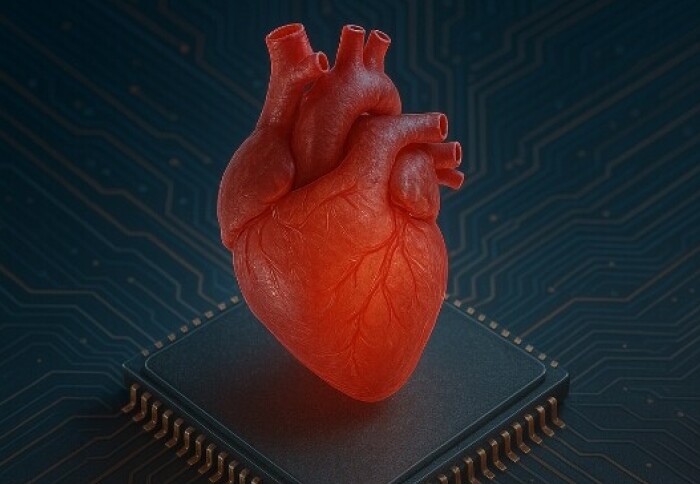
Researchers have developed a generative AI model that creates realistic and personalised animations of human hearts to help identify abnormalities.
“As we move towards more personalised healthcare, MeshHeart offers a new way to understand how each individual’s heart moves and functions. By comparing a person’s heart to a personalised ‘healthy’ version, we hope to catch early and subtle signs of disease that might be missed. It’s about bringing precision and detail to cardiovascular care.” Dr Mengyun Qiao Lead Author
Using images of real human hearts from over 38,000 UK Biobank participants, the Imperial team were able to develop MeshHeart - a generative AI model that accurately recreates 3D geometry and motion of the heart.
The work exemplifies a novel application of generative AI technology within the healthcare sector, helping to tackle cardiovascular disease, which is estimated to cause a quarter of all deaths in the UK.
Lead author Dr Mengyun Qiao said: “As we move towards more personalised healthcare, MeshHeart offers a new way to understand how each individual’s heart moves and functions. By comparing a person’s heart to a personalised ‘healthy’ version, we hope to catch early and subtle signs of disease that might be missed. It’s about bringing precision and detail to cardiovascular care.”
Their work is published in Nature Machine Intelligence.
Generative AI for healthy hearts
In heart research, machine learning techniques are increasingly used to analyse the shapes and movements from the human heart from imaging data.
Cardiac magnetic resonance (CMR) is the best way to look at the heart in detail for diagnosing cardiovascular disease. However, existing analysis techniques for CMR images only report simplistic volumetric measures from the images to describe the heart structure and function.
These measures are not able to describe the regional and subtle differences of the 3D heart shape and motion.
Dr Wenjia Bai explains: “In an analogy, if we describe a person just by their height, it is not able to reflect the 3D shape of the human body and different shape patterns across the population. Therefore, a better method to describe the 3D heart shape and motion would greatly enhance our understanding about the variations of the shape and motion, and discover patterns related to cardiovascular disease.”
MeshHeart
The Imperial team created a novel AI model called MeshHeart that builds detailed 3D models of the heart’s structure and movement throughout a heartbeat.
This uses a type of deep learning called graph convolutional networks to understand the shape of the heart and a transformer model to capture how it changes over time.
The system was trained on a large dataset of over 38,000 heart scans, allowing the model to understand what a healthy heart typically looks like for different ages and sexes.
Importantly, the model can generate a personalised normal heart model based on a particular individual’s clinical information. By comparing an individual’s actual heart model to their personalised healthy reference, the system can therefore detect differences that may indicate underlying heart conditions or potential health risks.
Next steps
According to the researchers: “Apart from the UK Biobank, we are currently curating more CMR datasets containing different disease types and acquired from different hospital sites, to further evaluate the shape modelling performance of the developed model.”
Next, the team plans to link MeshHeart with hospital records to create even more accurate, personalised heart models. They also aim to test how the heart might respond to treatments or medication by simulating future changes, helping doctors make better-informed decisions.
-
'A personalized time-resolved 3D mesh generative model for unveiling normal heart dynamics' by Qiao et al. published on 19 May 2025 in Nature Machine Intelligence.
Article text (excluding photos or graphics) © Imperial College London.
Photos and graphics subject to third party copyright used with permission or © Imperial College London.
Reporter
Gemma Ralton
Faculty of Engineering