Doctor talks lessons learned during iCARE research fellowship
by Nina Wagner
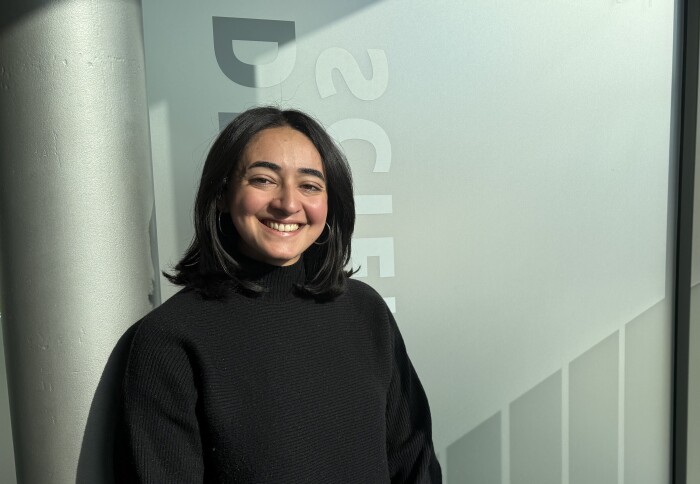
Dr Aya Riad at the iCARE Digital Collaboration Space
Dr Aya Riad completed a four-month data-based research fellowship at iCARE SDE
Dr Aya Riad did a four-month research fellowship at iCARE as part of the specialised foundation programme, which allocates a dedicated research block during the first two years of working as a doctor. It is designed to provide broad exposure to different specialties and equip you with basic clinical skills before moving on to specialty training.
Outside of her research fellowship, Dr Riad moved from Edinburgh to London to complete her foundation training at Imperial College Healthcare NHS Trust’s St Mary’s Hospital.
Dr Riad is part of the Surgery and Innovation programme at Imperial College London. After mentioning to her supervisor that she was interested in Big Data and Artificial Intelligence, she was matched up with iCARE Secure Data Environment.
iCARE is a multi-disciplinary research team and secure data environment which holds the health data for 2.8 million people in North West London and beyond. The iCARE SDE sits across the Trust and Imperial College London, located at the Digital Collaboration space which is part of the Paddington Life Sciences innovation cluster.
ICARE oversees the National Institute of Health and Care Research (NIHR) Imperial BRC Digital Health theme and provides access to health data in a secure data environment for research and innovation. ICARE also contributes to the OneLondon NHS England Sub-National Secure Data Environment programme.
During her final week at iCARE, Dr Riad talked about the lessons in data-collection and research methodology that she would be taking with her into future clinical praxis.
How did you end up at iCARE? What made you choose to do your placement there?
I have always been interested in big data. During medical school, I conducted research using big data in global health and surgery and began developing coding skills in R. I saw how powerful it can be to extract meaningful insights from large datasets. When choosing where to spend my four-month research block, I knew I wanted to build on these skills and learn how to apply artificial intelligence in healthcare. iCARE offered a unique opportunity to work in a multidisciplinary team with data engineers, scientists, and project managers, and with a very large, linked dataset. It also gave me the chance to explore how routine clinical data can be used meaningfully in AI applications. That combination really drew me in.
What projects have you worked on at iCARE?
My main project focuses on venous thromboembolism (VTE or deep vein blood clots most commonly in the leg, groin or arm) risk assessment. I have been evaluating how VTE risk assessments are currently carried out using a mandatory form for all admitted patients. The project examines whether the form is completed effectively, whether it correlates with appropriate prophylaxis prescribing, and whether it is actually reducing VTE incidence. The next phase involves exploring whether AI could automate parts of the VTE risk assessment process.
I have also contributed to the discharge summaries project, which looks at whether AI can help generate discharge summaries. I have been involved in assembling a junior doctor group for the project and helping evaluate the AI-generated outputs against those written by resident doctors. Beyond that, I have provided clinical input to various other projects, which has been insightful, especially working with a team primarily composed of data scientists and engineers.
If the VTE project came to full fruition, what might that look like?
Currently, radiologists manually review every suspected case of VTE and report quarterly. If the project succeeds, AI could automate identification of these cases, flagging them for clinician verification which would free up significant time. More importantly, it could transform clinical practice by pre-populating the VTE assessment form using data already in the patient’s record. AI could sift through much more information than a doctor has time to do and suggest whether prophylaxis is needed, acting as a decision support tool to aid, not replace, clinical judgment.  What has been the most difficult part of the research so far?
Working with routinely collected clinical data has been the biggest challenge. Much of the critical information is stored as free text in clinical notes, not as structured data. That made it difficult to extract what we needed for analysis. It required close collaboration with data engineers and a lot of problem-solving to build the dataset. But the process taught me a lot about the complexities of working with real-world data and how we might improve data collection for future research.
We often store a lot of contextual knowledge in our heads and assume others will understand it. But in structured records, that nuance can be lost. It is crucial that we record information in a way that is transparent and retrievable for others, not just for patient care, but also for research.
Will you take those lessons forward into your clinical practice?
Definitely. As clinicians, we generate data every day that others rely on for research. This experience has made me more mindful of how I structure and code data, and I think it is important that all doctors understand how valuable this data is. There is so much potential to improve how we record clinical information to make it more usable for both care and research.
Was there anything that surprised you about the workflows at iCARE?
Yes, definitely. In my previous experience, research teams were clinician-heavy with minimal data science input. At iCARE, the team is mostly composed of data engineers and scientists. That changed the way I approach projects. You must clearly define every step, justify every data point, and plan out the workflow thoroughly. It made me to articulate why each aspect of the clinical data matters and has given me a much better understanding of how to structure and manage research data effectively.
What would you like to see from iCARE in the future?
I would love to see more integration of the research outputs into the clinical front end, bringing the tools we are developing back into the day-to-day systems, like Cerner. There is huge potential to automate parts of clinical workflows and improve care. I am excited to see how some of these innovations start directly influencing clinical practice.
Article supporters
Article text (excluding photos or graphics) © Imperial College London.
Photos and graphics subject to third party copyright used with permission or © Imperial College London.
Reporter
Nina Wagner
Department of Surgery & Cancer
