Imperial’s latest Future Leader Fellow aims to slow or even reverse brain ageing
by Simon Levey

An Imperial scientist wants to cut the incidence of brain diseases like Alzheimer’s and help people to enjoy more years of healthy, independent life.
Two in every three people lose brain function as we age, and globally the population of older people is growing at a faster rate than ever before, meaning more people are at risk of cognitive decline.
Award-winning biomedical engineer, Dr Sophie Morse wants to reverse this trend and has received the backing of the national funding body UK Research and Innovation (UKRI) to do so.
Her past research in mice has focused on the benefits of delivering pulses of ultrasound to the brain from outside the head. This non-invasive procedure has been shown to successfully allow medication into the brain, clear the ‘plaques’ that are associated with Alzheimer’s disease, and modulate the brain’s immune system with a view to preventing future damage.
Now, she is one of 77 recipients of a Future Leader Fellowship from UKRI; a grant worth £2 million to develop her work in mice into treatments that will improve the lives of people who are at risk or already experiencing the effects of brain aging.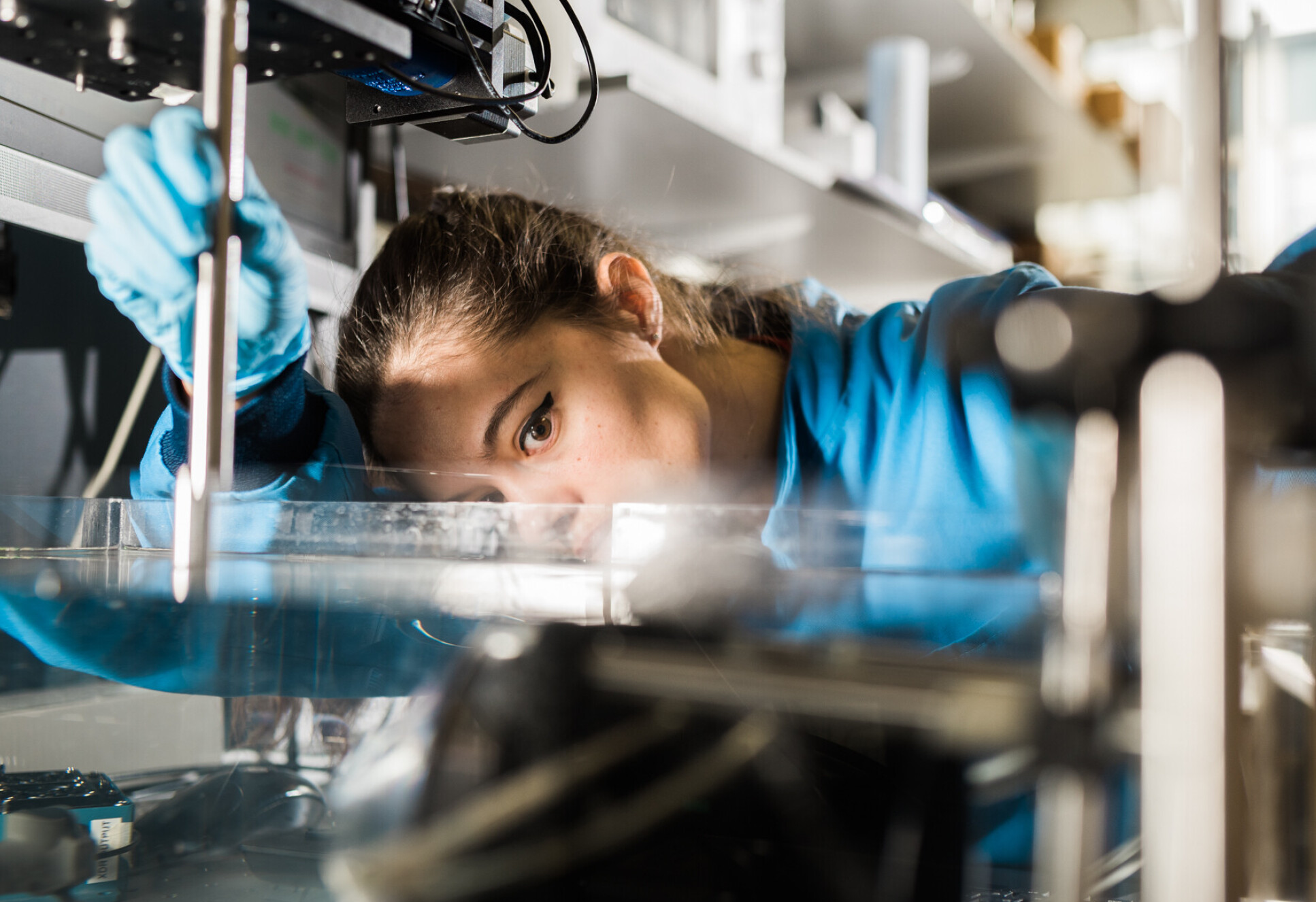
Dr Morse said: “The most exciting thing about this technology is its potential to delay the onset of brain disorders as well as restore cognitive function in those already with disorders in a non-invasive, portable, safe and inexpensive way.”
Dr Liz Elvidge, Associate Director (Early Career Researcher Development) in Imperial’s Early Career Researcher Institute, supported the application for funding.
She said: “Early Career Researchers are pivotal to the success of our research and our national and international standing. We are particularly keen to support applications to the UKRI Future Leaders scheme. Since the start of the scheme in 2018 the University via the Postdoc and Fellows Development Centre and now the Early Career researcher Institute have provided bespoke, tailored support to our FLF applicants.
We have worked with Sophie for many years- starting with her Imperial College Research Fellowship. We are delighted that she has been awarded a Future Leaders Fellowship and we look forward to continue to provide support as she excels in her career.”
Award winning research and engagement
Among her awards, Dr Morse has received the Gold Medal in Engineering and Westminster Medal at STEM for Britain, Young Investigator Awards from the British and the European Ultrasound societies, the Institute of Engineering and Technology William James Award, and the Top 50 Women in Engineering Award.
Her research vision has recently been recognised with her appointment as an Emerging Leader in the UK Dementia Research Institute at Imperial, and was chosen to meet the UK Science Minister at our White City Campus in 2024.
Dr Morse took part in the European Talent Academy 2024, a strategic venture between Imperial and the Technical University of Munich (TUM).

Early Career Researcher support at Imperial
At Imperial, we value our researchers as a community and are committed to ensuring that all researchers can develop and grow both personally and professionally. The Early Career Researcher Institute (ECRI) supports people in the first years of their research careers to take a proactive approach to developing skills and exploring career prospects.
Established in October 2024, ECRI brought together the former Graduate School and Postdoc and Fellows Development Centre forming a single institute for the support of all early career researchers (postgraduate research degree students through to Postdocs and Fellows) and those who support them.
Future Leader Fellowships
Dr Sophie Morse will receive £2 million from UKRI in its 2025 Future Leaders Fellowships (FLF) Awards.
The awards provide funding for up to seven years to support exceptional early-career researchers tackling ambitious and challenging problems and develop their careers as the research and innovation leaders of the future.
Dr Morse’s project, called ‘Therapeutic ultrasound against cognitive decline’, will pioneer a non-invasive approach to modulate the brain’s immune cells using therapeutic ultrasound, initially in mice, with the aim to promote healthy brain ageing by preserving cognitive function that can be applied to human treatments.
Dr Morse responded to this award, calling it: “An amazing opportunity to develop a non-invasive, portable, and safe technology to delay cognitive decline and restore brain function. I am incredibly excited to be advancing new strategies for dementia treatment with this Fellowship.”
Article supporters
Article text (excluding photos or graphics) © Imperial College London.
Photos and graphics subject to third party copyright used with permission or © Imperial College London.
Reporter
Simon Levey
Communications Division