Exploring the Future of Health Tech: Lessons from HETT 2025
by Nina Wagner
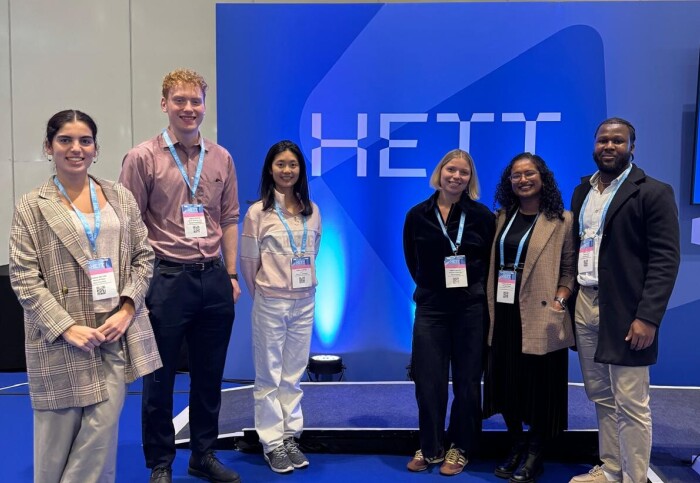
Maite, Oscar, Joy, Kathleen, Elizabeth, and Toheeb at HETT
iCARE researchers joined 4,500 delegates at HETT 2025 to explore how digital innovation can meaningfully improve healthcare delivery.
The Health Excellence Through Technology (HETT) conference brought together more than 4,500 delegates at London ExCeL this year, each contributing to an ongoing conversation about how technology, data, and collaboration can transform healthcare in the NHS. Among them were four members of the Imperial Clinical Analytics, Research and Evaluation (iCARE) team: Toheeb Sodiq, Maite Arribas Ardura, Joy Li, Oscar Windrath-Carr, Elizabeth Noble, and Kathleen Goldsmith who attended to learn from the sector’s latest innovations and reflect on how their work fits within this broader digital health landscape.
At iCARE, the focus is on using real-world clinical data to improve patient outcomes and system efficiency. The team’s work bridges data science, AI, and clinical expertise with a Secure Data Environment that hosts real patient data for North West London's 2.7 million population and beyond. ICARE's practical and patient-centered approach that aligns closely with the themes that dominated HETT 2025.
“It felt like a buffet of innovation and strategy,” said Data Scientist Toheeb Sodiq, reflecting on the event’s diversity. “You could move from AI implementation to governance to workforce transformation. It showed how the whole ecosystem has to work together to make digital health effective, not just the technology itself.”
One presentation that resonated across the team explored ambient voice technology, which listens to clinician–patient conversations and automatically generates structured documentation in electronic health records. “The speakers showed that it is not only about saving time,” said Data Scientist Maite Arribas Ardura. “If clinicians spend less time typing notes, they can focus more on their patients. It improves not just efficiency but the quality of the interaction itself.”
Research Assistant Joy Li said she was struck by the pragmatic tone of many talks. “A lot of companies are using large language models for NHS tasks, but what impressed me was their focus on problem-solving. It is not about using AI for its own sake, it is about using it where it really saves time and money while improving care.”
For Research Assistant Oscar Windrath-Carr, discussions about the single patient record initiative felt particularly relevant. “At iCARE, we often work with data that come from multiple sources. Seeing how the NHS is trying to unify these systems helps us frame our own projects. It reinforces how critical interoperability is for delivering better insights and improving care pathways.”
Several sessions also prompted reflection on the sustainability of AI models in healthcare. Toheeb described one example involving a fracture-detection algorithm in medical imaging. “The model worked well at first, but it was static and did not keep learning as data evolved. That made me think about our own work and how we could use MLOps to ensure models continue to learn and adapt once deployed.”
Throughout the two-day event, the iCARE team found value not only in the technical demonstrations but also in the strategic discussions about workforce, governance, and real-world implementation. The exposure reaffirmed how iCARE’s collaborative model, combining NHS partnerships, secure data environments, and applied research, sits at the intersection of what the wider digital health community is trying to achieve.
“It was refreshing to see the balance between technology and implementation,” said Maite. “The talks reminded me that the hardest part is not developing the tools but ensuring they are used in ways that genuinely help people.”
For iCARE, that remains the guiding principle: leveraging data and AI not as abstract technologies but as practical means to deliver measurable benefits to patients, clinicians, and the NHS system as a whole.
Article supporters
Article text (excluding photos or graphics) © Imperial College London.
Photos and graphics subject to third party copyright used with permission or © Imperial College London.
Reporter
Nina Wagner
Department of Surgery & Cancer
