QuEST research honoured at IEEE Quantum Week, advancing UK Quantum-AI ecosystem
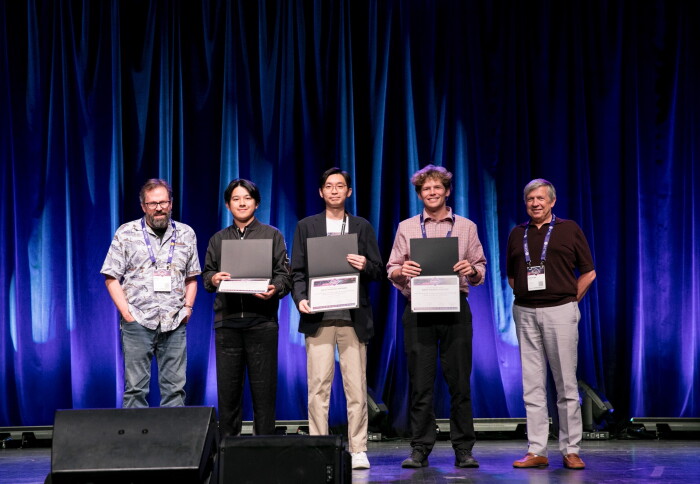
Imperial’s researchers affiliated with QuEST centre recognised for contributions connecting quantum and AI research across the UK.
At this year’s IEEE International Conference on Quantum Computing and Engineering (QCE25), one of the leading global events in the field, researchers affiliated with Imperial Centre for Quantum Engineering, Science and Technology (QuEST) received international recognition. Two QuEST-supported papers led by Dr Louis Chen (Department of Electrical and Electronic Engineering) and colleagues were among the top winners from hundreds of submissions.
Quantum intelligence will thrive through collaboration, where innovation in science meets real-world engineering. Dr Louis Chen Research Associate, Department of Electrical and Electronic Engineering
The paper Quantum-Enhanced Parameter-Efficient Learning for Typhoon Trajectory Forecasting received the IEEE Quantum Technical Community Distinguished Technical Paper Award and was named Best Paper in the Quantum Applications Track, the highest distinction in that category. Dr Louis Chen said, “Quantum intelligence will thrive through collaboration, where innovation in science meets real-world engineering,” highlighting the team’s approach to combining quantum research with practical applications.
Meanwhile, Distributed Quantum Neural Networks, developed as a part of the Distributed Quantum Computing (DQC) project led by Professor Kin K. Leung, with contributions from Marie Curie Research Fellow Dr Shang Yu (Department of Physics) and PhD student Felix Burt (Department of Electrical and Electronic Engineering), received Second Best Technical Paper in the Advances in Photonic Quantum Computing Track. This recognition further highlights Imperial’s growing strength in scalable and distributed quantum-AI systems.
Developing hybrid quantum–classical technologies
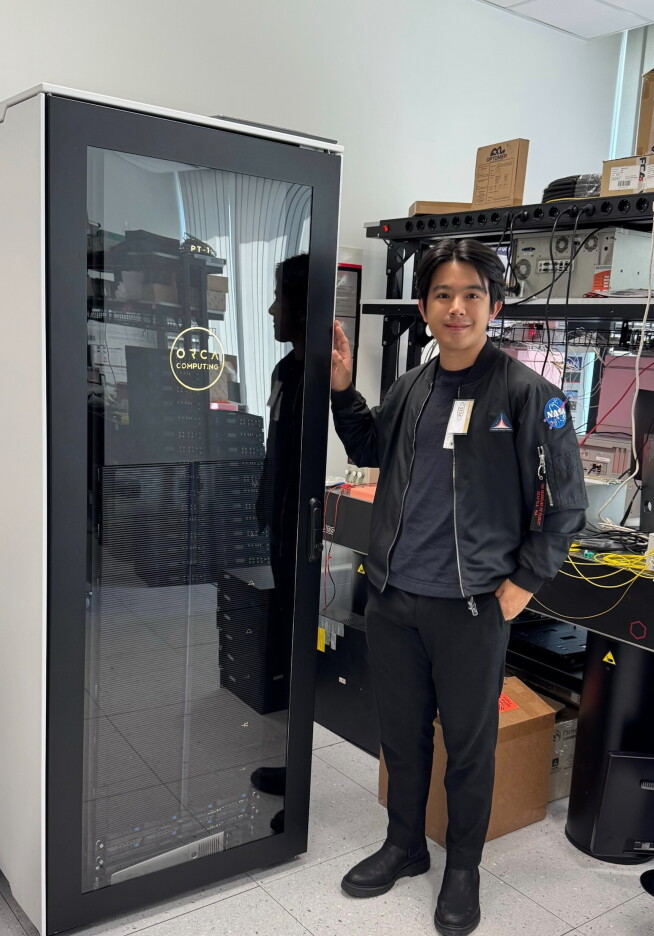
Building on this theoretical work, the QuEST community, together with ORCA Computing and the Poznań Supercomputing and Networking Center (PCSS), recently demonstrated a distributed quantum neural network operating within a hybrid high-performance computing environment. The project, co-designed by Dr Louis Chen from the DQC group and the PCSS team led by Dr Piotr Rydlichowski, combines photonic quantum processors with NVIDIA AI supercomputing. This setup enables hybrid quantum-classical deep learning across nodes in different locations, an important step toward scalable quantum machine learning.
The achievement has attracted attention nationally and internationally and was featured in NVIDIA’s announcement on the UK’s AI infrastructure. The collaboration between ORCA Computing, Imperial, and PCSS, supported by NVIDIA and the QuEST Seed Fund, provides a model for integrating quantum and AI technologies in modern data centres. The project demonstrates how quantum-AI architectures developed by the DQC group can speed up the integration of classical high-performance computing with distributed quantum systems.
Ongoing research aims to extend these advances into areas such as healthcare applications and solutions to classical computational challenges. Together, these initiatives reflect Imperial’s vision of a future where quantum and classical computing work together to advance science, engineering, and medicine.
Article text (excluding photos or graphics) © Imperial College London.
Photos and graphics subject to third party copyright used with permission or © Imperial College London.
Reporter
Louis Chen
Department of Electrical and Electronic Engineering
Sanjana Kakar
Department of Materials