
Cross-faculty
by Ryan O'Hare
/prod01/channel_4/imperial-news/media/news-images/3000X2000-main-article-images/iclmay2012-067_110086_001-(1).jpg)
From the potential for AI designed viruses, to detecting threats in our wastewater and protecting our food networks, biosecurity is becoming an increasingly urgent global concern.
Imperial’s leading biosecurity experts offered their insights into the current themes and concerns in the field, ahead of UN high-level meetings on pandemic prevention and other key biosecurity topics in New York this week.
The panel, drawn from the recently launched Biosecurity Network of Excellence, showcased expertise across epidemiology, international biosecurity, virology, analytical chemistry and synthetic biology, positioning Imperial as a leader in the field.
As an Imperial delegation joins some of the discussions in New York – including President Professor Hugh Brady, Vice President (Strategy) Amanda Wolthuizen, and Professors Azra Ghani and Karen Polizzi – here’s what we learned from our biosecurity experts.
In the wake of alarming reports from frontier AI lab Anthropic, media attention has centred on the potential for AI to assist bad actors engineer pathogens and make new threats, such as synthetic viruses.
Commenting on the recent reports, Professor Wendy Barclay, Regius Professor of Infectious Disease at Imperial, said: “The potential for harm is going to depend on how comprehensive the knowledge base is about the virus targeted. There's still a huge amount we don't know.”
“The problem we've got is that the same knowledge base is needed in our efforts to counter these viruses, to make new drugs and vaccines against them and detect them,” she explained. “We have now a double-edged sword: some people could use this new knowledge for good, others for bad.”
Urging caution on the steps to reduce risk without blocking vital scientific research, Professor Barclay added: “We need many voices around the table to find the way forwards. Knee-jerk reactions, such as total bans on work with viruses, are likely to only disadvantage scientists whose intentions are good, whilst not really impacting anyone with malicious intent.”
“We've had several discussions…to think about not only the guardrails, but the benefits and the way that the frontier labs can help respond scientifically as well to make us better prepared.” Professor Azra Ghani Director of Imperial Global Singapore
Imperial and other leading institutions are already working with frontier AI labs, explained Professor Neil Ferguson, Director of the Jameel Institute for Disease and Emergency Analytics and Director of the School of Public Health. He noted existing barriers in place to limit access to their cutting-edge technology for would-be bad actors.
“It is very hard, for instance, to get [Anthropic’s] Fable or [OpenAI’s] GPT Astra to say anything about a pathogen without actually having an agreement with those labs, and they recognise you as a respected and ‘good actor’ researcher,” explained Professor Ferguson.
“That is not the same, of course, as global regulation,” he added. “And that, again, points to the priority that we need to give to things like the UNGA High Level discussions and also just national regulation as well.”
Professor Azra Ghani, Director of Imperial Global Singapore, is part of the Imperial delegation in New York this week contributing to discussions on pandemic preparedness and AI, hoping to influence what the emerging global picture on biosecurity could look like.
“We've had several discussions – and those will continue [this] week in New York – to think about not only the guardrails, but the benefits and the way that the frontier labs can help respond scientifically as well to make us better prepared,” she explained.
Professor Ghani added she hoped the UN discussions would expand beyond pandemic preparedness to address biosecurity more broadly.
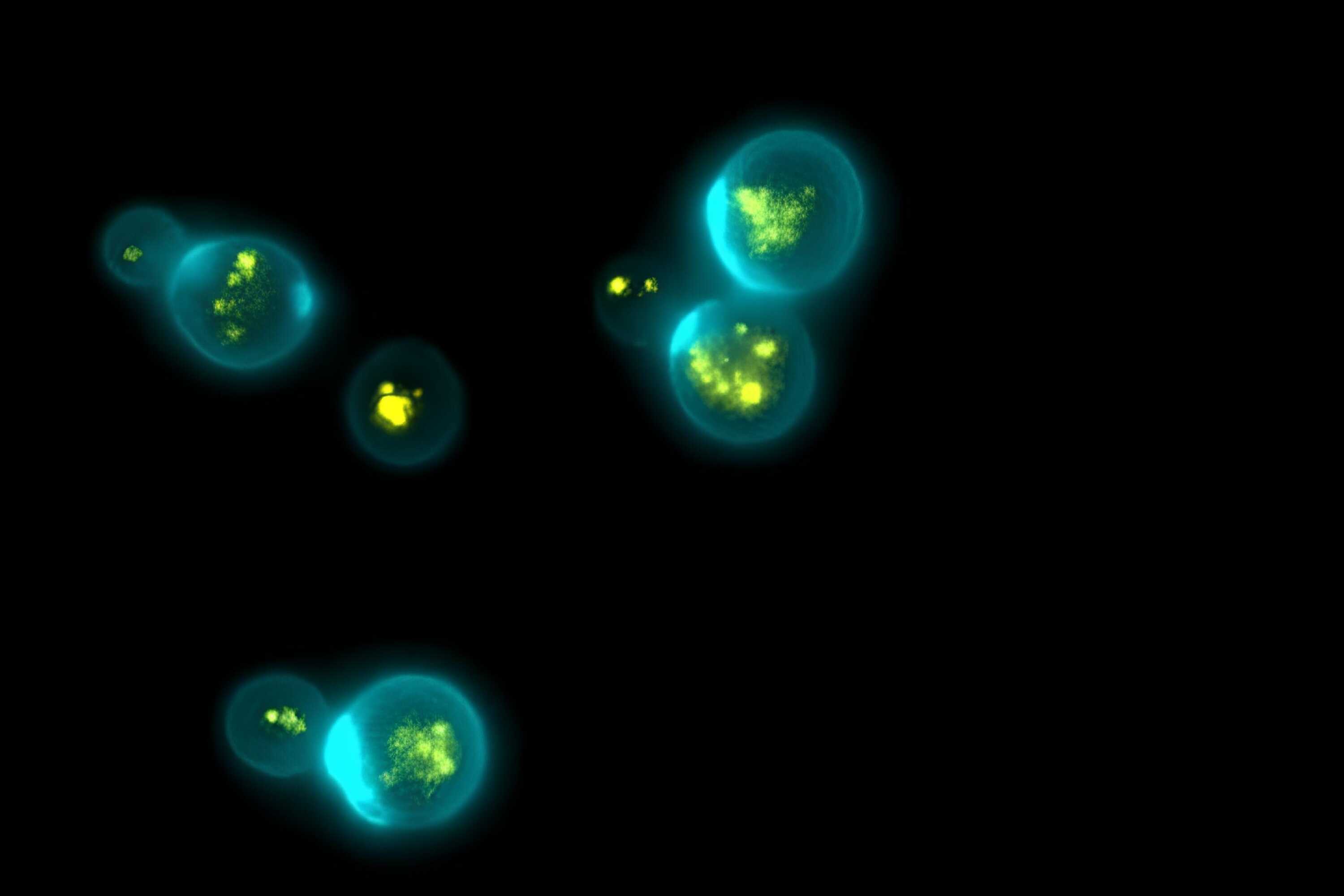
Recent concerns highlight the risk of AI in making new threats, such as synthetic viruses. But significant barriers remain, including a high rate of experimental failure and restricted access to the tools. (Image shows engineered Yeast cells. Credit: Imperial College London / Cinzia Klemm)
Beyond biosecurity risks from established facilities, DIY biology groups and bad actors operating in garage or clandestine labs – where AI could close the skills and knowledge gap – has also been the focus of public debate.
Professor Tom Ellis, from the Department of Bioengineering is part of an international group researching synthetic Yeast genomes. He offered some reassurance on the technical barriers and the complex nature of the science involved.
“My own research group is a well-funded group with a lot of ability to get equipment and get DNA. But the reality is that a vast amount, possibly the majority, of experiments we are trying every day, are failing. Because this kind of lab work is difficult,” he said.
“Even if you're a well-funded, well-connected ‘garage lab’, then it's not exactly going to be fast progress given instructions from AI,” explained Professor Ellis. “I think it's still very unlikely that people are going to be achieving success in AI-designed threats very quickly within a garage lab facility, for example.”
“Knee-jerk reactions, such as total bans on work with viruses, are likely to only disadvantage scientists whose intentions are good, whilst not really impacting anyone with malicious intent.” Professor Wendy Barclay Department of Infectious Disease
One measure to reduce risk would be to restrict access to raw materials. The “basic nuts and bolts of biology” would be a good place to start, said Professor Barclay. She highlighted DNA synthesis was an obvious area for greater oversight, noting that many companies already self-regulate. But international discussion is needed to develop a coordinated global approach.
“This is not a regional issue. This is a global issue,” said Professor Barclay. “We're right at the edge of this emerging technology and it is exactly the right time – now that we know what is potentially possible – to get together and talk about this.”
Even with restricted access to materials and a high failure rate for experiments, monitoring for biological and chemical traces in the environment remains vital to detecting emerging threats, explained Professor Leon Barron, from Imperial’s Environmental Research Group.
“The UK actually has very good capability for intercepting clandestine manufacturing laboratories, including through the use of wastewater as a detection tool,” explained Professor Barron.
“Most clandestine labs are connected to sinks, and these things can be detected – certainly from a chemical perspective. Every contact leaves a trace, including electronic ones,” he added. “I think the key thing is to make sure this is coordinated and that we don't have a blind spot for particular areas.”

Biosecurity is not just pathogens, it's also about pests, pollinators and ecosystems. The potential economic impact of targeting crops and livestock, remains a major biosecurity risk. (Image credit: Shutterstock / Aaron Watkins)
While AI and manmade threats may have dominated recent headlines, our experts warned the next major biosecurity threat may still be more likely to come from natural sources.
“One thing we say a lot in our field, where we are trying to design pieces of DNA to come together to do functions that are useful, is that ‘evolution is smarter than you’!” said Professor Ellis. “At the moment, I don't think AI-assisted DNA design is yet able to compete with what happens naturally,” he added, “so this kind of threat from the natural world is still much higher.”
“The UK actually has very good capability for intercepting clandestine manufacturing laboratories, including through the use of wastewater as a detection tool.” Professor Leon Barron Environmental Research Group
Top of the viable threat list is circulating viruses, with influenza a likely source of the next pandemic, warned Professor Barclay. She highlighted international concerns about the increasing spread of H5N1 bird flu across continents and species, with the recent incursion of the virus to Australia by migrating seabirds being “nigh on impossible to prevent”.
“[H5N1] has re-emerged and spread across the world since 2020, infecting wild birds, farm poultry, more species of wild and domesticated mammals than ever seen before for a flu virus – and of course humans…it has to be considered high risk as a pandemic source,” said Professor Barclay.
Despite the challenges inherent in countering a threat which readily mutates, can jump to other species, and fails to respect international borders, there are biosecurity measures which the international community can put in place to mitigate risk.
“Of course, in peacetime, as we currently remain, we should prepare and test vaccines, drugs, and diagnostics, and Imperial is involved in projects towards all of those,” Professor Barclay added.

Influenza remains a likely source of the next pandemic. H5N1 bird flu has spread across continents and species, infecting wild birds, farm poultry, more species of wild and domesticated mammals than ever seen before for a flu virus. (Image credit: Shutterstock / Wassana Panapute)
Beyond threats to human health, major biosecurity risks could also target food security and the ecosystems on which we depend.
Professor Neil Ferguson said a major risk, whether a threat is natural or synthetic, is the potential economic impacts of targeting plants and animals. One of the major hurdles in human pathogen research – generating enough experimental data to inform design – may be much lower for plant science and generating threats to crops and livestock. “I think we need to be probably as concerned, if not more concerned, about threats in that space, at least in the short term,” he warned.
“Imperial's initiative around building a biosecurity network is how do we realize that potential to deliver those unprecedented advances in our ability to detect and respond to the threats.” Professor Neil Ferguson School of Public Health
Professor Barron agreed, widening the scope of biosecurity: “One of the key things to speak to here is the threats to food security. It's not all about pathogens. It's also about pests. It's about pollinators. It's about ecosystem imbalance.”
“A great example is the introduction of legislation to restrict the use of neonicotinoid pesticides in the UK for their fear of the impact on pollinators,” he explained. “That shifted into use on pets, which now has ended up in that chemical being in our urban waterways.”
“I think it's not just all about 'germ warfare', to use a rather broad term, but there are several indirect knock-on impacts of these exposures within the kind of plant and animal space as well,” he added.
Ending on a positive note and the potential for rapidly advancing technology to enhance biosecurity, Professor Ferguson said: “Just as the hazards increase due to the new technology, so does our ability to respond to these new threats – to detect them early, respond to them, and develop counter measures.
“Imperial's initiative around building a biosecurity network is how do we realize that potential to deliver those unprecedented advances in our ability to detect and respond to the threats. I think we need to break down silos, both between scientific disciplines…but also importantly, between the health sector and in government, and the security sector, agricultural and plant side.”
Article text (excluding photos or graphics) © Imperial College London.
Photos and graphics subject to third party copyright used with permission or © Imperial College London.
Administration/Non-faculty departments
Cross-faculty

Imperial Global
.jpg)
Campus and community

Engineering
Engineering
Engineering
Imperial Global
Discover more Imperial News
Search all articlesDiscover more Imperial News
Search all articles