‘Failure in Science’ conference explores risk, uncertainty and research culture at Imperial
/prod01/channel_4/imperial-news/media/news-images/3000X2000-main-article-images/panel_with_slide_FINAL.jpg)
Researchers, clinicians, educators, publishers, industry leaders and artists gathered at Imperial College London for a major conference examining one of the most familiar yet least openly discussed aspects of scientific research: failure.
The Failure in Science conference, held on 16 April and organised by Imperial’s Good Science Project in collaboration with Nature, explored how failure shapes discovery, innovation, expertise, careers and research culture. The conference was jointly convened by Imperial’s Office of the Vice-Provost (Research and Enterprise) and Dr Magdalena Skipper, Editor-in-Chief of Nature, and funded by Research England.
Hosted in the Huxley Building on Imperial’s South Kensington Campus, the event welcomed attendees from universities, research organisations and publishing across the UK for a day of panel discussions, parallel sessions and plenary debates exploring how scientific communities respond to uncertainty, setbacks and intellectual risk.
Opening the conference, science communicator and broadcaster Dame Maggie Aderin-Pocock reflected on the importance of resilience, curiosity and perseverance in scientific careers.
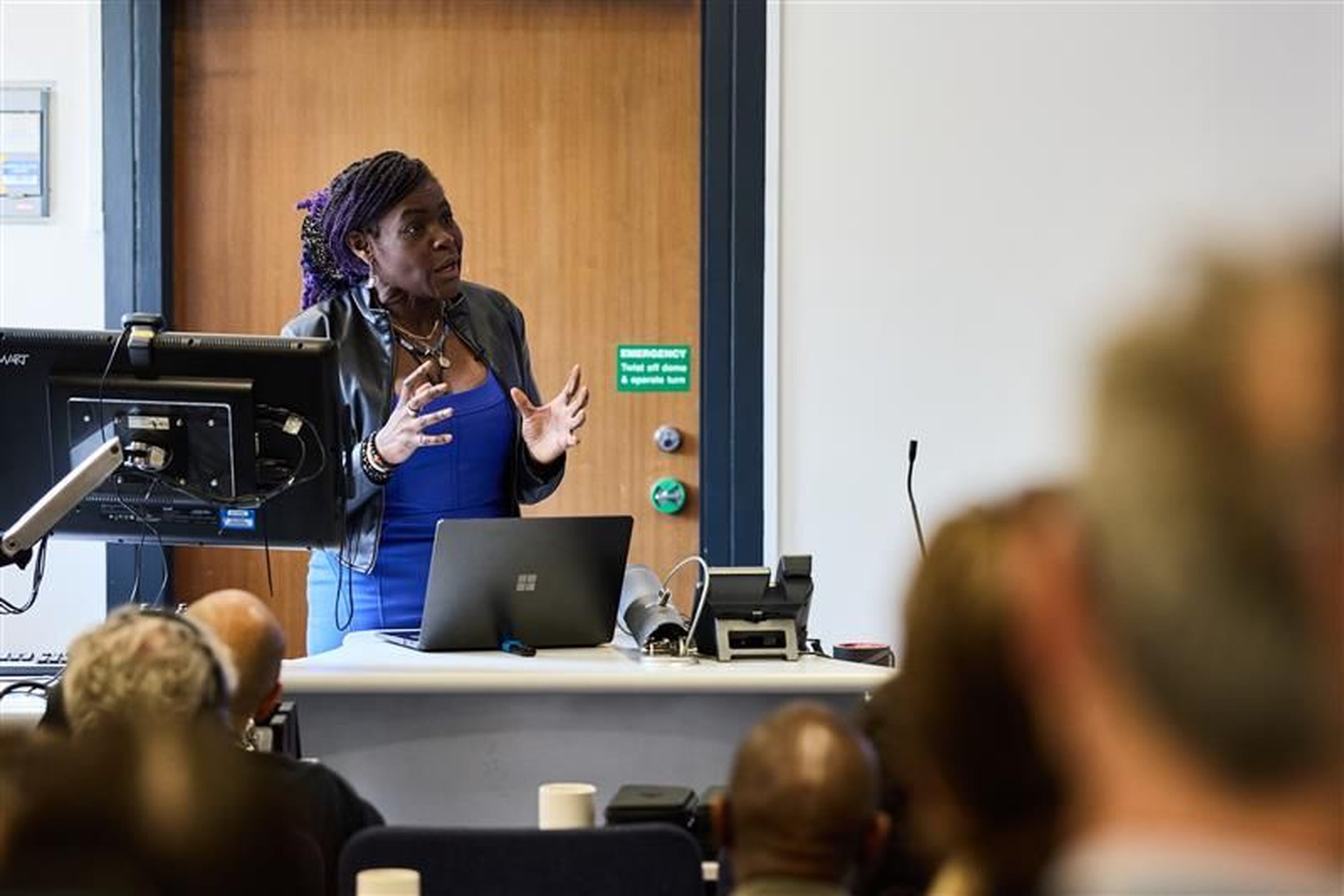
Dame Maggie Aderin-Pocock addresses delegates at the Failure in Science conference, Imperial College London
The opening panel, Perspectives on failure in science, chaired by Professor Jem Woods, brought together Professor Mary Ryan, Professor Andrew Stirling, Dr Magdalena Skipper and Professor Melanie Stefan to discuss the structural and cultural pressures surrounding failure in research.
Professor Ryan said:
“Science depends on people being willing to ask difficult questions, test ideas and pursue ambitious research where outcomes are uncertain. Yet research culture can still make it difficult to talk openly about failure, despite the fact that experimentation, setbacks and unexpected results are fundamental to discovery.
“If we want to support bold, creative and interdisciplinary research, we also need environments where researchers feel able to take intellectual risks, learn from failure and discuss challenges openly. That includes recognising that the impact of failure is not experienced equally across the research community, particularly for early career researchers and those working in more precarious environments.”
Throughout the day, speakers reflected on the tension at the heart of scientific research: while discovery depends on experimentation and the possibility of things not working, research systems often continue to reward only successful outcomes.
A recurring theme across multiple sessions was the need to move beyond seeing failure as an individual weakness or endpoint. Instead, discussions focused on how setbacks, unexpected findings and unsuccessful experiments are often an essential part of scientific progress and creative inquiry. A talking point of the conference therefore was how universities in general, and STEM institutions in particular, can see in failure a creative element, and not just a hazard.
For example, several speakers examined how funding structures, publishing models and assessment frameworks can discourage ambitious or unconventional research by penalising failure rather than recognising learning, iteration and exploration. In debates like these, speakers reminded the audience that daily management issues concerning job security, promotion and inclusivity all take on added significance.
The morning’s final session, A Taxonomy of Failure, was a scripted presentation, akin to a ‘Greek Chorus’, where a group of research scientists explored the impact of failure and its different forms on their daily practice. They explained that failure is an integral aspect of scientific creativity and showed that work-life balance, the fear of ‘falling behind’, and chance events in an individual’s research environment all take their place as powerfully influential in the life scientific. Professor George Constantinides, Director of Imperial’s Early Career Researcher Institute (ECRI), introduced the session and gave his own comments about how an institution such as Imperial, and in particular ECRI, can best manage the inevitable and indeed valuable occurrence of failure.
After a lively lunchtime of informal discussions about the themes of the conference, delegates moved on to a series of five parallel sessions exploring failure from different perspectives.
Failure and Education
In Failure and Education, chaired by Dr Mark Pope, Dame Maggie Aderin-Pocock, Dr Wayne Mitchell and Professor Camille Howson discussed how educational environments shape attitudes towards mistakes, confidence and resilience. The session also featured student panelists Shweata Hegde and Rosanne Choong, whose contributions offered a vivid counterpoint to the perspectives of established academics.
Dr Mitchell challenged the panel to consider who the education system is actually failing. Drawing on the example of a pupil who had struggled academically but, when given a different kind of challenge, independently organised a class car wash that raised nearly £500 for a bowling competition, delegating maths to the strongest students, managing logistics and motivating his peers, Dr Mitchell argued that such a child’s strengths were simply never valued by the system. “For many people,” he suggested, “education has failed them, rather than the other way around.”
Dame Maggie argued that the current education system remains rooted in a Victorian model designed for a narrow type of learner, and that it has not kept pace with the industrial, digital and AI revolutions. She observed that PISA research suggests children often leave school less curious than when they enter, a failure she said the system should urgently address. She also reflected on the nature of failure itself: those who experience small setbacks throughout their education may be better prepared for larger ones later in life.
Professor Howson pointed to a striking example from the Covid pandemic, when students were given boxes of materials to experiment with at home. Freed from direct observation and formal assessment, many engaged in what felt to them like real science for the first time. She also noted that a published paper is a reconstruction of the research process and does not reflect the messiness of how the work actually happened. A genuinely research-intensive education, she argued, should help students understand that messiness.
Student panelist Rosanne Choong reflected on the gap between students’ expectations and outcomes. Describing an assignment she had been excited about but had not performed as well in as she had hoped, she noted that students often judge themselves against subjective criteria that may not reflect the reality of their work. She suggested that platforms such as LinkedIn, which present a constant stream of peers’ achievements, make this worse by distorting students’ sense of what is normal.
Shweata Hegde raised the question of cultural context, noting that attitudes to educational choices vary significantly across countries. She pointed to a more fundamental challenge: how do we get people into science in the first place, and how do we sustain curiosity when access to resources is unequal?
The session ended with a spontaneous gathering at the front of the auditorium, as panelists and attendees continued their conversations informally, a fitting illustration of the panel’s own point that some of the most valuable learning happens outside formal structures.

Delegates contribute to the Failure Wall at the Failure in Science conference
Further parallel sessions
Failure and Innovation, chaired by Dr Nejra Van Zalk, explored uncertainty and experimentation in technology, policy and industry, and brought together Professor Stirling, autonomous vehicles barrister Alex Glassbrook, Dr Joanne Hackett and Dr Angelo Amorelli.
Questions surrounding hierarchy, inequality and research culture were examined in Failure and Power, featuring Professor Patricia Kingori, Dr Magdalena Skipper and Shomari Lewis-Wilson, and chaired by Dr Stephen Webster.
Meanwhile, Failure and a Career in Science, chaired by Nature staffer David Payne, focused on the realities of scientific careers and the role uncertainty, luck and career changes can play in professional development. Dr Nessa Carey, Dr Alex Richardson and Jack Leeming reflected on the movement between academia and industry, the pressures facing researchers and the importance of resilience, communication and adaptability.
Alongside discussions on research culture and scientific practice, the conference incorporated perspectives from music and the arts. The session Failure and Expertise explored how experiences of failure evolve throughout a career and across disciplines. Professor Roger Kneebone, Professor Richard Wingate, Professor Ruth Morgan and musician and mathematician David Gordon discussed expertise, creativity, interdisciplinarity and the relationship between uncertainty and innovation. The session featured a live improvisation performance from David Gordon, giving delegates a vivid real-time exploration of uncertainty, vulnerability and creative risk-taking.
Artificial intelligence also emerged as a significant topic throughout the day, with discussions examining how AI may reshape scientific and creative practice while raising broader questions about judgement, imagination, experimentation and human expertise.
The conference concluded with a plenary session featuring Professor Wingate, Dr Carey and science writer Dr Philip Ball, chaired by Dr Felicity Mellor. The discussion reflected on how universities, publishers and funders can better support open conversations around failure and create environments that enable ambitious, imaginative and collaborative research.
Following the conference, Nature published the editorial ‘We Need to Talk about Failure in Science’, praising Imperial’s conference, arguing that science needs to become more open about failure and the role it plays in research progress, and warning that systems which reward only success risk discouraging the kind of bold thinking and experimentation that drive scientific discovery.
Article text (excluding photos or graphics) © Imperial College London.
Photos and graphics subject to third party copyright used with permission or © Imperial College London.
Article people, mentions and related links
Caitlin O'Shea
Administration/Non-faculty departments