.jpg)
Campus and community
/prod01/channel_4/imperial-news/media/news-images/3000X2000-main-article-images/Claudia_headshot_3000X2000.jpg)
Imperial College London researcher Dr Claudia Ghidini has been awarded the 2026 Sir Michael Uren Prize for developing adjustable prosthetic technology designed to adapt as children grow, with promise for young patients in humanitarian and low-resource settings.
Her research addresses a longstanding challenge in paediatric prosthetic care: while prosthetic technology has advanced significantly in recent decades, many devices used by children remain adapted versions of prosthetics originally designed for adults. This approach fails to account for the rapid skeletal growth, biomechanics and day-to-day needs of young users.
As a result, children frequently outgrow their prosthetic sockets within months, often experiencing discomfort, skin issues, reduced mobility and repeated clinical visits. In settings where access to specialist care is limited, poorly fitting devices can go unaddressed for extended periods, creating long-term barriers to education, independence and participation in daily life.
Recent humanitarian crises have intensified focus on paediatric prosthetic care in conflict and disaster-affected regions. Drawing on fieldwork conducted across Cambodia, Ukraine, Türkiye and Jordan, Dr Ghidini’s research responds to the growing need for adaptable prosthetic technologies capable of supporting children through periods of rapid growth and changing physical needs. UN agencies and humanitarian organisations have also identified Gaza as home to one of the largest cohorts of children with amputation in modern history, further highlighting the scale and urgency of the challenge.
Operating within Imperial’s Centre for Paediatric Blast Injury Studies, Dr Ghidini’s work combines engineering design, clinical insight and direct engagement with young users and their families. Her doctoral research has provided a detailed understanding of how growth affects prosthetic fit and function in children, using clinical data, motion analysis and user-centred research approaches.
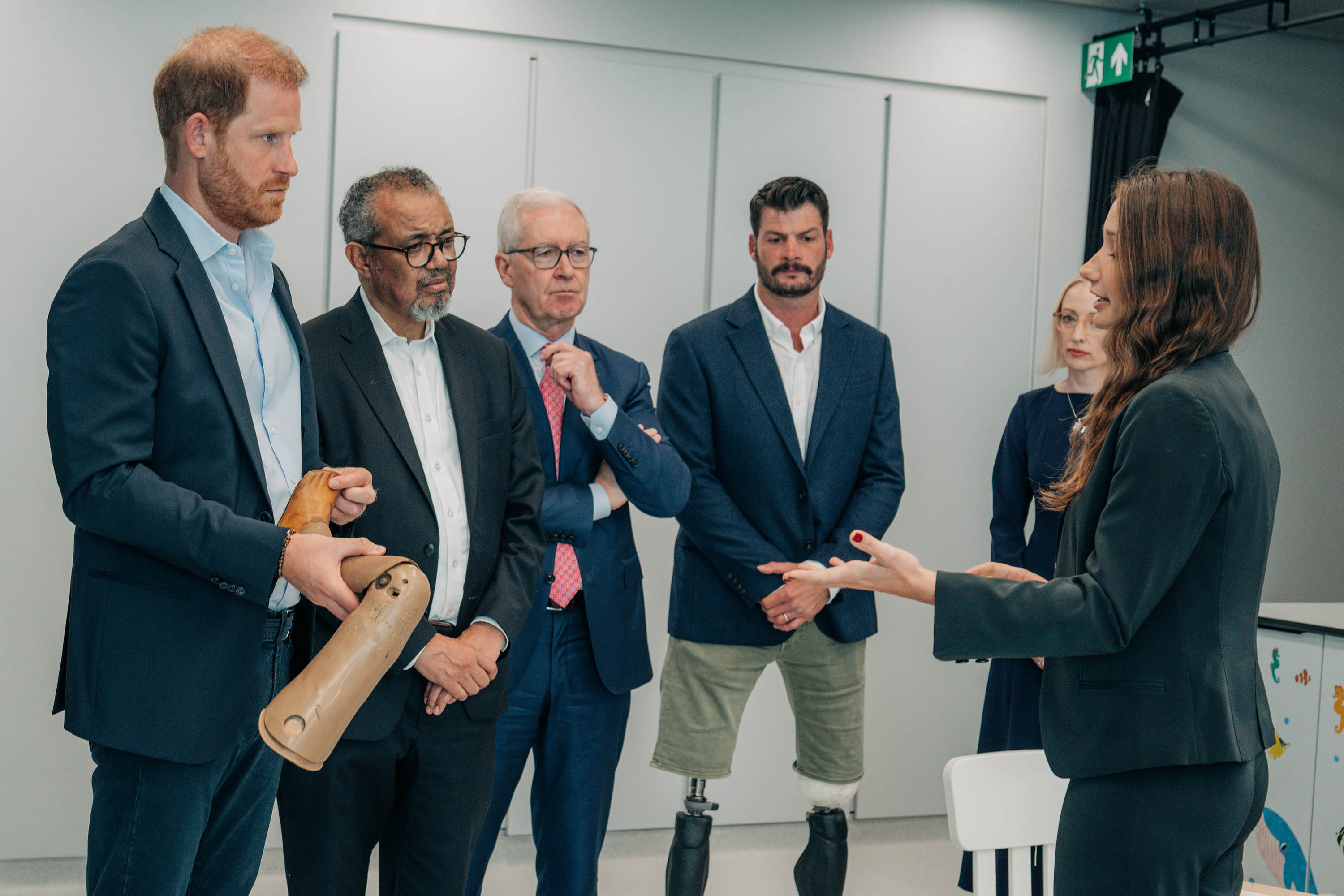
Dr Claudia Ghidini presenting her research to the Duke of Sussex and WHO Director-General Dr Tedros Adhanom Ghebreyesus at the Centre for Paediatric Blast Injury Studies, Imperial College London. Credit: Misan Harriman.
A key aspect of the work involved capturing the perspectives of children, clinicians and their families, helping to identify distinct and overlapping priorities. Children demonstrated a clear understanding of what worked well in their prostheses and what needed improvement, expressing preference for prostheses that are comfortable, easy to adjust, and provide the functionality needed to participate fully in play.
A modular socket designed to grow
At the centre of Dr Ghidini’s work is a modular, growth-adaptive prosthetic socket. Unlike conventional rigid designs, the proof-of-concept device can be manually lengthened and widened, allowing a single socket to accommodate a child’s growth over a significantly longer period.
The design incorporates adjustable features intended to improve fit and comfort over time while reducing the need for repeated specialist intervention. Importantly, the device has been designed with use beyond specialist clinical environments in mind, enabling adjustments outside a traditional clinical setting (e.g., mobile clinics). In low-resource and humanitarian settings, where access to prosthetic clinics may be extremely limited, a device that can be maintained and adjusted locally has the potential to make a significant difference to children whose needs might otherwise go unmet for months or years.
The design could also support more efficient care pathways in healthcare systems such as the NHS by reducing the frequency of specialist refitting appointments.
The development of a prosthetic socket that can grow with a child, and be used in the communities where the need is greatest, is precisely the kind of innovation this Prize exists to nurture. Trustees of the Michael Uren Foundation
Funding from the Prize will support the next stage of development, including refining the design for manufacture, and producing prototypes for validation and field testing. The project is being advanced in collaboration with an Imperial spin-out social venture - GO Assistive Technology - specialising in accessible prosthetic solutions for low-resource and humanitarian settings, providing a clear pathway towards real-world deployment.
The Sir Michael Uren Prize
Now in its third year, the Sir Michael Uren Prize recognises postgraduate researchers at Imperial College London whose work combines academic excellence with a strong pathway towards translation and societal impact. Established through the support of the Michael Uren Foundation, the Prize supports research with the potential to deliver meaningful environmental, economic, societal or health benefit beyond academia.
The award includes £20,000 in funding to help accelerate translational activity, supporting recipients as they move promising research closer towards implementation and deployment.
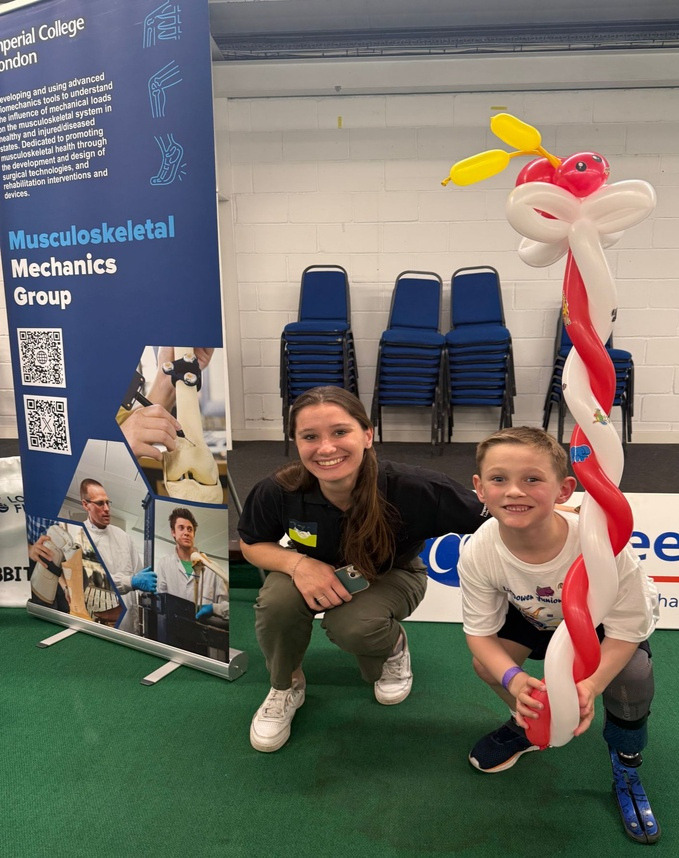 Dr Claudia Ghidini meeting a young visitor at a prosthetics outreach event.
Professor Mary Ryan, Vice-Provost (Research and Enterprise) and Chair of the Prize Committee, said:
“Claudia’s research is an outstanding example of translational innovation driven by a deep understanding of patient need. By combining engineering, clinical insight and direct engagement with children and families, she has developed a technology with the potential to make a meaningful difference to quality of life for young people living with limb loss, particularly in settings where access to specialist care is limited.”
The Trustees of the Michael Uren Foundation added:
“Sir Michael believed deeply in the power of engineering to transform lives, and Claudia's work is a wonderful reflection of that vision. The development of a prosthetic socket that can grow with a child, and be used in the communities where the need is greatest, is precisely the kind of innovation this Prize exists to nurture. We are proud to support her in taking this important work forward.”
Looking ahead, Dr Ghidini plans to continue developing the technology beyond the scope of her doctoral research, with the aim of delivering a scalable, accessible and manufacturable solution capable of reaching children in the communities where the need is greatest.
Dr Ghidini said: “I am deeply grateful to receive this prestigious award, particularly as it recognises a significant unmet clinical need. I have witnessed first-hand the challenges children face daily as their prostheses become tight and poorly fitted. This award will support the translation of research that is often difficult to fund, and, with the support of GO Assistive Technology, we can help ensure this innovation reaches those who need it most.”
Article text (excluding photos or graphics) © Imperial College London.
Photos and graphics subject to third party copyright used with permission or © Imperial College London.
Administration/Non-faculty departments

Campus and community

Engineering

Engineering

Engineering
Imperial Global
Cross-faculty
Campus and community
Discover more Imperial News
Search all articlesDiscover more Imperial News
Search all articles