
Business
by Ian Mundell
/prod01/channel_4/imperial-news/media/news-images/3000X2000-main-article-images/2026-09-22-AMS-renewal-handshake-Panji-Kaonga.jpg)
The agreement extends operation of Agilent Measurement Suite, which provides advanced analytical science tools and training to Imperial researchers and companies in its expanding west London ecosystem.
A partnership between laboratory solutions provider Agilent Technologies and Imperial College London will continue for a further four years under an agreement signed in September. This will ensure the future operation of the Agilent Measurement Suite (AMS), which provides researchers and companies with access to advanced analytical science tools and hands-on training so that they can carry out measurements otherwise out of their reach.
When you combine technical capabilities far beyond a typical academic lab with the deep expertise and curiosity of a world top‑ten university, you get both groundbreaking research and a world-changing innovation ecosystem. Professor Mary Ryan Vice Provost (Research and Enterprise)
Work at the AMS has helped advance research in areas such as antimicrobial resistance, energy storage, drug discovery and medicinal chemistry. Researchers from 17 Imperial departments as well as 30 companies and external users are working on diverse projects spanning drug delivery, nanotechnology, photocatalysis, green and environmental chemistry and biomass processing, cancer and immunology.
Located on Imperial’s White City Campus, the Suite's reach extends to the four innovation clusters that form the WestTech London innovation ecosystem. Since opening in 2019, the AMS has hosted over 1,200 users from companies and academic labs, and supported successful bids for over £200 million in research funding and venture capital investment.
“The continued partnership with Agilent and the renewal of the AMS will be important in sustaining and expanding these benefits, ensuring that Imperial remains at the forefront of training the next generation of scientific and engineering leaders,” said Imperial’s Provost and Deputy President, Professor Peter Haynes.
“When you combine technical capabilities far beyond a typical academic lab with the deep expertise and curiosity of a world top‑ten university, you get both groundbreaking research and a world-changing innovation ecosystem,” said Professor Mary Ryan, Vice Provost (Research and Enterprise) at Imperial. “With Agilent as a driving force in the rapid growth of WestTech London, I’m excited to see what we can achieve next.”
“This collaboration demonstrates what can be achieved when scientific excellence, advanced technology and a shared ambition come together,” said Frédéric Laget, Vice-President of the Commercial Sales and Application Organisation for EMEA at Agilent Technologies. “We are proud to continue our partnership with Imperial and look forward to exploring new opportunities to expand its impact in research and innovation, while further strengthening our broader collaboration across science, education, and technological advancement.”
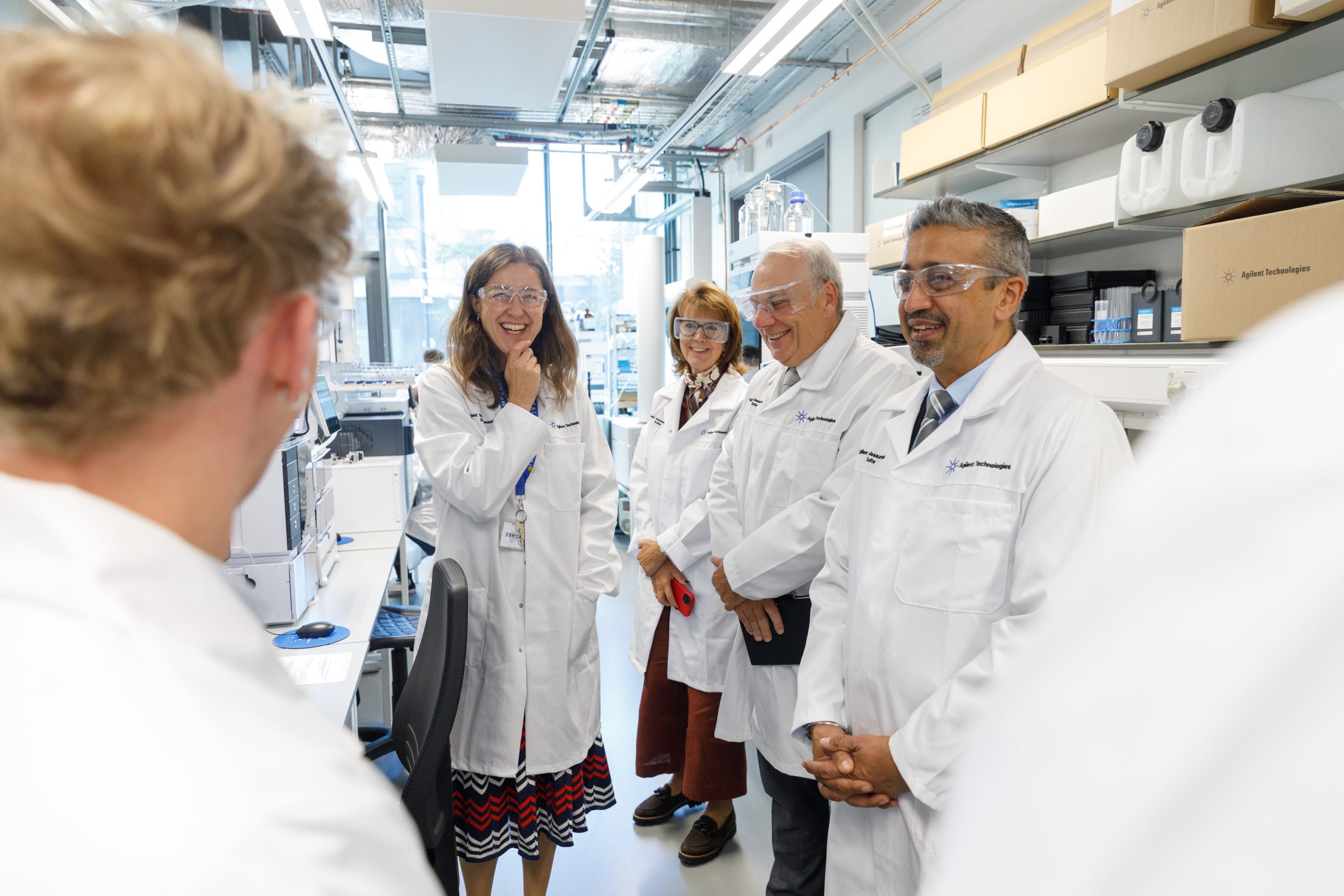
“The Agilent Measurement Suite gives us something incredibly valuable: the opportunity to put our technology in the hands of outstanding researchers and innovative companies working on some of the most important scientific challenges,” said Gub Singh, Vice President of Agilent’s EMEA Customer Service Organisation. “By enabling scientific discovery and innovation, the collaboration helps advance Agilent's vision of expanding the frontiers of science while creating meaningful impact across Imperial's growing innovation ecosystem.”
Initiatives that have benefited from the AMS include large-scale academic research programmes such as the Fleming Initiative, which is using £100 million from philanthropists and partners such as GSK to tackle antimicrobial resistance, the Bezos Centre for Sustainable Protein, Centres for Doctoral Training in chemical biology and next-generation chemistry, and the AI for Chemistry hub.
The AMS has also supported the development of academic startups such as cell culture innovator Multus, energy storage spinout Certain Energy, and AI-driven chemical process company SOLVE Chemistry.
“I’ve seen companies use the AMS to make one critical measurement – at a level of precision they could not achieve elsewhere – that unlocked a funding round, helped them to scale, or took a product to the next stage,” said Professor Marina Kuimova, Director of the AMS.

Crucially, the AMS involves scientists and companies in the analysis, providing the training needed to conduct and interpret the measurements. “Researchers often tell us that working with the AMS is unlike any other analytical experience,” says Professor Oscar Ces from the Department of Chemistry. “Rather than sending a sample off and receiving data back, they’re involved at every stage – from method development through to interpretation. That’s incredibly valuable for training, confidence and scientific rigour.”
So, while the instruments are essential to the AMS, so are the people involved. “Behind the success of the AMS’s operational model is an excellent team of dedicated staff: the technical team supporting each AMS instrument based in the Chemistry Department, working closely with Agilent’s product specialists,” says Professor Kuimova. “This close interaction ensures that each user gets directed support to advance their project, fast.”
The continuation of the partnership between Imperial and Agilent will support both future research and the development of the innovation ecosystem in West London.
“Looking ahead, the AMS offers substantial strategic opportunities for growth, particularly through its connection to the wider WestTech London ecosystem,” said Professor Ramon Vilar, head of the Department of Chemistry. “As a rapidly developing hub for research and innovation, the ecosystem provides the AMS with an ideal environment to catalyse new partnerships across academia and business.”
Photo credit: Panji Kaonga
Article text (excluding photos or graphics) © Imperial College London.
Photos and graphics subject to third party copyright used with permission or © Imperial College London.
Administration/Non-faculty departments

Business

Engineering

Cross-faculty

Imperial Global
.jpg)
Campus and community

Engineering

Engineering
Engineering
Imperial Global
Cross-faculty
Discover more Imperial News
Search all articlesDiscover more Imperial News
Search all articles