
Engineering
/prod01/channel_4/imperial-news/media/news-images/3000X2000-main-article-images/201204_jessica_design_engineering_JA_006-(1).jpg)
Imperial recently carried out a major test of its Emergency Communication System, using the SafeZone platform to send alerts to tens of thousands of staff and students.
The test forms part of a wider, ongoing programme to identify the most effective long-term platform for mass communications. While SafeZone is currently one of the tools Imperial uses, the university continues to explore alternative or complementary systems to ensure we have the best solution in place for future emergencies.
The goal of this test was simple but vital: to make sure we’re using the most reliable tools to keep our community safe and to prepare for the introduction of Martyn’s Law, which will place new duties on organisations to plan for and respond to major incidents.
Martyn’s Law is raising the bar on how organisations prepare for and respond to major incidents Brindha McDonald Director of Security and Community Safety.
On Wednesday 12 November, a test alert was sent via SMS and SafeZone push notification. This was not just a technical test, it was also an opportunity to understand how familiar people are with SafeZone and how well they receive information through different channels.
SafeZone already plays a useful role in campus safety, allowing users to request help from Security, share their location when working late, or access wellbeing support. This test also examined its effectiveness as a mass communications tool - while acknowledging that the university may refine, replace, or supplement SafeZone as part of its future strategy.
“Martyn’s Law is raising the bar on how organisations prepare for and respond to major incidents,” says Brindha McDonald, Director of Security and Community Safety. “Testing is essential to ensure any system we use performs exactly as it should when it matters.”
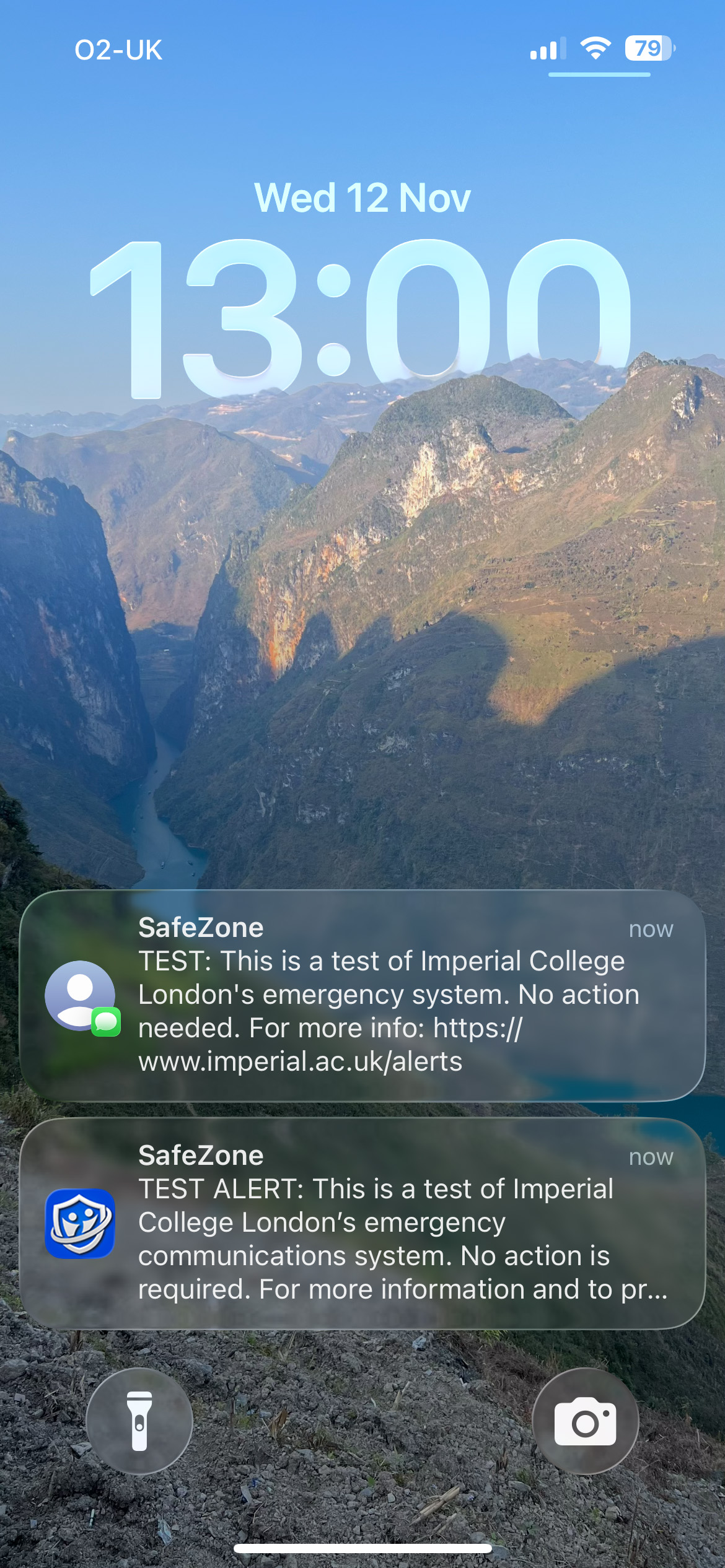 The test aimed to confirm system performance, check the accuracy of contact data, assess delivery times across SMS and push notifications, and build confidence among staff who may need to issue alerts. It also helped raise awareness and collect feedback to guide future improvements.
On the day, SMS messages and push notifications were issued simultaneously across the community, giving teams valuable insight into how both channels perform under real conditions. The test confirmed that generally, messages were successfully reaching staff and students and highlighted where small adjustments, such as notification settings and contact information, can make delivery more reliable. More than 1,600 staff and students completed the feedback survey, and we’re grateful for the thoughtful responses. Your feedback is helping us understand how the alert was received and where improvements will have the greatest impact.
A key finding was that many respondents received the SafeZone push notification faster than the SMS, especially when the app was configured correctly. This highlights the value of having the app installed and notifications enabled, even as Imperial continues to evaluate its long-term mass communications approach.
“One of the most encouraging findings was how often people said the push alert arrived before the text,” says George Wrigley, Community Safety and Security Projects Manager. “Speed matters in an emergency. This kind of insight helps us understand how different tools perform and what we may need from a future solution.”
Some alerts were delayed or missed due to mobile signal issues, notification settings, overseas routing delays, or out-of-date contact details. Others simply didn’t notice the alert due to silent mode or being in class or meetings.
Following the test, teams are now focusing on four priority areas:
This work feeds directly into Imperial’s preparation for Martyn’s Law and the wider review of mass communication tools across the university.
You can play a part too. If you haven’t already, download and register in the SafeZone app, enable notifications, and make sure your contact details are up to date. While our long-term communications strategy continues to evolve, every improvement we make today helps strengthen Imperial’s ability to keep you informed and protected.
Article text (excluding photos or graphics) © Imperial College London.
Photos and graphics subject to third party copyright used with permission or © Imperial College London.
Administration/Non-faculty departments

Engineering

Health

Health

Health
Science
Science
Campus and community
Discover more Imperial News
Search all articlesDiscover more Imperial News
Search all articles