
Science
/prod01/channel_4/imperial-news/media/news-images/3000X2000-main-article-images/220304_centre_quantum_engineering_084-3.jpg)
QuEST PhD researchers studied how quantum teaching and jobs connect to the UK’s Quantum Missions.
Imperial Centre for Quantum Engineering, Science and Technology (QuEST) PhD researchers performed a comprehensive analysis of UK quantum teaching and job market opportunities, exploring how universities can support the National Quantum Strategy and prepare the workforce that will deliver the Quantum Missions.
The research was prompted by Quantum Skills Taskforce Report, published in April 2025 by the Government’s Office for Quantum. The report emphasised the need for new pathways into quantum, especially for non-physicists, and inspired the team to examine Imperial’s own quantum provision: were Imperial graduates being prepared for the next technological revolution?
To investigate, Josephine Hunout and Shey Dylan Lovett, PhD students in Department of Aeronautics and Physics, built three datasets: where quantum was taught across Imperial’s undergraduate and graduate degree programmes, where quantum was taught in UK Masters programmes advertised as quantum on UCAS and FindAMasters, and all quantum-related LinkedIn job postings in the UK over a period of three months.
They then evaluated how well the quantum courses and job listings aligned with the National Quantum Missions.
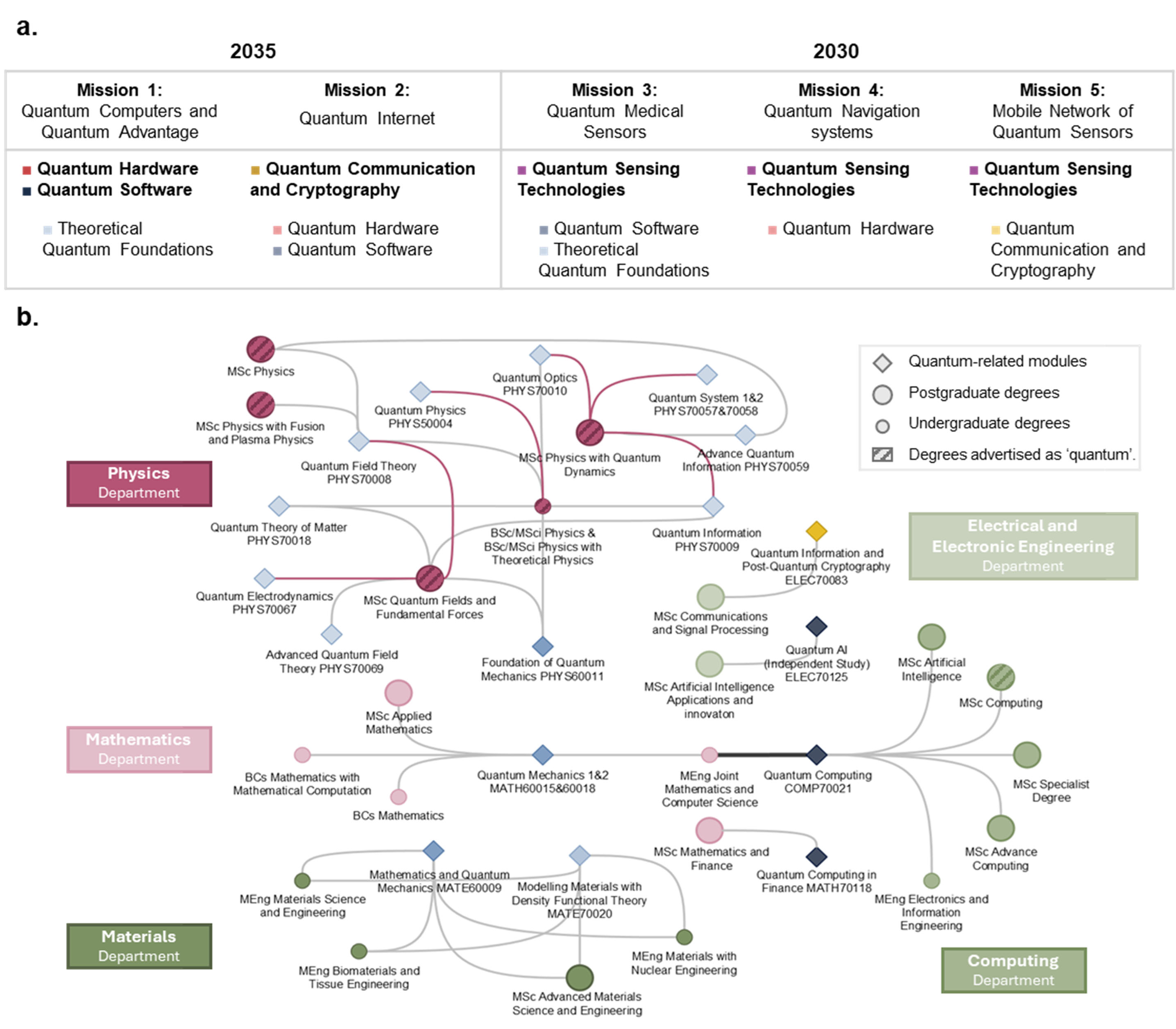
Fig1. a) Summary of national quantum missions and the main and secondary quantum skills they require. b) Network of quantum-related modules taught at Imperial and their links to undergraduate and postgraduate degrees. Modules colours correspond to the skill categories in panel a. Links are light grey for elective modules, coloured for core modules, and dark grey for modules shared between departments.
The map of Imperial revealed a rich network of quantum modules spread across the Departments of Physics, Mathematics, Computing and Electrical and Electronic Engineering. Around 70% of the teaching was delivered through elective modules, opening the door to quantum-curious students from many academic backgrounds.
However, only a third of these courses appeared on public platforms associated to the keyword ‘quantum’ (e.g. UCAS and FindAMasters), meaning students browsing through degree directories could miss much of what Imperial offers. This pattern reflected national trends, where Master’s programmes often include significant quantum content without making it explicit. Students with low ‘quantum capital’, those with limited familiarity with quantum concepts and limited exposure to the sector, may struggle to discover the full range of opportunities.
Courses and job postings place strong emphasis on quantum computing, hardware, and algorithms. These areas dominate media attention and attract the majority of applicants, while other sectors such as sensing, imaging, and timing are less visible.
This is a concern for quantum sensing which underpins three of the five Quantum Missions, all of which have imminent deadlines (e.g. quantum for healthcare by 2030). Despite this urgency, quantum sensing only appeared on a small number of advertised Master’s programmes and job postings. Josephine and Shey’s research highlighted a clear gap: the Missions with the most imminent deadlines rely on skills that are underrepresented amongst our current students.
This year Imperial launched an Advanced Sensors focused Master’s programme to upskills engineers in next generation sensing technologies.
The study highlights a simple but powerful opportunity: many existing courses already prepare students for careers in the quantum sector, but do not present themselves in a way that allows applicants to recognise it. Increasing the visibility of quantum teaching could broaden participation, strengthen recruitment and help Imperial and other UK institutions to maintain their leadership in the field.
This study has led to two comment pieces published in Nature Reviews Physics; Assessing the skills gap for the UK’s quantum missions, and Quantum training in the UK needs better visibility.
Article text (excluding photos or graphics) © Imperial College London.
Photos and graphics subject to third party copyright used with permission or © Imperial College London.
Faculty of Engineering

Faculty of Engineering
Faculty of Engineering


Science

Cross-faculty

Health

Engineering
Science
Health
Health
Discover more Imperial News
Search all articlesDiscover more Imperial News
Search all articles