
Engineering
/prod01/channel_4/imperial-news/media/news-images/3000X2000-main-article-images/2026-05-26-Plato's-allegory-of-cave.jpg)
Researchers at Imperial have shown that different AI models used to simulate materials can independently learn the same underlying chemical patterns, a finding that could enable models to be more easily compared, reused, and combined.
A new study from Imperial’s Department of Materials, published in Nature Machine Intelligence, has found that independently developed artificial intelligence systems can converge on shared representations of the physical world.
The research explores whether AI models trained to simulate materials develop similar internal structures, an important step towards determining whether such systems can be directly compared and combined. This work establishes a way to make AI models compatible with each other.
The team focused on machine learning interatomic potentials (MLIPs), a rapidly growing class of AI models trained to predict how atoms behave inside materials. These systems enable fast digital simulations of atomic-scale physics, allowing scientists to study and design new materials far more quickly than traditional quantum mechanical methods.
Despite their success, most MLIPs are developed independently, with no common way to directly compare how they represent chemical information or assess consistency between models.
Researchers from the Department of Materials found that independently developed MLIPs organise atomic environments in remarkably similar ways, despite differences in their design and data.
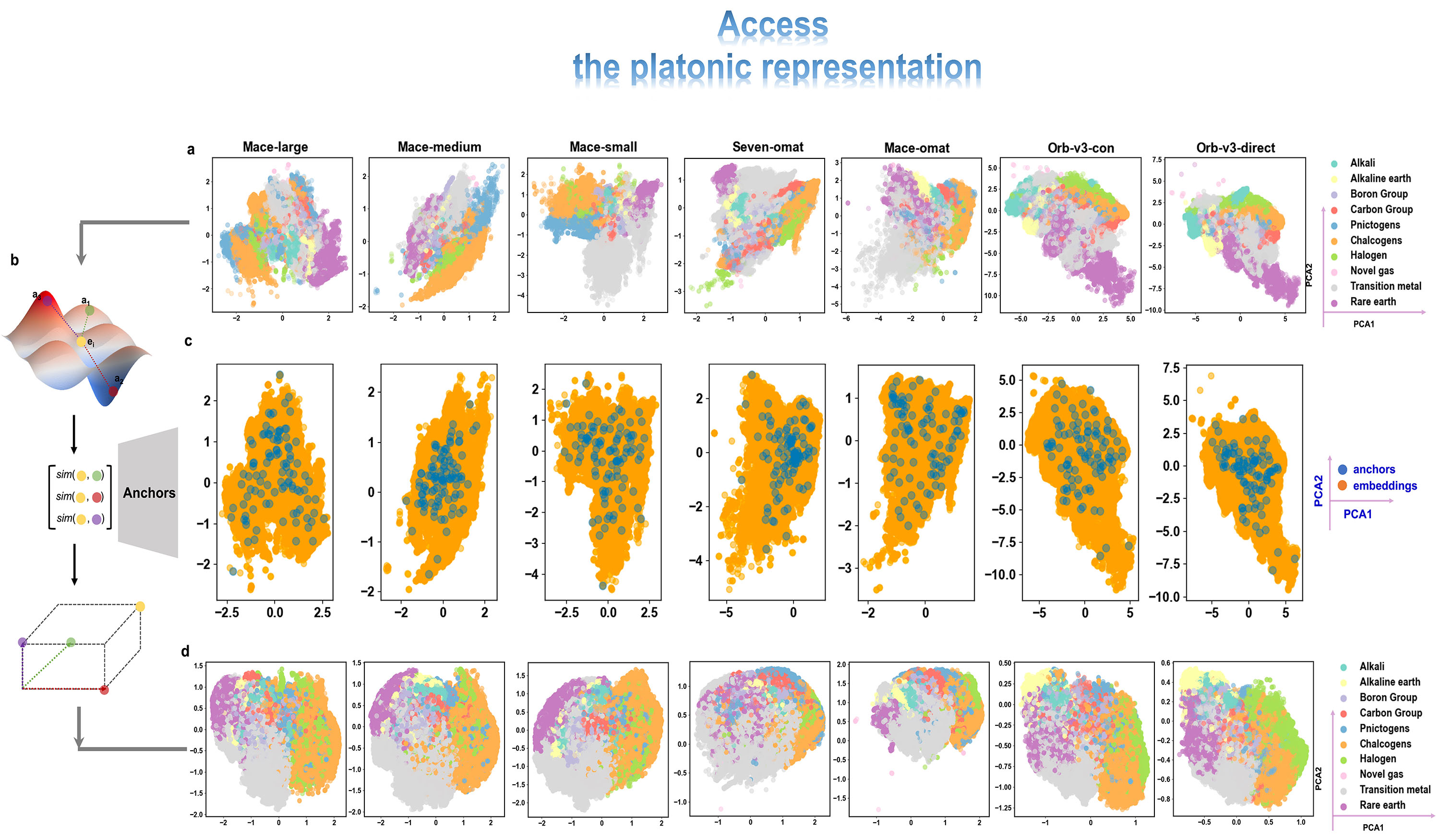
Using a framework based on “anchor” atomic environments, they mapped seven leading MLIPs into a shared space, allowing them to directly compare how each model represents atoms, revealing a common internal “language” for encoding atomic environments. The unified representation preserves key chemical relationships, including periodic trends and structural invariants.
The framework also allowed them to isolate and stitchparts of these internal representations together, enabling a more structured way of analysing how different models encode chemical information.
Despite their differences in design and training, the models showed strikingly consistent geometric patterns in how they organise chemical information, suggesting that different systems are effectively learning the same underlying structure.
We are advancing the materials models toward Plato’s ‘ideal’ reality. Professor Aron Walsh Chair in Materials Design, Department of Materials
The findings support the “platonic representation hypothesis”, an emerging theory suggesting that sufficiently advanced AI models trained on the same reality may converge towards shared internal representations. Inspired by Plato’s idea of underlying ideal forms, the hypothesis proposes that different AI systems may ultimately approximate the same deeper structure of the physical world.
Professor Aron Walsh, Chair in Materials Design, Department of Materials, and co-author of the paper said, "We are advancing the materials models toward Plato’s ‘ideal’ reality.”
We believe AI in Science will become a subject of Science, which can be interpreted and interoperated. Dr Zhenzhu Li Research Fellow, Department of Materials
The ability to align models opens up new possibilities for comparing and reusing AI systems in materials research, where models are often developed independently.
By mapping different models into a shared representation space, the approach allows knowledge to be transferred between systems, supporting more connected and efficient workflows for scientific discovery.
Dr Zhenzhu Li, Research Fellow, Department of Materials and co-author of the paper said, “We believe AI in Science will become a subject of Science, which can be interpreted and interoperated.”
In practical terms, the framework could support more efficient development of new models and enable researchers to reuse existing systems across different applications, from materials discovery to chemical simulation.
As AI becomes more central to materials science, understanding how these systems internally represent the physical world is becoming increasingly important. The team hopes the work could contribute towards future interoperable AI systems for science, where models developed by different groups can more effectively exchange and build on knowledge.
Li, Z., Walsh, A. Platonic representation of foundation machine learning interatomic potentials. Nat Mach Intell (2026). https://doi.org/10.1038/s42256-026-01235-7
Article text (excluding photos or graphics) © Imperial College London.
Photos and graphics subject to third party copyright used with permission or © Imperial College London.
Faculty of Engineering


Cross-faculty

Imperial Global
.jpg)
Campus and community

Engineering
Engineering
Engineering
Imperial Global
Discover more Imperial News
Search all articlesDiscover more Imperial News
Search all articles