

Campus and community
/prod01/channel_4/imperial-news/media/news-images/3000X2000-main-article-images/2026-01-08-Undaunted_-Collage_2_Landscape.jpg)
Solutions to help us mitigate and adapt to the climate crisis are shaping a more sustainable future. Here are seven reasons why we’re Undaunted in the face of climate change as we start the new year.
Undaunted offers a host of programmes and a thriving ecosystem to support early-stage innovators developing ideas to impact a broad range of sectors and industries. It’s the tenacity and talent of this community of founders and supporters that keeps us Undaunted in the face of climate change!
Below are just a few of the reasons why we remain Undaunted as we start a new year. There's lots planned for 2026: sign up to our newsletter to stay in-the-loop on climate innovation opportunities, events and news across London, the UK, and beyond.
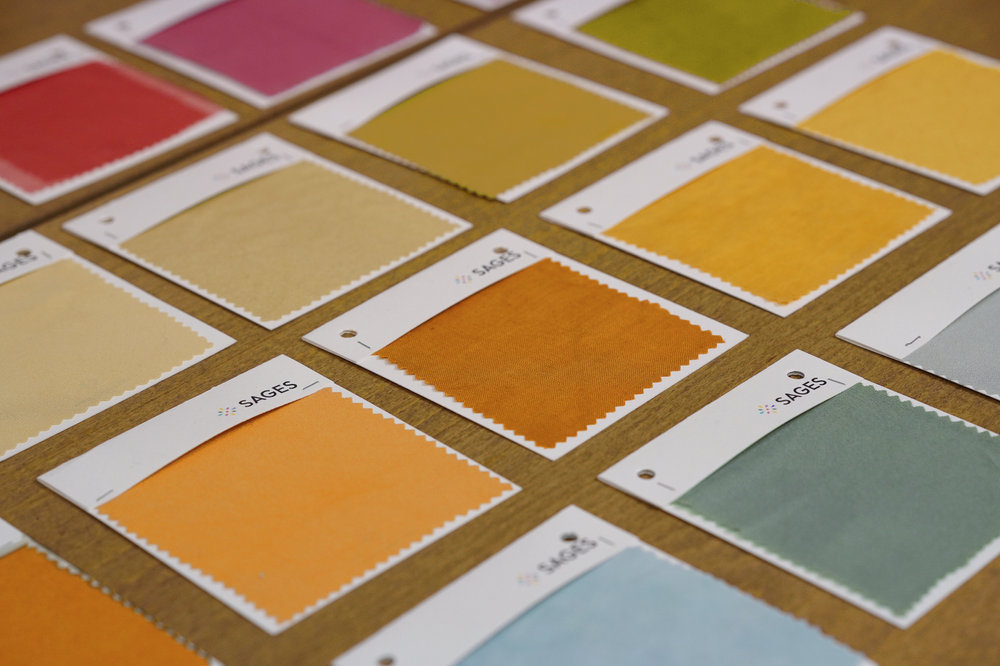
SAGES has developed a sustainable extraction process to manufacture low-impact, biodegradable, and non-polluting dyes from food waste. These dyes are industry ready and available across a wide range of colours.
In 2025 the team completed its most ambitious grant-funded project to date, supported by a £500k Innovate UK SMART Grant, proving that it can consistently produce powder dyes at scale, in a range of colours for both fabric and yarn dyeing. Its tech is now manufacturing-ready and moving into scale-up. The team has also secured waste partnerships with global food businesses, including Westfalia and Bananatex®, ensuring it has the consistent feedstocks required to scale.

Deep.Meta enhances metals manufacturing by using AI to boost production efficiency, reduce waste, and lower CO2 emissions for steel producers. Founded by Imperial and Undaunted alumnus, Dr Osas Omoigiade, Deep.Meta has worked with Spartan UK to identify and tackle inefficiencies in the steel production process, with the tech now slated to enter a live pilot stage.
Using it's AI-powered Digital Twin, Deep.Optmiser-PhyX, Deep.Meta was able to simulate years of production time in only a few hours to fix issues that result in avoidable emissions.
“Our ultimate ambition is to save 10 megatonnes of CO2 from entering the environment by 2030, creating a lasting impact here in the UK and across the steel industry,” its Founder and CEO, Dr Osas Omoigiade, told The Engineer. “Our work with Spartan UK is a crucial step towards achieving that."
Mater-AI uses physics-based artificial intelligence to design next-generation thermoelectric materials that transform waste heat into clean electricity and advanced cooling. In 2025 it secured £1.5 million investment.
“Our mission is simple: make heat useful again,” its Co-Founder and COO, Gatleen Bhambra, told Tech EU. “Imagine data centres generating their own power from waste heat, electric vehicles that travel further by recapturing their thermal energy, and infrastructure that never needs batteries. Our platform finds new materials in weeks instead of years, bringing us closer to a world with a fundamentally different energy architecture – where everything powers itself.”
“After a decade focused on scale and cost, 2026 will mark a shift toward batteries designed for specific applications – from space and satellites to robotics, physical AI, defense, and industrial systems,” says Dr Moshiel Biton, CEO and Co-Founder of Addionics, who gained his PhD from Imperial within Professor Nigel Brandon's group.
Addionics, which operates in Israel, the UK, and the US, combines hardware and AI software to optimise battery structures for specific performance attributes.
“The limits of generic battery designs are becoming clear. Extreme environments, high-duty cycles, and mission-critical performance demand batteries engineered for purpose, not optimised only for volume,” he continues. “This shift is already underway - and it will define the next generation of battery innovation.”
Notpla’s award-winning sustainable packaging has returned to its roots at Imperial to help reduce single-use plastic across our catering operations. The partnership is set to have a major impact over the course of the next year:
Its co-founders, Pierre Paslier and Rodrigo Garcia Gonzalez, developed their first product concept – the edible liquid bubble called Ooho – as Innovation Design Engineering students. During development, the team progressed with support from Imperial programmes like the Venture Catalyst Challenge, and Undaunted's accelerator, now called The Greenhouse.

AirEx smart bricks

AirEx smart bricks being installed by an engineer

AirEx smart bricks being operated via a smart phone app
AirEx aims tackle fuel poverty and climate change through novel, cost-effective smart home solutions. The team, who took part in Undaunted’s Better Futures Retrofit Accelerator, has designed and manufactured the world’s first smart air brick that helps householders and landlords reduce their energy demand while managing air quality in homes.
In 2025 it reached a milestone: over 33,000 AirEx smart air bricks installed across the UK, saving 32.5 million kilograms of carbon dioxide and £32.2 million on fuel bills.
“This means warmer homes, healthier living environments, lower energy bills and meaningful progress towards Net Zero,” says the team, emphasising the part stakeholders across the built environment have to play in enabling innovation. “Progress would not be possible without the trust and collaboration of our customers, partners and project teams. From landlords and local authorities to installers and retrofit professionals, thank you for working with us and believing in better outcomes for homes and residents.”

A new powerhouse for science and technological innovation has arrived: WestTech London! As Imperial College London's home for partnerships, spinouts and innovative technologies, Imperial Enterprise works every day with founders, corporates and investors to turn ideas into impact. With the launch of WestTech London that mission gains a major new platform.
Learn more about this cross-sector community that’s shaping the next generation of deep tech to advanced manufacturing, and frontier technology to life sciences and follow WestTech London on LinkedIn for news, opportunities and ways to get involved. Download the WestTech London investment brochure (PDF).
Undaunted is a partnership between Imperial’s Grantham Institute – Climate Change and the Environment and The Royal Institution. Sign up to our newsletter.
Article text (excluding photos or graphics) © Imperial College London.
Photos and graphics subject to third party copyright used with permission or © Imperial College London.
Faculty of Natural Sciences

___SMALLER-FILE.jpg)
Health

Engineering

Health

Business
Health
Health
Health
Discover more Imperial News
Search all articlesDiscover more Imperial News
Search all articles